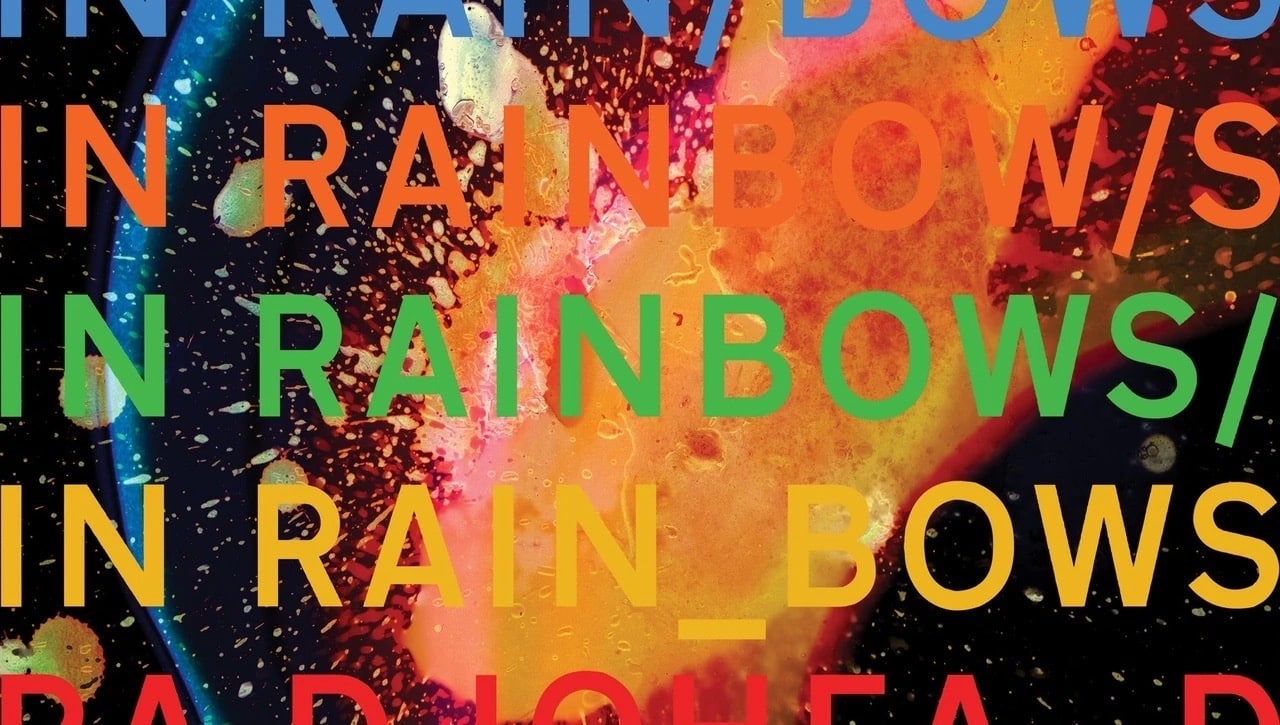
The most famous fan theory in popular music culture is surely that of Paul McCartney’s untimely demise and his subsequent replacement in the Beatles. Several inconsistencies undermine this urban legend, most notably the stubborn survival of the person at its center. Another British band that frequently becomes the subject of fans’ theories is Radiohead. From supposed hidden messages in music videos to entire secret albums yet to be released, their followers have identified a myriad of possible mysteries in the band’s oeuvre over the years.
One theory that has gained particular popularity among fans in recent years is the Binary Theory, which argues a link between the band’s landmark album OK Computer (1997) and their 2007 release In Rainbows. In the following, we follow the proverbial breadcrumbs, go down the rabbit hole, and test the theory. Within the context of the band’s enigmatic music, image, and marketing, is the Binary Theory another case of misdirected fan passion, just like the Paul Is Dead myth – or will a closer analysis, as a lyric on the 2007 album goes, in fact reveal a “jigsaw falling into place”?
Radiohead Fan Theories’ Jigsaw
Radiohead’s Riddles and Musical Mysteries
It has been a decade since British rock band Radiohead released an album. After 2016’s A Moon Shaped Pool, the band went on hiatus, with several members releasing music outside the band. Thom Yorke and Jonny Greenwood formed the Smile and released three records in the span of two years. Both have also released film scores, including Yorke’s soundtrack for Suspiria (2018) and Greenwood’s One Battle After Another (2025). There has been no shortage of solo projects, such as Phil Selway’s Strange Dance (2024) and Ed O’Brien’s Blue Morpho (2026).
As Radiohead prepares for the second stint of its residency tour in Australia and Japan, however, members are quick to dismiss any talk of new Radiohead material in interviews. Yet the band remains popular, as shown by their continued popularity on streaming platforms. Among the longest-running bands in alternative rock today, Radiohead found early commercial success with their 1992 single “Creep”.
Global fame and critical acclaim followed with their landmark 1997 album OK Computer, after which the band released a string of celebrated, best-selling albums. A famously reclusive group whose music is known for comparatively intricate arrangements and abstract lyrics, the band has, over the years, created an enigmatic image that explains why fans look for hidden meanings in their music.
Perhaps the most enduring Radiohead fan theory centers on the music video for the band’s 1995 single “Just”. The video features a character lying on a sidewalk for mysterious reasons, while passersby try to make sense of the situation. At the song’s climax, the gathered crowd finally convinces the man to explain his odd behavior, leading everyone else to lie down alongside him.
Crucially, however, the video withholds the reason he lies on the sidewalk from the audience for the rest of the video, sparking passionate speculation among the fanbase ever since, as the director still refuses to disclose the line the actor speaks. In other music videos, the band has drawn on similar narrative ambiguity. The video to “Karma Police” follows a man who is being chased by a car, which is ultimately revealed to be driverless. Among the more recent examples of the band’s fondness for plot twists, mysteriousness and secrecy, finally, A Moon Shaped Pool’s lead single “Burn the Witch” features in its animated video a pastoral village that is revealed to be led by a cult in an homage to the 1973 horror film The Wicker Man.
On a strictly musical level, Radiohead’s frequent use of rhythmic illusions is emblematic of the band’s mystery-mongering. A prominent example is the veiled 4/4 time signature in “Pyramid Song” from their 2001 release Amnesiac, which only reveals itself halfway through when the drums enter. Metrically, harmonically, and lyrically ambiguous, “Pyramid Song” in particular has sparked speculation among fans and music theorists alike. In his book Everything In Its Right Place, Brad Osborn, for example, identifies pyramidal shapes in the song that unveil themselves both in the visualization of chordal thirds in the piano motives and in the palindromic 3-3-4-3-3 rhythm, which is numerically reflective of a pyramid’s geometry. In a nod to what is perhaps the most pervasive cipher in Western music history, the song also features a transpositional variant of the aforementioned BACH cipher.
Like the Beatles, Radiohead used backmasking in their music. On the song “Daydreaming”, a reversed audio snippet is featured prominently towards the end of the song, revealing a line interpreted as “half of my life, half of my love”; this instance of backmasking has been linked to the passing of Thom Yorke’s long-term partner Rachel, an event that allegedly inspired the overall album. Furthermore, the follow-up to OK Computer, Kid A (2000), features a secret booklet hidden within the CD’s jewel case. Against this backdrop, it is hardly surprising then that fans would look for more in Radiohead’s releases than immediately meets the eye or ear. In this, In Rainbows is no exception.
The Binary and Golden Ratio Theories
Sixteen years on, Radiohead’s seventh album is primarily remembered for two things: its surprisingly accessible, stripped-down sound within the context of the band’s discography; and the curious nature of leaks of their previous albums. Frustrated by the leaks, Radiohead decided to release the music as an online download without an initial physical release or even an extended period of promotion. More importantly, the band gave listeners the option to choose their price. Among Radiohead fans, however, the album is also known for the Binary Theory, which connects In Rainbows to what many consider the band’s masterpiece, their breakthrough album OK Computer.
Released a decade later, In Rainbows, like their earlier output, too, features several rhythmic illusions, ranging from the introductory guitar riff on “Bodysnatchers” to the entirely unheard, hidden rhythm in the album closer “Videotape”. This sets the tone for the album’s alleged numerological mystery. Originally posted by journalist Kevin Flick shortly after the release of In Rainbows, the Binary Theory is based on the perceived prominence of the number ten both in the build-up to the release and on the album itself. According to Flick, the album announcement was preceded by 9 cryptic messages sent to fans that ungrammatically featured the Roman numeral x in phrases such as ‘xendless xurbia’. In addition, the album was officially announced on 1 October 2007, leaving fans exactly ten days before the eventual release on October 10: “Hello everyone. Well, the new album is finished, and it’s coming out in 10 days” (“In Rainbows”). Fittingly, the initial download was also rumored to have been made available on exactly ten servers.
If one were to spin this theory further, there are even more instances of the number ten to be found on the album: Its title consists of ten letters; the letters ‘i’ and ‘o’ in the band’s name on the album cover look like the number ten in the font chosen; and the record also features a total of ten songs. Additionally, one could take the biblical references in the lyrics – including the “pearly gates” in “Videotape” – along with the album title to make a conjectural connection to the Covenant of the Rainbow from Genesis 9:1: “I have set My rainbow in the cloud, and it shall serve as a sign of a covenant between Me and the earth.” Corresponding to the integers that make up the number ten, the link to binary code that gives this theory its name comes from OK Computer’s working title, Ones and Zeroes, which reflects the numerical basis of all binary code. [See artwork by Green Grass here on YouTube.]
Based on the prevalence of the number ten surrounding the release of In Rainbows, Flick argues that OK Computer represents 01 and In Rainbows, released a decade later, represents ten, two numbers that coincidentally complement each other in binary code. This numerical logic finally leads us to the heart of the theory: A complementary track list which supposedly combines both albums into one alternating playlist that begins with OK Computer’s first track “Airbag” and ends with “Videotape”, the final track on In Rainbows.
Flick and his many followers suggest this was indeed the band’s secret intention while recording the 2007 album. Although the ten-second crossfade between the songs Flick suggests creates some awkward transitions, the untreated playlist works surprisingly well. Of particular note in this context are the metronome beats that lead from “Airbag” to “15 Step” (as opposed to the original transition to “Paranoid Android”), which nicely set up the tempo for the latter, and the reverb-laden transition from “Subterranean Homesick Alien” to “Nude”. However, aspects of both the track list and the overall theory don’t add up quite as smoothly.
One of them pertains to the absolute number of tracks. Alternating the ten songs on In Rainbows with OK Computer’s 11 technically gives a slightly different track list than the one Flick suggests. To address this complication and avoid starting and ending on songs from the same album, supporters of the theory conveniently exclude the spoken-word track “Fitter Happier” from their count. This, however, is only the first of several concessions and inconsistencies that complicate this theory. Crucially, In Rainbows includes no significant lyrical or musical references to OK Computer. “Nude”, the third track on In Rainbows and the only discernible musical link, may have originated during the OK Computer writing sessions, but the band is well known for tinkering with material until they find the right version of a song.
In fact, every album since OK Computer has featured songs originally written for previous albums, including A Moon Shaped Pool’s “Burn the Witch” and “True Love Waits”, both fan favorites that had been in live sets for decades before finally appearing on an official release. While the band has occasionally quoted their older material, for example, reusing the outro chord progression from OK Computer’s “Paranoid Android” in 2001’s “Knives Out”, In Rainbows contains no such references. In fact, when the band references other music, it is exclusively music written not by themselves. Among others, the band have cited John Frusciante’s guitar playing on the music of the Red Hot Chili Peppers as the inspiration behind the song “Reckoner”.
Lyrically, the two albums appear to share at least a thematic link. According to Thom Yorke, In Rainbows is “about that anonymous fear …, sitting in traffic, thinking, ‘I’m sure I’m supposed to be doing something else.’ … it’s similar to OK Computer in a way.” Despite this relatively vague connection, however, there are no direct lyrical references or allusions between the records. The same can be said about lyrical clues to the existence of the complementary track list. When reading the album’s lyrics through the lens of numerology, it is especially noteworthy that the number ten doesn’t appear at all. The only two numbers are 15 in “15 Step” and 21 in “Bodysnatchers”. The band also missed other opportunities to include the number ten in writing. For example, the title is featured seven – not ten – times on the album artwork.

Similarly, some of the numerological evidence Flick presents does not hold up under closer analysis. If there is any significance to the release dates, as indicated by the original theory, the albums were not released on the exact same date but instead on 21 May 1997 and 10 October 2007, respectively. Given that In Rainbows was first released as a digital download, Radiohead could have timed the release accordingly. Flick’s claim that ten messages were released before the album’s release also cannot be substantiated. The link he provides as evidence in his blog post leads only to eight (not nine) cryptic images. In addition, the images do not include any of the “xendless xurbia” images later used in the boxset version of the album, as Flick claimed. (See Stanley Donwood’s Xendless Xurbia.)
Herein ultimately lies the problem with numerology: If one is fixated on a number, one usually tends to find said number irrespective of any hidden meanings and – sometimes – even irrespective of contradictory evidence.
While Flick vaguely cites “a source close to Thom Yorke” as verbal confirmation of his theory, Radiohead have refrained from outright confirming any of these fan speculations in interviews. When asked whether there is any truth to the theory, drummer Phil Selway offers a humorous response: “I’m sure that there must be. No smoke without fire.” When pressed further, he gives an ambiguous answer that dodges the question: “I feel like the custodian of Radiohead secrets here.”
Likewise, lead singer Thom Yorke has reverted to humorous replies when questioned about the validity of the theory: “There’s one about… ‘ten’ comes up a lot. … every time …, I get asked about it, … I say ‘Oh, yes, absolutely! We thought of all that.’ Yes.” In the same breath, however, he debunks the theory, admitting that “[The fans are] usually slightly wrong. … I think it’s nice that people are interested enough to come up with all these mad ideas.”
Far from serious evidence, these quotes show a band either evading the question or playfully ridiculing the theory. While Radiohead may well be unwilling to give confirmation for reasons other than the theory’s lack of validity, the Binary Theory ultimately remains unconvincing against the inconsistency of both the numerological and the musical evidence presented. The theory is further complicated by competing theories.
For example, some fans have linked In Rainbows to another number: the golden ratio. This fan theory claims the record’s title is sung in the backing vocals of “Reckoner” at the exact point in the record’s duration that coincides with the famous mathematical ratio. Though difficult to make out, the line “in rainbows” is sung at 2:50 into the song, which is the 26:22 mark on an album that runs 42:39. According to the golden ratio formula a/(a+b) = a/b, a is thus 1582 seconds, and b is the remaining 977 seconds. While the equation produces two different numbers, neither of which equals the golden ratio, they’re surprisingly close, especially given the sonic format and artistic constraints of the theory’s subject.
However, this theory, too, is an example of overactive fan imagination, as Radiohead guitarist Ed O’Brien confirms: “I love that [theory. It] … says that you get to the heart of the record right in the middle of ‘Reckoner’. … Which is true but … it wasn’t deliberately done like that, obviously.” Verbal confirmation aside, however, the Golden Ratio Theory appears more concise, more elegant, and thus more convincing than the Binary Theory, further decreasing the latter’s probability.
Indeed, fan theories often blur the line between fandom and fanaticism. The release of Radiohead’s eighth album, The King of Limbs (2011), shows how far fans can take their theories. Disappointed by the record’s comparatively short runtime and the perceived quality of the material, fans lost themselves in increasingly abstruse speculation centered on song titles, moon cycles, and the few promotional photos the band released. Arguing that the band would immediately follow up with an album like Kid A and Amnesiac, released back-to-back in 2000 and 2001, respectively, the theory spawned both a dedicated website and a passionate fan following.
Unsurprisingly, however, this theory also came to nothing, and supporters along with the world at large had to wait a full five years before the band eventually released another, completely unrelated album. How, then, despite better judgment and convincing evidence to the contrary, do such theories continue to capture the imagination of both music fans and scholars? Examining the cognitive structures and behavioral patterns behind the allure of riddles may offer an answer.
Enigmatic Music Marketing: Theories, Strategies and Cognition
Over the years, Radiohead have curated an enigmatic image through their musical, lyrical, visual, and narrative choices in both their albums and music videos. This also extends to the band’s marketing and advertising. After the commercial and critical success of OK Computer, Radiohead opted for a less conventional strategy for the two follow-up albums, Kid A and Amnesiac. Instead of following the industry handbook and releasing singles, Radiohead posted so-called ‘blips’: short, animated videos set to snippets of the album’s music.
Their communication around album releases has often been cryptic. For both The King of Limbs and A Moon Shaped Pool, the band refused to give interviews or tour the albums until several months after their release. Instead of running traditional promotional campaigns, the band have, among other things, sent ambiguous postcards to fans with no clear context and posted mysterious statements on social media in the guise of a fictional character called Chieftain Mews. This notable lack of information is mirrored also in the way the band makes their music available.
Until recently, Radiohead had been among the artists who refused the streaming behemoth Spotify access to their music. With later albums, the band has routinely offered limited-edition vinyl box sets featuring additional artwork and songs. Since leaving their major label EMI in 2005, there have been longer gaps between albums, as they broke with their previous two- or three-year album cycles. A case in point: their latest record, A Moon Shaped Pool, was released seven years ago in 2016.
This approach aligns with what psychologist Robert Cialdini coined the “principle of scarcity” in his book on the psychology of persuasion in marketing and advertising, Influence. According to Cialdini, customers value what they might lose out on more than what is readily available to them: “The idea of potential loss plays a large role in human decision making. In fact, people seem to be more motivated by the thought of losing something than by the thought of gaining something of equal value.”
Radiohead’s comparative withholding of both information and easy access to their music is indeed a countermodel to the oversaturation on the music market. At least according to psychologist Barry Schwartz’s “paradox of choice”, this is not at all a counterproductive strategy. While choices are commonly associated with liberation, autonomy and control, Schwartz observes dissatisfaction beyond a certain number of available choices: “… more choice may not always mean more control. Perhaps there comes a point at which opportunities become so numerous that we feel overwhelmed.” Nowhere is this more evident than on the digital music market.
As the internet has become a primary medium for both music marketing and consumption, fans are constantly bombarded with new content, from promotional emails and social media posts to online ads on YouTube and Facebook to the thousands of new songs published on Spotify every day. In this context, psychologist Clark L. Hull’s well-established 1940 “law of less work” (from Principles of Behavior) and the studies on cognitive avoidance that build on it address the problem at the core of modern music marketing: There is among humans “a bias in favor of the less demanding course of action … [suggesting] that anticipated cognitive demand plays a significant role in behavioral decision-making.” This means music consumers might focus on only a limited number of artists and routinely ignore everyone else; they might also gravitate toward artists who use alternative, less overwhelming methods of advertising their music.
In recent years, at least some parts of the industry have caught on to this effect and tried to circumvent it. Spotify, for example, now personalizes its user feeds with weekly suggestions based on individual listening history to avoid information overload. In modern music marketing, less is indeed more. At the same time, the internet, especially social media, has made it easier for artists and fans to engage. Paradoxically, such online interaction can still be a profitable business model, even amid market oversaturation.
Another pillar of successful marketing according to Cialdini is the rule of reciprocation, which “says that we should try to repay, in kind, what another person has provided us. … by virtue of the reciprocity rule, … we are obligated to the future repayment of favors, gifts, invitations, and the like.” Noting the rule’s “pervasiveness in human culture” according to sociological studies, Cialdini observes that the rule indeed “permeates exchanges of every kind”. By offering content to fans in a way that stands out either in terms of its novelty or its perceived generosity, companies (and in this context, bands specifically) can build a perceived bond with their customers.
In recent decades, Radiohead have done just that. After gaining artistic, financial, and legal freedom upon leaving major label EMI in 2005, the band doubled down on their unusual marketing approach. Since then, the band has been known to spontaneously release music online as a free download. Among songs made available in such a way are the stand-alone single “These Are My Twisted Words” (2009) and the rejected Bond-theme song “Spectre” (2015).
Most famous, however, and perhaps most poignant in the context of this paper, is how Radiohead released In Rainbows. The innovative pay-what-you-want model effectively meant releasing an entire album as a free download. Assuming the relationship between fans and artists is reciprocal, fans may support bands financially by purchasing albums, concert tickets, and merchandise, and, following the age-old advertising slogan “buy one, get one free”, bands show their appreciation by giving away free content. Paired with the band’s refusal of standard promotion, this arguably lets Radiohead focus on their considerable existing fanbase and avoid broader, costlier marketing campaigns. More than merely offering free content, however, Radiohead actively invited their fans to participate.
For the In Rainbows single releases, the band launched a fan contest that produced fan-made videos for the songs “Reckoner”, “15 Step”, “Weird Fishes/Arpeggi”, and “Videotape”. Four years later, Radiohead released the audio stems from their 2011 album The King of Limbs for fans to remix the songs (which also resulted in an official remix album made by professional musicians). The band has also used treasure hunt-like activities as a marketing tool. Coinciding with the release of The King of Limbs, the band published Universal Sigh, a free newspaper with additional artwork and writing, available in select record stores worldwide on a specific date. This led fans to travel to different cities and countries to get a physical copy.
For their OK Computer OKNOTOK 1997 2017 remaster box set, Radiohead came up with a digital easter egg for their fans. In addition to the remastered songs, early demos, B-sides, and unpublished artwork, the band also hid a computer code in the audio of an included C90 cassette that, when decoded and read via a word-and-image emulator, contained a message from the band. Examples like these show a band actively inviting fans to be involved rather than passive listeners. This invitation may create an environment where fans feel more inclined to look for hidden meanings as a form of communication in the band’s music; at the same time, it adds a notable social element to fan theories that appears to promote their longevity.
This is where Cialdini’s third and fourth behavioral principles come into play: social proof and consistency. According to the former, people look to how others behave, which helps explain the allure of fan theories perpetuated through active discussion and collective theorizing. The latter suggests that we tend to stick with something once we have made a decision: “consistency [is] a central motivator of our behavior. … The drive to be (and look) consistent constitutes a highly potent weapon of social influence, often causing us to act in ways that are clearly contrary to our own best interests.” This helps explain why fan theories are not easy to debunk in the eyes of their followers. Once someone takes a stand in support of a theory, it can become almost self-perpetuating until it either comes true or crashes. This also happens because, as an expression of fandom, fan theories are meaningfully linked to the individual fan’s sense of self.
In the context of our social nature, psychologist Henri Tajfel’s social identity theory posits that a person’s sense of self is based in no small part on their group membership(s). It follows that fandom is a central part of identity formation. The excitement and appreciation generated among fans, through free content, surprise announcements, and reciprocal interaction, arguably foster a stronger perceived bond between the band and its followers. Because Radiohead does not reach all music consumers the same way it reaches newsletter subscribers or website followers, fans also feel part of a special, selected group. Building on Tajfel, continuity theory suggests that belonging to such a fan community indeed informs our self-identity throughout the course of our lives: “many people define themselves in part through being a fan. … [The] continuing relationship [with that one loves] contributes to a sense of consistency of the self over the years.” (Zubernis).
Radiohead is not the only band to use participatory elements in their marketing. Nor are they the only rock band to curate an enigmatic image in order to generate interest in their music. In Radiohead’s case, however, their idiosyncratic release strategies have created a self-perpetuating, word-of-mouth marketing machine that fan theories are at least part of.
After the release of In Rainbows, fellow musicians such as British pop star Lily Allen and Kiss’ Gene Simmons publicly criticized the band’s business model, fearing it would devalue music from lesser-known acts. More than the band’s status or the quality of their music, however, Radiohead’s cryptic engagement with their fanbase (or lack thereof), when viewed as a marketing strategy, ensures continued commercial success. Accordingly, the band has reported increased profits from In Rainbows and, since becoming independent of major labels, generally higher profits from subsequent album releases.
Like many fan theories, the Binary Theory ultimately does not bear closer scrutiny. Regardless, it reveals productive insights not only into the band’s framing and marketing of their music but, by extension, into the psychology and cognitive structures behind our cultural fascination with riddles. Fan theories are a vital part of popular fan culture. Sociological and psychological research indicates that they provide fans with cognitive pleasure and a heightened feeling of community, as well as a chance to interact with both the music and the artist on a more meaningful level.
For artists, these theories offer reciprocation and validation by confirming continued fan interest and providing free promotion for their music. In Radiohead’s case especially, fan theories have functioned as a low-budget, self-perpetuating element in the band’s larger, independent marketing machine.
Primary Sources
Flick, Kevin. “Radiohead: 01 and 10 (The Binary Theory).” Puddlegum. 21 November 2020.
“OK Computer/In Rainbows.” YouTube. Playlist, compiled by Mijail Ayala, 24 January 2022.
“Radiohead: 01 and 10 Playlist Transitions.” YouTube. Uploaded by EricThePooh. 20 June 2012.
Radiohead. In Rainbows. London: XL, 2007.
– –. OK Computer. London: EMI, 1997.
– –. “Radiohead: Kid A Blips.” Archive [n.a.]. 21 June 2021 [2000].