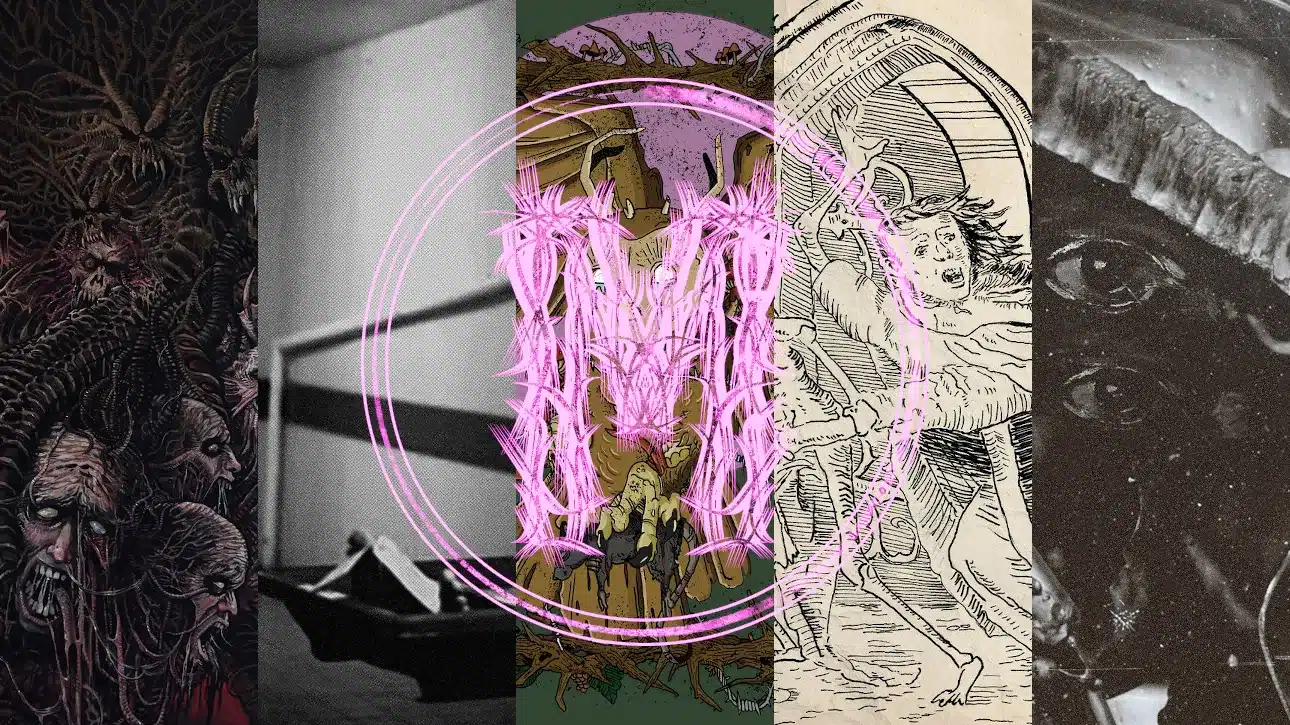
Every summer I complain about the scorching hot weather, and this July will be no different. Though my anger is very well manifested in the same manner of execution that the stunning Fake Dust record unfolds, I am very pleased that new works from Emptiness and Inferno arrived in a timely fashion to drench me in their cold bleakness. Otherwise I would start to resemble one of the entities on Coprolith’s Putrescence cover.
At the same time, despite its melancholy, I found snag.’s new record to be quite a fitting listen for the summertime; its balancing act between screamo and post-hardcore made a difficult exercise appear easy. Staying on the broader hardcore scene, Sex Prisoner put together a completely punishing record, reaching the heights of their previous LP, Tannhäuser Gate. Back to the metallic side, both Mortem and Witches Hammer pay tribute to the past, the first in Scandinavian black metal fashion, and the latter in a thrash/proto-extreme metal way. Both are excellent, and very much worth your time.
The Best Metal Albums of July 2026
Coprolith – Putrescence (Me Saco Un Ojo / Rotted Life)
In the era of the old-school death metal revival, the goal is not innovation but adherence, and to a certain extent, rediscovery. The likes of Cerebral Rot and Undergang dug deep into the death metal underground, unearthing the festering corpses of early days Death and Autopsy, while also drawing heavily from the infernal qualities of Incantation. Coprolith is a new addition to this lineage, and their take does not deviate from the norm.
The original death metal vision possessed a strong visual fascination and a physical immediacy that other forms of extreme metal rarely matched. The genre was not about philosophizing, but rather interested in the morbid mechanics of mortality. Coprolith’s debut, Putrescence, immediately recalls those early years, with their guitar work walking the same fine line between the melodic and the abhorrent, imbuing the riffs with a necrotic quality, their hooks in “Sentenced to the Grave” mirroring the great renditions of Autopsy. They can twist this around, instead delivering a devilish touch that recalls the early days of Incantation. In both cases, Coprolith descend to doom-laden passages at times, which enhances this putrid sense.
This flirtation with doom is a key component of the original death metal bands, and something that Coprolith take to heart. The determined pace in “Birthed by Remorseless Flames” plunges the listener into doom’s depths, the gruelling procession turning into something punishing. Stretching it to further ends, “Possessed by Incoherent Violent Suggestions” takes a turn for the weirder, a hallucinatory sense settling in, making the experience otherworldly. In these moments, Coprolith also tap into the European scene, the doom component clicking with the heavier groove of Grave and Demigod, particularly in “Defiling Incantation”.
These are simple techniques, carried over through years of death metal tradition, and Putrescence implements them fully to create a dark, nightmarish record. The original spirit of the scene is thus preserved, in a record that remains fascinated by the physical aspect of decay and decomposition. This is not about innovation but precision of execution, and on those terms Putrescence is a success.
Emptiness – Nowhere Speaks (Season of Mist)
Honed in the black/death space, Emptiness produced one of the genre’s seminal works in 2014’s Nothing But the Whole. Keeping one foot in extreme metal, Emptiness subtly expanded their sound through increasingly far-reaching influences. Post-rock and post-punk motifs are engraved in the compositions, and ambient and industrial textures add to the record’s despair. Their subsequent releases, Not For Music and Vide, found them stepping outside of extreme metal. Black/death became mostly an aesthetic in Not For Music, where darkwave, post-metal, and post-punk became the fundamental pillars. However, Vide went too far in that direction, stripping any extreme element from their music and instead retreating to a dark and damned post-punk motif.
Their new record, Nowhere Speaks, introduces itself with the short “Nothing But the Whole (Part 2)”, promising some recalibration. Soon enough, they establish that this is by no means a return to their earlier extreme metal days, but still some earlier components resurface. The traditional black metal riffing finds its way back into the compositions, but it does not carry the discordant touch of their early days, much like Emptiness themselves. Coupled with Emptiness’ dark demeanour, harrowing vocal delivery and downtrodden progression, this reinforces the sense of dread.
Emptiness take advantage of the structural openness shared by black metal and post-metal, blurring the lines between these two scenes. “When the Whole Arrives” fluently interchanges these two sides, where the ethereal aspect of post-metal collides with the eerie black metal past. It moves Nowhere Speaks closer to Not For Music rather than Nothing But the Whole, and it especially shows in tracks like “Words to the Winds”. In that instance, you can see the black metal side gradually melt into Emptiness’ post-punk aspirations, where the repetitive rhythmic framework provides a sense of finality. On top of that, they also apply a stronger shoegaze quality, following the footsteps of acts like My Bloody Valentine to clash the big, formless guitar riffs against a bleaker ambiance.
Where Nowhere Speaks differentiates itself from Not For Music is in the subtler adjustments that it makes. It was a similar case with Nothing But The Whole, where slight additions of post-punk and industrial added an extra twist to the black/death onslaught. In this case, they unearth certain avant-garde elements and apply these to their rhythmic backbone. They have taken on the teachings of Chaos Echoes, and applied them to their darker brew. “All For Nothing” unfolds an energetic and erratic style of playing, making their gloom less static and more menacing.
At the center of Emptiness’ music has always been atmosphere. No matter if they are playing Portal-esque black/death, or retreating to complete post-punk, it is the one constant through all of their manifestations. Nowhere Speaks carries the same bleakness, a dread feeling that is fantastically interpreted by the ominous and towering vocal delivery.
The middle part in “Words to the Winds” best exemplifies this, with the instrumentation settling down to a near halt, allowing for a nightmarish grandeur to come into view. “The Clash of Forces” takes a different approach, letting an industrial influence provide the track with a determined, mechanical, repetitive structure. It demonstrates Emptiness’ command of atmosphere, which they treat as something malleable without losing its core darkness.
Nowhere Speaks is a very welcome return, and a return to form following the more stripped-down Vide. While the expectation might be that Emptiness would return to the days of Nothing But the Whole, that is not exactly the case, at least on the surface. Their extreme metal days are a thing of the past, but it can still influence their presence. In that way, Nowhere Speaks maintains a dialogue with that earlier self. And though on the surface it is closer sonically to Not For Music, Emptiness are actually descending to stranger and more extreme paths. In that process, they reintroduce some of the early days magic into their latter-day self, with the result being one of the stronger releases in their catalogue.
Fake Dust – Decrepitizing Din of the Cerebral Psyopticon (Iron Lung)
Coalescing different strands of a genre’s expression is a tall feat, and one that separates good acts from excellent ones. Grindcore has long exhibited this tension, with one lineage remaining rooted in its raw punk origins while another embraces increasingly noise-driven abstraction. Fake Dust’s early demos revealed an act equally comfortable with both traditions, looking for a way to align them. Their debut record, Decrepitizing Din of the Cerebral Psyopticon, is the closest they have reached in that attempt, balancing these competing impulses and delivering a surprisingly cohesive result.
That same unhinged spirit reaches back to the genre’s inception, with Fake Dust unearthing a substantial portion of primal punk energy. To that end, “Lost Signal” channels the early, ferocious Napalm Death blueprint, a Neanderthal-like approach that infects both the structure and demeanour of the track. While violence is a key component throughout Decrepitizing Din…, these moments reduce it to its most basic form: simple, direct, and unembellished. They even brush against sludge on “Insomniatic Fluid”, retreating into a gruelling crawl where slow riffs and a glacial pace showcase another side of their songwriting.
Their versatility also propels them into noisier territory. Grindcore’s frantic energy often lends itself naturally to this noisier side. “Neural Frame Network” operates in this mode, where lightning-fast blastbeats, discordant guitars, and cutthroat vocals create an all-devouring wall of sound. This is a very different manifestation from the punk-ish bursts of aggression. In a sense, this is moving them from the Insect Warfare space and into the Discordance Axis realm. Much like the famed New Jersey act, Fake Dust also display a stunning level of control, not letting their compositions deteriorate into formless white noise. “Mosaic” is a perfect example of this, where through all the layers of chaotic arrangement and complex songwriting you will not find a mindless blasting recital, but a rather meticulously put together composition.
Reconciling these two grindcore traditions is easier said than done. Otherwise, these competing approaches risk pulling against one another. Avoiding that requires a high level of musicianship and compositional aptitude. Thankfully, Fake Dust have both, and this really shines on the rhythmic dimension of this work. “Implanted Imperative” is a pivotal moment where the high-octane, discordant manifestation naturally folds into a slower, punishing stampede. It is a fluid motion, one that displays control but without introducing rigidity.
It is this quality that further moves the needle for Fake Dust, in that they are not solely capable of reiterating traditions, but they can unify them seamlessly as well. It is early days for them still, and the question for the future is already whether they can focus a bit less on existing traditions and pave their own path. But given how deeply they understand the mechanics of grindcore, they seem well positioned to take that next step.
Inferno – The Anthropic Sophisms (On the Heights of Despair) (Debemur Morti)
One of Czechia’s historic black metal bands, Inferno have been gradually evolving their sound over the past decade. Starting with Omniabsence Filled By His Greatness, the band’s black metal became more mystical and metaphysical, while still retaining its raw edge. Gnosis Kardias refined this synthesis, remaining both devastatingly aggressive and deeply otherworldly. While 2021’s Paradeigma shifted this equilibrium, Inferno did not abandon their black metal pedigree in favour of ritualism and ambiance. They instead let their past inform their present, and occasionally let it shine through fierce blast-driven parts.
Their new record, The Anthropic Sophisms, further tips the scales toward the psychedelic and atmospheric. Everything is subordinated to the ritual, and Inferno make good use of past strategies to augment this experience. First comes the repetitive rhythmic structures, mirroring a distorted image of krautrock where cosmic wonder is replaced by cosmic dread. The fluid drumming in “Dekranos Katexochen” establishes a trance through circular rhythmic patterns that gradually disorient. Those circular patterns later harden into abrupt, punishing repetitions, taking on a quasi-industrial presence in “With Raving Mouths They Utter…”, recalling the harsh, inescapable rhythmic structures of early Killing Joke and Swans.
For the most part, the ritual is unbreakable, a continuous, endless experience that Inferno orchestrate. However, there are moments when the spell breaks, taking a detour through a more immediately volatile pathway. Electronic applications are applied to contradict the rock instrumentation, echoing with the Coil DNA. These interventions remain subtle, with feedback becoming an anchor while synthesizers erupt in brief electrical bursts, causing the ritual to shimmer momentarily. These small deviations make the heavier counterparts more impressive, either in moments when Inferno take a near-drone form, recalling through glacial riffing the apocalyptic visions of Khanate, or their sparse black metal outbreaks.
The Anthropic Sophisms does not feature many traditional black metal outbreaks. The ending of “Dekranos Katexochen” is the sole moment that returns to the band’s point of origin, its blastbeat-driven progression and discordant riffing recalling the band’s grim past. However, every element of Inferno’s sound is still grounded in that same tradition. Their aesthetics are deeply embedded in their psychedelia, not an external factor taken from krautrock, shoegaze or post-metal, but one shaped by black metal itself. Even in its most abstract, the music never ceases to think like black metal.
It is this dual effort that makes The Anthropic Sophisms an exciting and well-structured release. Inferno’s dedication to the ceremony they are enacting is absolute; they never forget that their end goal is drowning the listener within their mystical weaves. At the same time, they ground the ceremony in their black metal pedigree, lending the proceedings an authenticity that distinguishes it from bands merely borrowing psychedelic language.
The only point where the record falters is that in their complete commitment to this ritualistic endeavour, they have left behind some of their more aggressive moments that made Paradeigma and Gnosis Kardias exciting in their unpredictability. The Anthropic Sophisms attempts to provide the same effect through different means, but ultimately some of the harsher, down-to-the-bone black metal is missing here.
Mortem – Mørketid (Peaceville)
While Mortem were the precursor to Arcturus, they themselves never crossed over from death metal to black metal. So when they crawled back from obscurity with their 2019 debut, Ravnsvart, it was not so much a return but rather a new beginning. Instead of the lo-fi, death metal stench, Mortem returned with a work that stands proudly within the early black metal tradition while embracing its more majestic possibilities. In many ways, this is exactly the type of record that fits the pre-Aspera Hiemns Symfonia period of Arcturus, and now they return with a second chapter in Mørketid.
The foundation is of course the early Norwegian scene, with the tremolo-picked guitars radiating an icy presence. They provide a detached and grim demeanour through their sharp riffing that can be easily adjusted to fit both faster assaults and more mid-tempo grooves. Given the adventurous pedigree of its members, it is no surprise that Mortem frequently tamper with this recipe. The start to “Aftermath” suggests a Thorns-ian touch, where dissonance merges with the staccato rhythmic progression.
Still, they combine it with an early Arcturian keyboard part, which gives the passage a surreal character. The drumming also escapes the confines of traditional black metal, with Hellhammer showcasing meticulous arrangements, making parts like the start of “The Mighty Odious” not only volatile but also unpredictable. These additions bring Mortem closer to the early Emperor works, and their attempt to escape the one-dimensional early nature of black metal and move toward something richer.
It is in this mould that Sverd makes the biggest difference. The keyboards are not supplementary material to the guitars, but a vital part of the record. They retain Arcturus’ sense of playfulness, though here it is deployed against a harsher backdrop. Within the traditional black metal mould, Sverd can twist the keyboards to provide a sentimental undercurrent, clashing against the more austere black metal riffing and Vold’s cutthroat vocals. This is especially effective when it takes a melancholic turn, further enhancing the latent melodic aspect of Mortem, but it can also become something darker and more harrowing. “Den Sanne Gud” exemplifies this, with the mid-paced structure recalling Celtic Frost, where the keyboards help build an asphyxiating atmosphere.
On the surface, these deviations might appear minimal, simple embellishments to a traditional black metal framework. But collectively they reshape the record’s emotional character. Mørketid can operate on the esoteric level while also allowing itself genuinely soaring moments. In the latter case, Mortem channel Bathory’s epic sensibility, with “Skyggeånd” leaving behind the elusive eeriness and instead producing a more in-your-face beatdown inspired by the great Swedish act. While Mortem can eloquently channel triumphant moments, they can also produce something far more oppressive. “Blodvassen Grunn” is such an example, its towering form still channeling an epic scope but in a bloodier, more gruesome fashion.
Mortem’s intricate songwriting and their balanced outlook between traditional and majestic black metal have a precise end goal. That is not to create a work that is purely complex and daunting, but to reach a fragile equilibrium, the equilibrium that defined Emperor’s earliest works. Mørketid succeeds in that experiment, able to reconcile the genre’s exhilarating force with its atmospheric depth. While that does not necessarily produce novelty, it is an experiment that many have attempted and failed. Thankfully, Mortem are not among them.
Sex Prisoner – Cautionary Tale (To Live a Lie)
Sex Prisoner have always been outliers in the powerviolence scene. Since their early days, they showed a resistance to the ultra-speed violence the genre is associated with. Instead, they looked both backwards toward hardcore punk’s rhythmic foundations and outward toward the crushing weight of sludge and metallic extremity. The result was a series of short, aggressive bursts that carried a weight and attitude not usually found in powerviolence. The epitome of this practice was 2016’s Tannhäuser Gate, a masterful work that encapsulates Sex Prisoner’s vision. A decade later, they return with Cautionary Tale, refining rather than reinventing their formula.
Sex Prisoner’s success has always stemmed from their ability to create structural contrast and move naturally between contrasting ideas. Take a track like “Built for Speed” for example. The start clearly recalls the extreme practices of Dropdead, as lightning-fast blastbeats combine with angular riffs to cause complete havoc. At this point everything is a blur, and what remains is neither structure nor hooks, but a primal sense of violence. Just a few seconds into the song, everything changes. The momentum shifts from lightning fast to glacial, the frantic guitar work becomes well-defined heavy riffs, more akin to sludge than powerviolence.
These transitions, from powerviolence to sludge, or from sludge into traditional D-beat as on “Falling Down”, might seem incidental. Still, they eventually become the defining compositional principle of the album. Through the record, these shifts do not feel like stylistic detours, but rather necessary changes to maximize the physicality of this work.
Taken together, Sex Prisoner’s rhythmic shifts create an unpredictable landscape, and the band applies more adventurous ideas to make this experience even more unstable. To that end, they can move closer to feedback sculpting territory, where their sludge foundation crumbles into a restrained drone, as with the ending of “Wildcat House”. Here they move closer to Man Is the Bastard, and their further tampering with noise and sweeping sound effects in “Feelin’ Low Down” augments the harrowing core of Cautionary Tale.
They also weave brief tremolo-picked passages between these heavier sections. These parts borrow from black metal’s tremolo-picked aesthetic, giving tracks like “Glass Worms” a very different aftertaste. Both these aspects, noise and black metal, showcase Sex Prisoner’s creative depths, and their willingness to keep pushing into new directions.
Still, Cautionary Tale is not a work that is looking to innovate over what Sex Prisoner have done in the past. On a sonic level, it remains remarkably close to Tannhäuser Gate, following the same structural logic and projecting the same overwhelming physicality. Yet, the result is astounding. Rather than expanding their vision, Cautionary Tale improves on it. The transitions between powerviolence, hardcore and sludge are cleaner, each shift landing with maximum impact. The heavy production and the drone, noise and blackened components hit that much harder. The result is a record that shows musicians with complete mastery over their craft.
snag. – All the Cages Holding Us Will One Day Turn to Dust (Deathwish)
Screamo is a domain that is primarily defined by rough melody clashing with melancholy. While these two forces have resulted in some of the finest extreme music from the 1990s onwards, there is a much richer undercurrent. Milwaukee’s snag. are one of the acts that perceive this wider spectrum of expression. Since 2016, snag. have been emphasizing these aspects more strongly than many contemporary bands. Their latest work, All the Cages Holding Us Will One Day Turn to Dust, is their finest attempt to date in presenting this broader spectrum of expression through more dynamic control and a fantastic production aesthetic.
The first thing that stands out is how melody functions within an extreme music setting. Here, snag. partake in the same practices that acts like Loma Prieta perfected. In their distorted form, their riffs are overwhelming, uncontrollably fuzzing out until they lose their definition. However, they carry a melodic leaning that transforms them into something strangely soothing, and not as asphyxiating. There is a certain versatility that comes with this, as they can easily adapt it to fit their heavier breakdown structures (“Foam Cup, Pt 3”), or become even more amorphous with the added tremolo picking (“Cages”). They can also completely strip their music of heaviness, with “Juneberry” and “Paris, WI” retreating into sparse, almost America-esque motifs that almost move outside rock conventions.
These two sides, the explosive hardcore passages and the stripped-back atmospheric interludes, are just the bookends for All the Cages Holding Us Will One Day Turn to Dust, and that is where snag. show their quality in controlling the dynamics of their music. The dynamics in “Whisper” create a strong narrative flow, with snag. patiently shaping the emotional progression of the track as they start with subtle build-ups that raise the tension before exploding into full-blown, soaring crescendos. They display the same composure in “Pray for Peace”, slightly mixing dynamic manipulation with stylistic shifts as they move from tremolo-picked riffs to heavy, slower grooves.
However, the key component that makes everything click together is the production, which is stellar for what snag. are trying to do. It is not pristine, but it fully complements their sound. Much like the band’s approach to balancing the aggressive and the melodic, their production balances the raw and the clear. It preserves the overwhelming fuzz instead of trying to tame it. It allows the drums to be rougher, keeping them true to the hardcore aesthetic. The distortion applied over the vocals gives them a ragged sheen. It could have easily been the case that the wrong production could doom this record, tilting more heavily toward either the clean or the brutal side, and in the process missing snag.’s essence.
Apart from shaping the sonic weight, the production also determines how the emotional force of the vocals is perceived. Listening to the lyrics of “Shelf Life”, it is easy to see how under a different production a clean rendition of the phrase “You can’t tell me why you are so hard to please” could come across as a much softer, melancholic line, and not like the visceral gut punch that it is.
All the Cages Holding Us Will One Day Turn to Dust might not be the most novel of releases, but it shows snag. further honing their craft. Here, every aspect of their approach, from the melody to the dynamics and the production, comes together more focused than ever. The manner in which they tap into screamo, emo and post-hardcore feels more informed. Rather than redefining screamo, snag. demonstrate just how much expressive range exists within the genre, bringing forgotten possibilities back into focus.
Witches Hammer – Final Storm (Nuclear War Now!)
It is easy to forget how far back Witches Hammer go. The Canadian act formed in the early 1980s at the height of thrash’s dominance, but disbanded after releasing only a handful of demos. Through their raw recordings, and in part due to Marco Banco’s involvement in Blasphemy’s monumental Fallen Angel of Doom, they became a cult act. During the 2000s, multiple compilations of their demos surfaced, but the biggest surprise came when the band reunited in 2018 and released their debut record, Damnation Is My Salvation, in 2020.
Despite the three-decade gap, Witches Hammer produced an uncompromising recital of black/thrash fury. Remaining true to that tradition, their work thrived on its discordant solos, punk-ish energy, and the raw but suitable production that obscured everything into primal darkness, something that continued with their follow-up, Devourer of the Dead. Their new, and by accounts final, record, Final Storm, follows the same black/thrash blueprint. Still, its cleaner production casts the songwriting in a different light, bringing its melodic and traditional heavy metal impulses into focus.
The foundation remains on thrash and proto-black metal, with Witches Hammer providing an exhilarating recital. They carry the frenzied and ragged approach of the 1980s, their guitar work spiralling into discordant solos and razor-sharp riffs. Their rhythmic progression in line with 1980s thrash taps into the punk tradition, giving the songs a reckless momentum that often feels one step away from being derailed. While for the majority of Final Storm they stay within these boundaries, they occasionally push into more extreme territory. The faster parts in “Mantle of Death” reach a near, but not quite, blastbeat-level ferocity. “Twisting in Torment” applies tremolo picking to evoke a more blackened perspective, while its martial rhythmic backbone lends the song a death metal weight.
Where things shift is mainly through the production. Comparing Final Storm to Witches Hammer’s two previous records, the production provides a much cleaner presentation. As a result, the riffing comes across as even more precise, the definition of every picked note coming through in striking clarity. It makes the guitar in “Into the Gates of Hell” feel like a machine gun, every note landing with brutal force. In turn, this has exposed Witches Hammer’s heavy metal sensibilities, especially when it comes to the solo work.
Final Storm does not feature the frenzied, Slayer-derived methods of the 1980s. It also adds a melodic flavour on top. The interaction of these two sides creates a great spectacle, especially in “We Are Legion” where the first solo arrives with full dissonance and no mercy. In contrast, the second iteration strives for something more nuanced and expressive.
If Final Storm is indeed the final release from Witches Hammer, then this is exactly the way that they should go out. Not only does the record present an overarching collection of their history, but it is also presented most appropriately. The cleaner production, the heavy metal sensibilities, together with the more extreme blackened parts, make for a record that feels as complete as it could be.