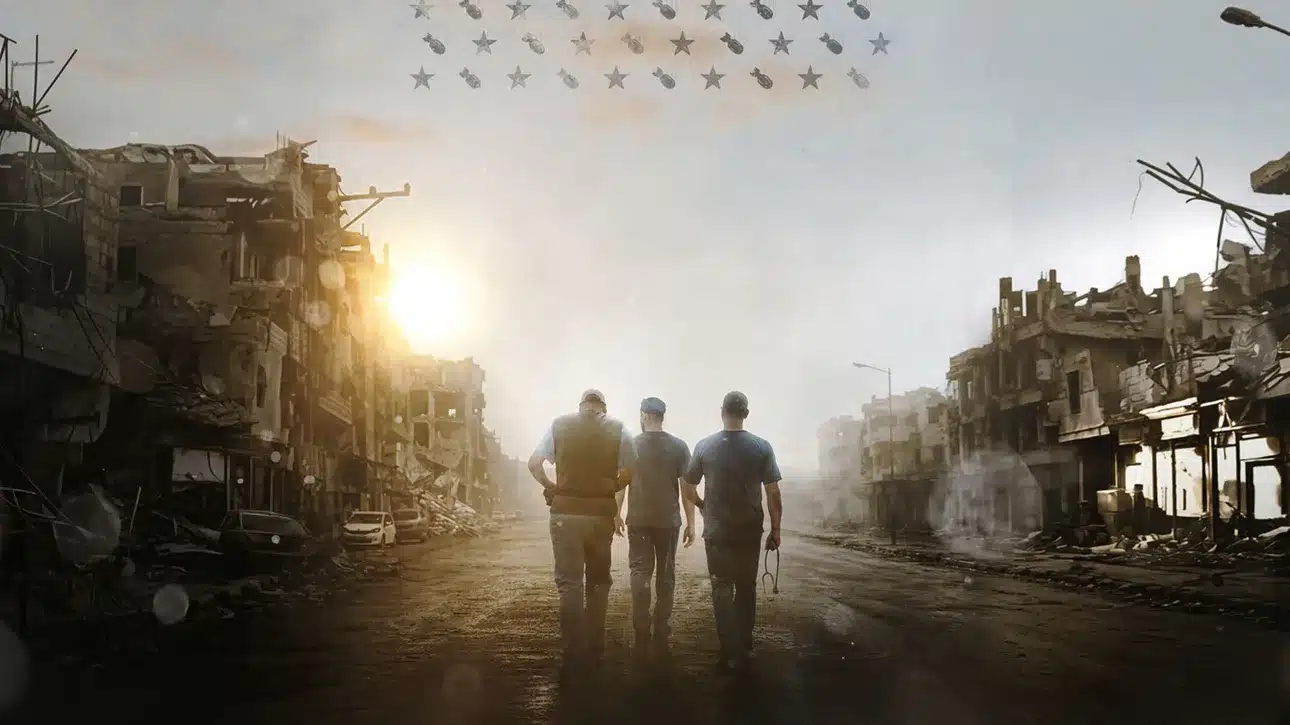
Director Poh Si Teng’s American Doctor is a documentary that follows three American doctors who volunteered in Gaza before, during, and after the 2025 ceasefire. Jewish-American orthopedic surgeon Mark Perlmutter is from North Carolina. Palestinian-American ER doctor Thaer Ahmad is from Illinois. Parsi-American trauma surgeon Feroze Sidhwa is from California.
To be clear, all three are “birthright” US citizens, a fact that I feel I need to mention in our current political climate. Also, be cautioned and calmed: I will reference the violence, but I will not give explicit scene details. That violence is not my interest here. The context, or lack thereof, is.
The American Doctor opens with a pointed discussion between Perlmutter and Teng about showing a photograph of dead children. Teng wants to blur the image. She uses the term “dignity of the dead” in support of a reluctant argument for professional documentary standards. She is right. For example, WITNESS, an international organization supporting audiovisual technology in defense of human rights, has guidelines that support Teng’s stance. She doesn’t say it outright, but her question is: Does showing the photograph deepen the documentary or simply shock the viewer?
In this exchange, Teng expresses concern about skewing the viewer’s perception, or something very close to that. Her concern that the viewer’s perception should be blurred suggests why this film seems stancless, which I explore later in this piece. How can a documentary focusing both on dead Palestinian children and the US support for the Gaza war not skew a viewer’s perception? The film seems to be an essay that deleted its thesis in an attempt to appear neutral, in the sense of facts and only facts, no opinions. American Doctor, however, is not neutral, just blurred.
Perlmutter successfully argues that showing the photograph of the children is giving dignity back to the dead. Their dignity had been taken in their killing. Also, he has family consent. He argues that the documentary should aim to show unblurred images of what happens to people in Gaza. Blurred images, both literal and metaphorical, are what we already see in much of our media, but not what we should see here. We see the photograph, which is actually quite tranquil, thus sublime rather than shocking. American Doctor becomes more graphically violent from this point onward.
Abstract Violence
Next came the scene I found the most disturbing for its abstractness. Drone footage hovers above blocks, if not miles, of destroyed buildings. Groups of people appear like small dots, walking along the streets cleared between the ruins. The images recall Japanese and German cities at the end of World War II. I thought, “It looks just like a movie.” These images of Gaza could have been substituted for an establishing shot in any post-apocalyptic Hollywood blockbuster. The camera would zero in on one of the small black dots. Here is our hero, Tom Hanks, Denzel Washington, maybe Tom Hardy, if we want a real hard-ass.
Then I caught myself. This documentary doesn’t look like a fictional movie. Fictional movies look like reality. Right? Or will American Doctor simply be another series of images of violence indistinguishable from all the other series of images of violence we see from the comfort of our presumed safety? This question framed my viewing. The documentary doesn’t address the thinness of images of violence.
This is not Teng’s invective against Israel. Subjects, particularly Perlmutter, inveigh against Israel. He even uses the word “Zionism”. Others are apprehensive that Perlmutter’s rhetoric is off-putting, while they understand that as a Jew he can say things non-Jews can’t. Nor is the film a meditative personal essay like much of Werner Herzog’s recent work. American Doctor is very much an old-school observational documentary of letting the subjects speak with little editorial filter.
Teng is obviously sympathetic to her subjects, but her stance on the Gaza war and the overall conflict is indiscernible. I assume she thinks the suffering is horrible and needs to be documented, but besides that, I don’t know. The focus is on the three American doctors. We see their personal experiences, opinions, and judgments. We don’t receive any reflection. This paucity of depth in such a complex situation is a weakness.
Teng made a documentary that is too pure: she only documents. She does not comment, contextualize, explore, explain, or enlighten. Feroze Sidwa ridicules the Israeli claim that Hamas built tunnels beneath hospitals. “[T]he claims are untrue,” he says. And? Teng lets such a statement stand with little exploration. Someone in the scene challenges him, but he dismisses the challenge. Thaer Ahmad says that “the last nine months have been nothing short of horrific.” Yes, that is obvious, but is there nothing more to say about the situation? Perlmutter uses the word “genocide”. Perlmutter, a surgeon, is angry enough to use that word. We want to hear more of his opinion.
American Doctor may not be worth seeing, unless one wants to view images of death and devastation, especially of children. If one supports Israel’s war, then the documentary is simply anti-Semitic propaganda. If one opposes the war, then it reinforces one’s anger. If you’re in the “it’s complicated” category, it will sadden you but probably won’t change your view. By the end, I wasn’t sure what I was supposed to take from it except that the situation is bad.
The documentary might better serve as source material for a more thoughtful examination of the war. It’s more like a collection of letters and photographs that a historian can use as parts of a history of the Gaza War. In some ways, it is too purely factual, in that we get what we see. Is it factual in the sense of being accurate? From my preliminary research, I haven’t found much fact-checking or follow-up on American Doctor. We are left only with the images on screen. Ironically, given Teng and her cinematographers Ibrahim Al Otla and Chris Renteria’s skill, these images are often beautiful in their composition, color, and lighting. This movie about war may be too well-made a war movie.
The Violence of Political Indifference
The criticism that Teng fails to give a reason to care is valid, given the world as it is. The Yale Humanitarian Research Lab documented Russia’s mass kidnapping of around 20,000 Ukrainian children. The UN documented the systematic use of mass sexual assault in the Sudan. Bangladesh hosts a Rohingya refugee camp of around one million people fleeing what even the US State Department calls a genocide in Myanmar.
In the US, by the Department of Homeland Security’s own numbers, in 2026 it detained around 50,000 people per day, over 500,000 total, and deported over 1,000 on average per day. The UN is collecting evidence that the US may have committed a war crime with indiscriminate civilian attacks against Iran. With these examples in mind, it’s fair to ask Poh Si Teng, “Why did you choose to depict Gaza in American Doctor, and only Gaza?” Could a broader study of those who suffer and work in global conflicts, combined with global political will (or lack of it), have been more informative? What is the filmmaker trying to instill in a (most likely) informed audience drawn to see this documentary?
The last section of American Doctor tries to answer this. We follow the doctors through the halls of the US Congress and multiple conferences. The doctors and their entourage make the rounds of Representatives’ and Senators’ offices. Some elected officials listen. Many are not present. Their staff responds with platitudes; some even push back. The doctors give speeches, interviews, and contributions to panel discussions. They are tired. At times, they appear to follow an agenda out of obligation rather than enthusiasm.
These shots are short. The cutting is often quick. The impression is frantic activity with little result. The doctors appear to think that facts will persuade the Trump Administration to work to end Gaza’s destruction and provide humanitarian aid to suffering Gazans, but the facts were never in dispute. The suggestion isn’t that the world isn’t listening to the doctors, or to Poh Si Teng, but that it already knows what they have to say.