
The hardest thing a documentary director can do is get out of the way. The temptation, especially with a subject whose life touches on something as public and politicized as gender identity, is to shape the person into a message, to sand off the rough edges and present a tidy symbol for the audience to admire. In “Call Me Micky,” director Andrew Rasmussen resists that temptation at every turn, and the result is a 22-minute short that feels less like a lesson and more like spending time with someone you are genuinely glad to have met.
The subject is Micky Angelo Petrillo, a Bergen County business owner, author and performer who began living openly as a man at 59. Rasmussen, working with the New York City production company CARDINAL and executive producer Dominique Jackson of “POSE,” follows Micky through the texture of his new life: Pride events, open-mic performances, first-time photo shoots and his work advocating for visibility. Those public moments are set against far quieter ones, conversations with family and friends about the transition, including the pain of his mother’s rejection and his fear that access to his gender-affirming care could be taken away.
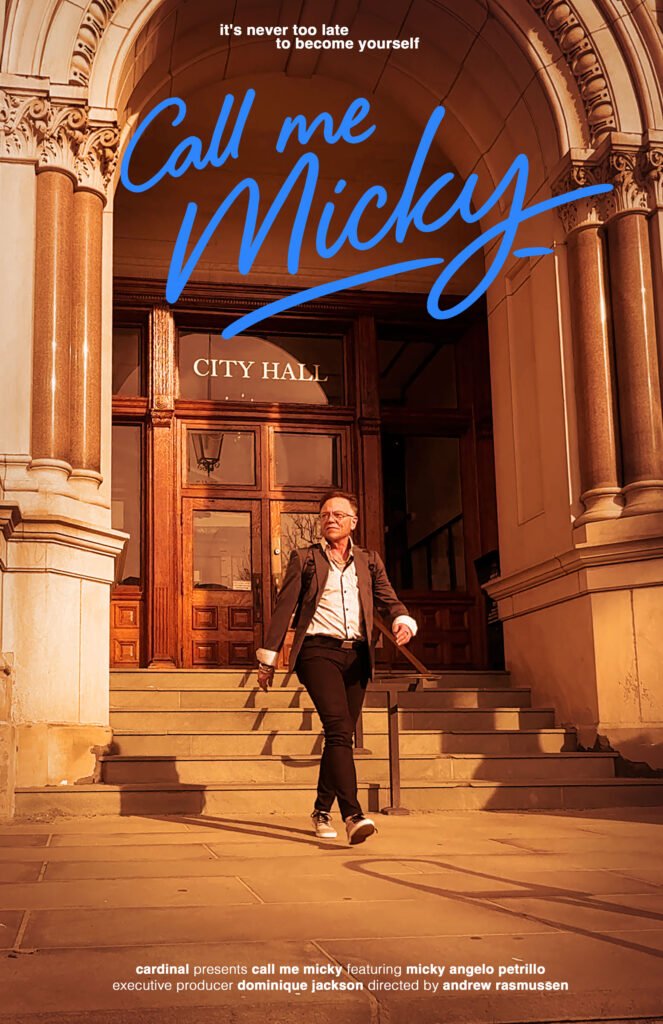
Rasmussen’s smartest decision is how he handles the film’s rhythm. Rather than imposing a calm, orderly structure, he lets the film move the way Micky moves, with a deliberately restless, high-energy pace that mirrors the spontaneity of the man at its center. It would have been easy to treat that energy as something to manage. Instead, Rasmussen understands that it is the point. Micky’s humor, his outspokenness and his rough edges are all left intact, and the camera seems far more interested in letting the audience get to know him than in explaining him. That is a rare kind of restraint, and it gives the film its warmth.
The direction also earns its emotional weight by refusing to separate the joy from the hardship. The film is vibrant and often funny, but it does not look away from the hostility and fear Micky faces. A Jersey City Transgender Day of Visibility event introduces Rev. Erin Kinahan, a transgender Lutheran pastor, widening the frame just enough to show the community around him. The conversation between Micky and Dominique Jackson about identity and visibility is the film’s emotional anchor, and Rasmussen wisely keeps the focus on Micky even with a star of Jackson’s stature in the room. Running beneath it all is a sense of a man who knows he started late and is determined not to waste a single day.
Rasmussen has described the film as both a trans story and an everyone story, and that is exactly what his direction achieves. By treating Micky as a whole person rather than a single issue, he makes the specifics of one man’s life feel universal: the risk of being seen, the fear of running out of time, the courage to start over. Festival juries have clearly responded. “Call Me Micky” has won Best Documentary at the New York Transgender Film Festival and the Spirit of Pride Award at the Susquehanna LGBTQ Film Festival.

In just 22 minutes, Andrew Rasmussen has made a film that is honest without being heavy and celebratory without being simple. He trusted his subject, and his subject rewarded that trust. “Call Me Micky” is a portrait of becoming yourself, directed by someone who understood that the best way to honor that journey was to let Micky tell it his way.
“Call Me Micky” screens Saturday, November 14, 2026, at the Barrymore Film Center in Fort Lee, New Jersey, as part of the Fourth Annual Barrymore Short Film Festival.
The official website for “Call Me Micky” may be found at https://www.callmemickyfilm.com