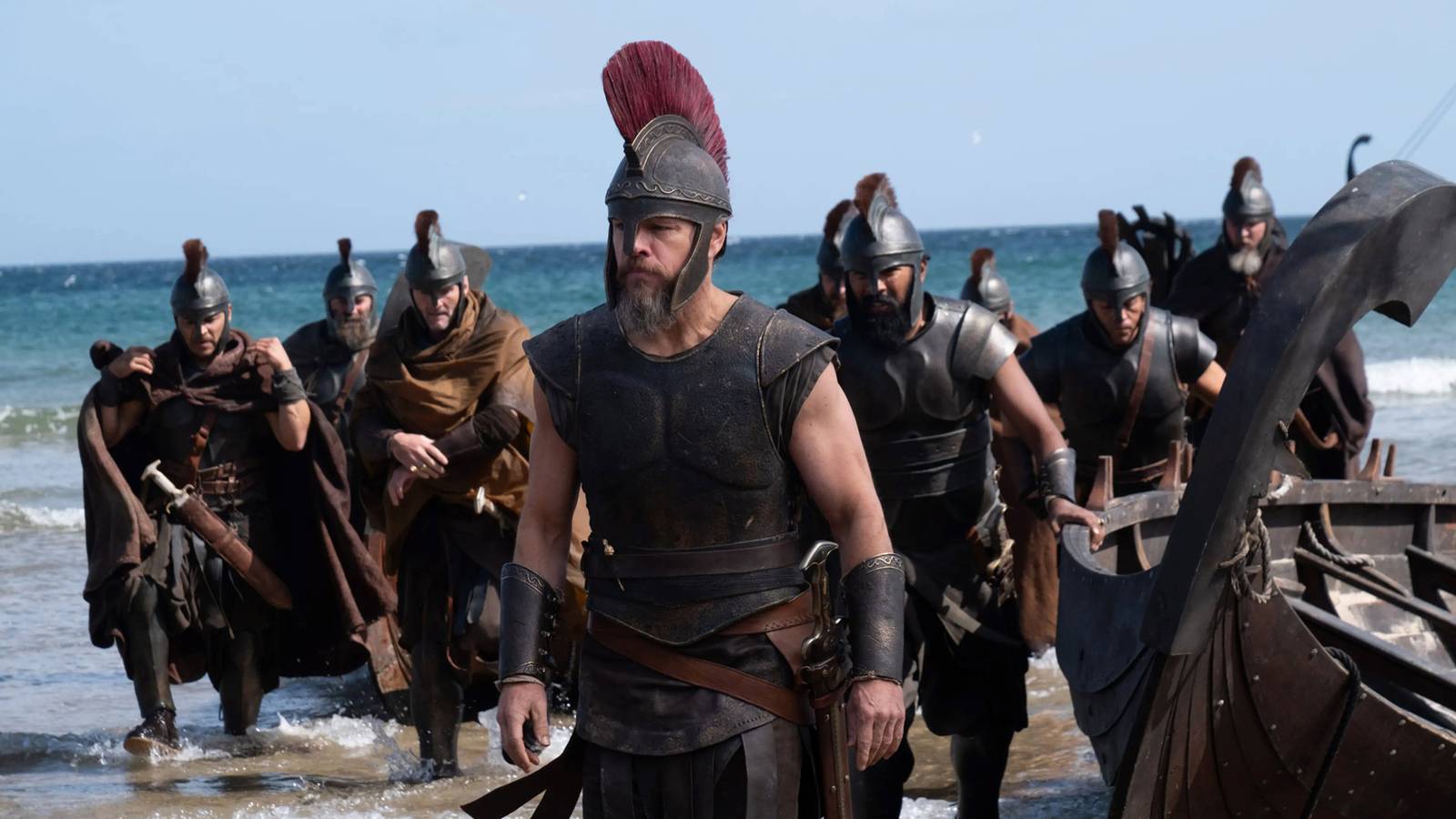
Christopher Nolan’s The Odyssey retells Homer’s classic poem about a hero and his journey home, where he learns along the way that his entire life has betrayed his ethics and moral code. Nolan does a brilliant job in telling the nuances of how Odysseus learns that he is on the wrong side of history in this retelling, and to do so, he eliminates some of the more extraneous plot points from the original mythological tale.
>The Odyssey originated around the 8th century BC, one of the oldest stories still told today. It is also one of the most important stories to come out of Greek literature, as it tells the classical stories of how people honored their gods in that era, and Nolan’s movie goes a long way in showing how that honor can be turned around on these same people when they falter. There are several gods and monsters from the Greek myths who play an important part in the story, and eight of them appear on-screen in this movie.
The reason for the absence of some of the gods and mythical figures was to help Nolan move the story forward without weighing things down by showing everything Homer told in his tale. Names like Aeolus, Heracles (in Hades), Hermes, and Ino are skipped over entirely, while three other gods are only used to push the story forward without showing them in the actual movie. Here is a look at the eight Greek gods and monsters in Nolan’s The Odyssey.
Circe

Circe is a witch in The Odyssey, although in Greek mythos she has also been described as a goddess or a nymph. In most descriptions, she is described as the daughter of the sun god Helios and the Oceanid Perse. She had great knowledge of science, potions, and herbs. She was also known for her power to turn people who offended her into animals. That is where her role in The Odyssey comes into play.
In both Homer’s tale and Nolan’s retelling of the story, Odysseus and his crew end up on her island on their way home from the Trojan War, and she changes most of his crew into pigs. In Homer’s tale, he manages to convince her to turn them back into humans, and then he lives with her for a year and has children with her. In the movie, he convinces her to return them to normal and then leaves after asking for her help. Samantha Morton plays Circe, and she delivers a great performance as a woman who knows the true nature of men.
Calypso

Calypso is a nymph in Greek mythology who lived on the island of Ogygia. In Homer’s tale, she held Odysseus for seven years against his will. She even offered to give him immortality if he would stay with her forever, but Odysseus wanted to return home to his wife and son. It actually took the intervention of other gods to force her to free him and allow him to return home. That is not how Nolan portrays her in the movie.
In The Odyssey, Charlize Theron plays Calypso, and she does hold Odysseus captive for years, but instead of it being against his will, it is by using drugs to keep him happy and satisfied to stay with her, by erasing the memories of his past. The way that Nolan changes the story is to have Calypso voluntarily decide to give Odysseus back his memory and wish him well on his way back home.
Athena

Athena is an interesting character in Nolan’s movie, and she plays a considerable role in the changes that the director made to the end of his story. In mythology, Athena is the ancient Greek goddess associated with wisdom and warfare, and she played a major role in Odysseus’s journey throughout Homer’s tale. In her life, she aided heroes like Perseus, Heracles, and Jason, and then later played a big role in the Iliad and was a mentor for Odysseus in The Odyssey.
It was Athena in Homer’s tale that convinced Zeus to rescue Odysseus, but in the Nolan movie, she only serves as a vision that Odysseus sees on occasion, and she is the one who reveals the truth of the entire Trojan War and the idea that it was Odysseus and his shipmen who were the men from the sea who had the world, including Odysseus’s own kingdom, living in fear. The final twist during the Trojan War changes everything about Athena’s role in the movie.
Helen Of Troy

In Greek mythology, Helen of Troy was considered the most beautiful woman in the world, and she was the reason for the Trojan War. In the Iliad, Helen, wife of Menelaus, and the most beautiful woman in the world, was taken by Paris from Menelaus’s home in Sparta. Menelaus and Paris agree to duel, and Paris loses. This led to much of the conflict, and in The Odyssey, she is back home, but she never really makes it clear what she wants.
She shows up in Nolan’s The Odyssey by the side of her husband, Menelaus, now with a scarred face. Her role here is mostly to tell Odysseus’s son what happened when the warriors returned home from the Trojan War. This is where the movie reveals what her sister did to her husband, Agamemnon, in revenge for his previously sacrificing their child. Helen is a demigod by heritage, as she was hatched from an egg laid by Leda after she mated with Zeus while he was in the form of a swan.
Polyphemus

The first monster that Odysseus and his crew meet in Nolan’s movie is Polyphemus. From Greek mythology, Polyphemus is a Cyclopes, the one-eyed son of Poseidon and Thoosa. In Homer’s story, he was a savage man-eating giant who trapped Odysseus and his crew before beginning to eat them. This went against Odysseus’s belief in following Zeus’s laws of custom and hospitality. Odysseus blinds Polyphemus, and this allows them to plan their escape.
Odysseus tricks Polyphemus into thinking his name is Nobody, so when he calls for help, he says, “Nobody” has hurt him. Odysseus makes the mistake of telling Polyphemus his real name when escaping, which seals his doom. In The Odyssey movie, Odysseus still blinds the Cyclopes, but instead of yelling his name, he fires an arrow to taunt the giant before escaping, and this leads Poseidon to curse Odysseus and his trip back home.
The Sirens

The first monsters that Odysseus’s crew faces after leaving Circe’s island the last time in Homer’s poem are the sirens. These sirens have the power to sing songs that tempt sailors to their island, where they lead them to their doom. In the Greek myths, the sirens live on their small islands, and they have been represented in different myths, even used in Christian art years later when that religion was formed.
The sirens are only shown from a distance in The Odyssey movie because Nolan keeps them as a distant threat with some great production work. As in Homer’s story, Odysseus promises to save his crew, so he has them all put wax in their ears, but he demands to hear the sirens’ song himself. Nolan cuts the sound so that the audience can’t hear the song, but can only see Odysseus’s reaction to it.
Laestrygonians

The Laestrygonians are a tribe of man-eating giants who are said to have sprung from Laestrygon, son of Poseidon. This makes their attack in The Odyssey make a lot of sense. When Odysseus blinds and taunts Polyphemus, the Cyclopes prays to his father to get revenge. When Odysseus and his men land on an island looking for food and rations, the Laestrygonians’ attack is clearly influenced by Poseidon answering his son’s prayers, as they eat several of Odysseus’s men.
In Nolan’s movie, the Laestrygonians eat several of Odysseus’s men and destroy all his ships but one. This makes it almost impossible for Odysseus and his men to make it back home, and it is all a carryover from the attack earlier in the movie on the son of Poseidon.
Scylla

The last actual monster that Odysseus and his men battle that actually shows up is the Scylla. In Greek mythology, the Scylla is a legendary, man-eating monster that lives on one side of a narrow channel of water, opposite her counterpart, the sea-swallowing monster Charybdis. Odysseus has a choice of one or the other, with the promise that the Charybdis will kill his entire crew while the Scylla will kill only six crew.
In the movie, it is very fast and sudden as the Scylla attacks and eats six men quickly before the others are allowed passage. This isn’t the last tragedy, as there are other obstacles, but the Scylla is still the last actual monster or god who appears on screen in Nolan’s The Odyssey.
Other Gods Mentioned In The Odyssey

The rest of the monsters and gods are only mentioned or hinted at. First, the main god, Zeus, is mentioned throughout the movie. He is the one whom Odysseus and his son reference when saying that all travelers should be met with generosity and an open door. However, he is also the god that Odysseus himself betrayed the trust of when he used the Trojan Horse to win the Trojan War, betraying the idea of a fair fight.
Poseidon is the second god mentioned in the movie, as he is the father of Polyphemus and the one who curses Odysseus and his return home. The third god is Helios, the sun god who has the sacred cattle that Odysseus’s crew slaughters and eats despite warnings. After his sacrilege, Odysseus and his crew are sent back to sea, where Zeus and Poseidon work together to sink their ship and slaughter all the men other than Odysseus.
There is also the point where Odysseus is visited by the men who died for him, including those who tell the warrior that he betrayed their memories. While the god Hades is not shown, and Heracles doesn’t show up here as he does in Homer’s story, Hades itself is still a strong mythological reference. Finally, Ino doesn’t show up in the movie to help Odysseus when his raft sinks, and The Odyssey movie just shows him arriving on Calypso’s island.

- Release Date
-
July 17, 2026
- Runtime
-
172 Minutes