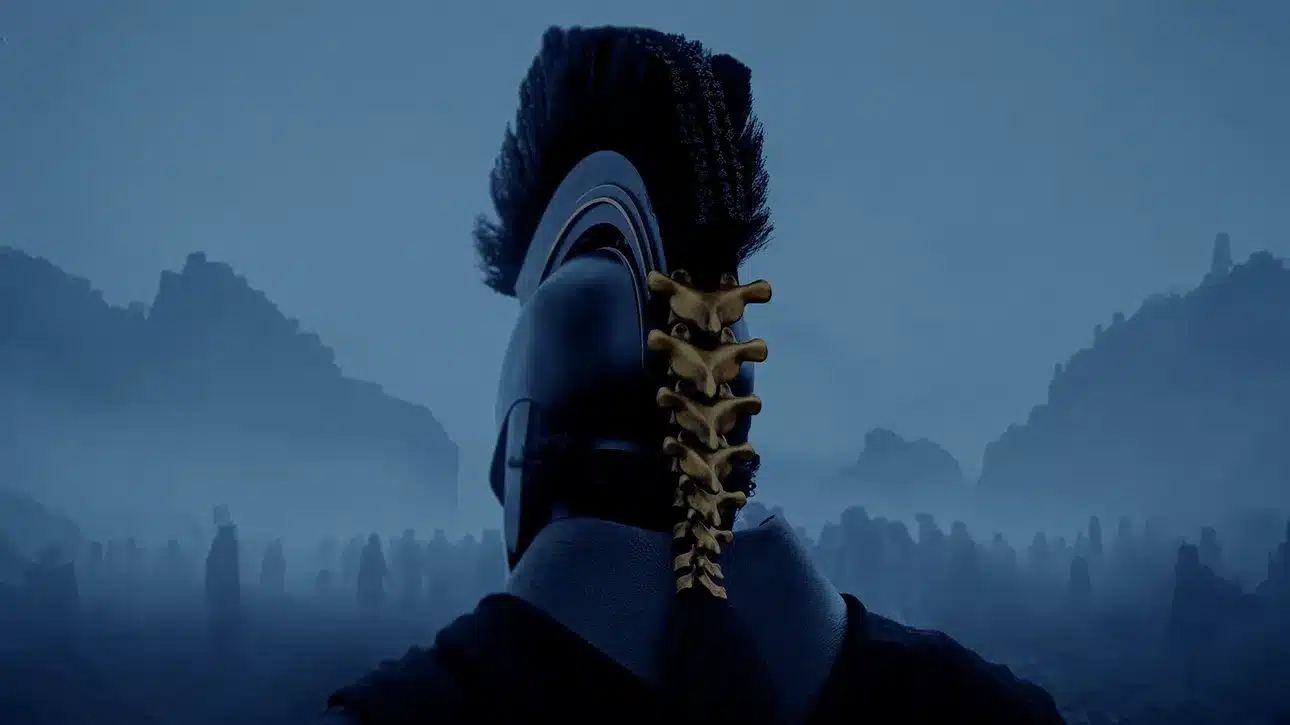
In his interpretation of Homer’s epic poem, The Odyssey, director Christopher Nolan offers us a contemporary version of the Homeric lotus flower. “Eat of this,” Nolan incants. “You will believe once existed a time and place when a powerful man who generaled wars of death and destruction felt really bad about it.” No time and no place ever existed. No such leaders ever existed (one exception noted below). And they still don’t.
The Odyssey begins with seemingly PTSD-stricken Odysseus (Matt Damon) under the therapeutic clinical care of Calypso (Charlize Theron) on her exclusive celebrity island rehab clinic. They both wear the required back-in-the-old-days burlap tunics and sit beneath beach cabanas of gauze strung across rickety lean-tos.
Calypso has been administering a strong narcotic to Odysseus to help him cope with his memories of war, particularly guilt about his leadership role. Calypso has also been sleeping with Odysseus as part of a sex therapy protocol she developed specifically for him. Professional ethical standards were different in ancient times. When the state regulatory agency appeared in the guise of Athena (Zendaya) and threatened Calypso’s licensure, Calypso weaned Odysseus off the narcotic and implemented talk therapy to help him recover memories of his family and the war. The film is unclear if the somatic body work continued.
Numerous reviews frame Nolan’s The Odyssey as a story about the lead character’s combat-induced trauma. Scholars have analyzed the original poem as such. The film also explores the moral injury that Odysseus suffers. He breaks Zeus’s law of xenia, that is, the obligation that host and guest hold towards one another, even at war, it seems, when he tricks the Trojans with the gift horse, thus also creating an enduring metaphor. As a military leader, Odysseus causes widespread death and destruction during the Trojan War, the sacking of Troy, and the return voyage. All his men die.
Odysseus’s rue, or ruse, is all fine – if we ignore his position as a king, which in ancient Greece would have been as a warlord. War was his profession. His banquet hall was filled with weapons. His killing was mechanical and precise. He made war. That’s what he did.
Other reviews read The Odyssey as Christopher Nolan’s commentary on the current state of the world, America in particular. Militarization of civil society, overseas military and trade conflict, sacrifice of common folk, deceit, xenophobia, the list goes on. Yet, Odysseus the man never critiques the system, only his ineffective role within it. The film’s false critique of a leader of war offers the audience, that is, the common folk, a psychological defense against the suspicion that those in power don’t really regret the consequences of their actions. We know but refuse to accept the truth that powerful men who cause suffering in the world don’t really care.
The Odyssey conveys that powerful men suffer, too. They suffer deeply. We should weep for them as they weep for us.
Though other characters are important to the film, this article focuses on Odysseus. I will not analyze in detail Odysseus’s wife Penelope (Anne Hathaway), even though the role of wife is stronger than that of the husband in The Odyssey, and for that matter, the actress is stronger than the actor. I will note that Penelope gives the only comment on the system of kingship and hierarchy with her exchange with her son Telemachus (Tom Holland) when he tells her to return to her woman’s work. Penelope says, “I’ve been sitting on that empty throne for twenty years! My knowledge, my years of experience, that’s all nothing compared with the bristles on your chin!”
Granted, the film refocuses almost exclusively on violent men, but female characters are given their say. Nolan makes two visual choices that support the female characters; both Hathaway and Theron look their age, mid-40s and early 50s, respectively. Practical makeup or computer effects could have erased the lines, smoothed the skin, and so on, but Nolan allowed the women to appear as they are.
Also, Nolan excluded the commonly included topless scene, in particular a scene where the woman mounts the man so that she can arch her back, yadda yadda yadda. In the only somewhat sexual scene in The Odyssey, Penelope is fully clothed, and Odysseus is topless. Keeping the female characters looking their age and fully clothed signals that their stories are serious parts of the plot, so kudos to Nolan for these non-typical Hollywood movie choices.
Who Really Suffers from Military Trauma?
Let’s return to the theme that military leaders suffer PTSD and moral injury by examining numbers from our own heroic age in America. The 2025 National Veterans Suicide Report (US Department of Veterans Affairs) counts the daily veteran suicides at nearly 20 per day, well over 1.5 times higher than the general population. No data breaks these suicides down by rank for veterans, but a US Department of Defense Annual Report on Suicide in the Military for Calendar Year 2023 for current service members notes that most suicides are young and junior enlisted, that is, not individuals in positions like Odysseus’s rank.
There is scant evidence that any Department of Defense civilian leaders kill themselves, especially high-ranking political appointees. In our world outside cinema fiction, if anyone suffers from PTSD, then it is not Department civilian staff or Pentagon officers. Psychological trauma is the common soldier’s burden.
In Christopher Nolan’s version of military trauma, the common soldiers are all dead, which truly pains Odysseus. If The Odyssey accurately portrayed combat trauma, Odysseus’s men would have returned home traumatized, and he would have returned to a highly compensated civilian position, which is a fact in America’s military that the film got right. The only voice Odysseus’s men are given is when he visits Hell. Overcome by anger, they give chase to him. Odysseus escapes. His men are still dead, and in Hell, it’s a very different exchange than in the original poem.
Nolan tries to explain why Odysseus is traumatized. He is presented as a military leader from a militarized society who realized that he led his troops over a moral line. During his talk therapy sessions with Calypso, Odysseus remembers the sacking of Troy. We see the Greek soldiers running amok, slicing and jabbing and burning and desecrating, which is not the worst that happens during a good pillage and plunder. We see Odysseus pause during the fighting, look at the mayhem, and realize, “By Zeus, what have I done?”
Given the limited range of Matt Damon’s acting, we must read into his frozen facial expressions this realization and regret. Few real-life examples of such leaders exist. Odysseus is presented as a warlord who is shocked by both war and his lordship. Most high-ranking military officers got over that early in their careers.
In the United States, much is made of the psychological anguish that American Civil War generals experienced. In the North, both Ulysses S. Grant and Tecumseh Sherman openly regretted the loss of life. James Longstreet and John Singleton Mosby did so in the South. In World War II, Dwight D. Eisenhower took full blame for strategic errors. William Westmoreland grieved failed military and political strategy in Vietnam. Mark Milley openly noted failed decisions in Afghanistan.
These real-world examples explain why Nolan’s Odysseus is a false representation. All the above-named military leaders regretted failed tactics and strategies, not war or the political mechanisms that cause war. In The Odyssey, Odysseus frets about his role as a military leader. We never see him question kingship, hierarchy, war itself, the casus belli for invading Troy, the underlying economic motivations, and so on. As the other military leaders mentioned, Odysseus regrets bad decisions in an assumed good war waged for good reasons. For Odysseus, the overall militarized world of the Greeks is OK. The war simply required questionable decisions, and the return journey took an unfortunate turn. He needs time to process that.
America’s Warlords Don’t Question Who Benefits
Before someone claims that no military leaders question the system, let’s look at a real-world example that could have been a model for Nolan’s Odysseus. US Marine general Smedley Butler fought in Cuba, the Philippines, Central America, Haiti, Mexico, and World War I. Congress awarded him two Medals of Honor, the highest military award in the United States. After retirement from the Marines, Butler reflected on his military service, but instead of the “I made some mistakes along the way” apology others gave, Butler rejected the entire system that supported war.
In a series of speeches during the 1930s, Butler said, “War is just a racket. A racket is best described, I believe, as something that is not what it seems to the majority of people. Only a small inside group knows what it is about. It is conducted for the benefit of the very few at the expense of the masses.” In other speeches, Butler went on to detail how he, as a Marine general, was used as a tool not for foreign policy but for corporate plunder. He didn’t fully reject his military career, but he didn’t celebrate it either, and Butler advocated vigorously for veterans. Such leaders do exist.
However, they do not exist in Nolan’s The Odyssey. Both the character (double meaning intended) of Odysseus and most, if not all, reviews focus on Odysseus the individual, his anguish, suffering, and regret. At the end of the film, in his homecoming, lacking a hand-painted “Welcome Home” sign and balloons, Odysseus does not speak against the existing system. Through an orgy of violence, he reinstates his position at the top of a very steep hierarchy. After all the death that he has seen, Odysseus finds a few dozen more men in need of killing.
Does this mean his work with Calypso succeeded or failed? After the final blood sport, Odysseus and Penelope sail to western lands, like the Elves from The Lord of the Rings, or 19th-century US generals retiring to estates in the American West.
Odysseus is haunted by the past because from his standpoint it is his past, his men, his decisions, his leadership, his wife, his son, his kingdom, his legacy, his, his, his, on and on. The Odyssey laments the suffering of war due to poor leadership; it does not question the overall system that creates such wars.
If anything, the film suggests through its constant reference to the Law of Zeus that if traditional roles within the system had been properly fulfilled, the suffering would have been less. The theme of Christopher Nolan’s The Odyssey is that there are no bad wars, only bad decisions by war leaders, who often regret these bad decisions, which is unintentionally a very contemporary view.