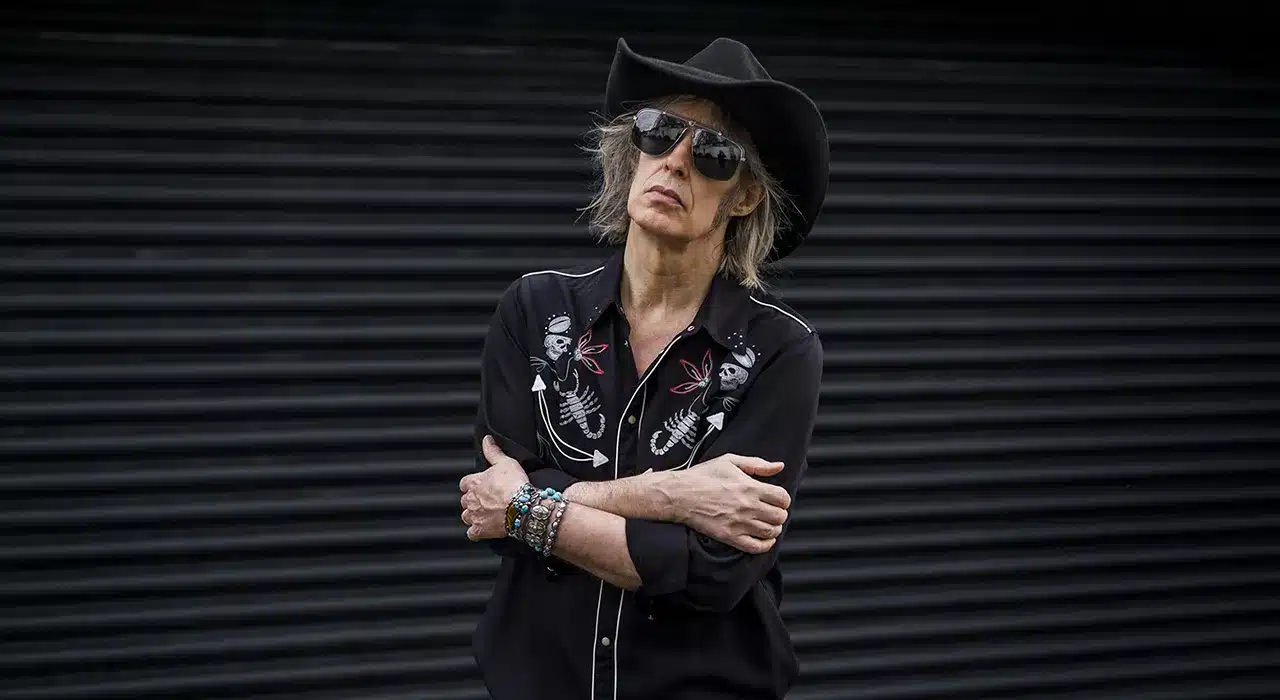
The Waterboys formed in London in 1983, and over the decades, this outfit has changed styles and lineups, making an impressive smorgasbord of sounds. Fronted by Scottish singer-songwriter Mike Scott, their pedigree ranges from symphonic blues to folk, traditional Irish to indie rock. Singers who have covered their tunes include Prince, Tom Jones, and Lewis Capaldi. Scott lives in Ireland and met up with PopMatters for a coffee and a chat about his long and impressive career.
Guitarist Mike Scott is in jolly form. It’s not that he’s returned from a tour, or that he’s about to enjoy a coffee during a sunny day in Dublin. No, Scott is chuffed at the release of a new Waterboys project: Atlantic Rain. “I don’t know how much you know about it,” Scott begins. “It took a long time to make Fisherman’s Blues: 1986 to 1988. It began in Dublin, carried on in Galway, and we recorded a huge amount of music. I lost my perspective, and all the music sounded fine to me, but I couldn’t figure out how to do the album the right way.”
His drink arrives, and he carries on speaking to me. “Eventually, I cut it down to the album,” he confesses. “Some of them were the best songs, some of them weren’t, and over the years I’ve returned to the tapes. I thought I released what was the full thing in Fisherman’s Box in 2013; six full CDs. I thought: ‘That’s it.’ What I didn’t know was there were about eighty tracks without song titles, nothing. I got the tape list from the record company, because they keep a great archive collection of the Waterboys.
Anything that is numbered is kept in the catalogue, so I looked over the songs I remembered for Fisherman’s Box. My eyes always skated over those without titles. Stuff like ‘Instrumental’ or ‘Jam’; sometimes nothing. I never computed how many those were, but the record company told me about these reels that nobody’s listened to.” Scott was asked whether he wanted them transferred. He agreed, and was sent them in a zip folder. “I went through them all, and found lots of recordings I had forgotten. There were things I might have had on a cassette, but not on a multi-track. Over about 18 months, I edited and mixed the material and realised a lot of it was release-worthy; much of it as good as the original album. It turned out to be a triple vinyl worth of music.”
“I think some of it is as good as anything on the Fisherman’s Blues album,” Scott says, with a sincerity in his voice. He has served as the Waterboys’ captain for decades. The group has included several notable musicians such as Steve Wickham, Anthony Thistlethwaite, Sharon Shannon, Karl Wallinger, and Richard Naiff, yet Scott has been the sole anchor through every iteration. “I heard Steve Wickham on a demo tape of another singer, and that was with Ensign Records,” the musician elaborates.
“They had discovered this singer called Sinéad O’Connor, and they asked Karl Wallinger to record some demos with her. Karl phoned me up, and told me I should listen to them. He had a home studio, an early home studio person: this was 1984, 1985. He was a pioneer in that. I played the two songs, and she was very good, but that wasn’t what my ear was attracted to. It was the fiddler; that’s what caught my ear. I always loved those Bob Dylan Rolling Thunder recordings. I liked Scarlet Rivera, and Toni Marcus, who performed with Van Morrison. Finding a fiddler for The Waterboys was the next part of the puzzle, and when I heard the demo, I realised this was the guy I was waiting for. He didn’t have a phone, so I got him via Windmill Lane Studios.”
Thistlethwaite has toured with the Saw Doctors for many years, but reunited with the Waterboys in 2005 for a charity concert. “Anto hadn’t played sax for about five or six years as he played bass with The Saw Doctors, and refused to play sax, “Scott chuckles. “I begged him to do it, but he said: ‘No, I only play bass.’” Scott knew The Saw Doctors as younger men. “I worked with the Saw Doctors in two capacities. They were our support band on tour, and a wonderful support band. It was their first proper tour, so they brought to it that sense of being thrilled: ‘We’re in a real band out on the road!’ We had been on the road for ten years, so it was a great reminder for us what it feels like. They were a great band, and the other capacity was as a producer. I produced their first record: ‘N17’. They were green then, but very good in the studio. We got the job done.”
Scott’s musical education started in his native Scotland. Decades of living in Ireland haven’t dulled the strength of his accent. “I grew up in Edinburgh until I was twelve, and then moved to Ayr, which is very close to Glasgow,” he reminisces. “My early musical concert experiences were in Glasgow. I had long left Scotland when the Jesus and Mary Chain [emerged]. They’re later and younger than me. They still sound great as a band. I moved back to Edinburgh in 1977 when punk was exploding. It took me a while to get a band together. We were part of the ‘New Wave Scene’, and the contemporaries would be Orange Juice and the Scars. It was a funny old scene, and because I had come from the West of Scotland, I think I was seen more as an ‘incomer’, even though I was born in Edinburgh. I don’t think my bands were particularly welcomed on the scene.”
Was Scott aware of the Skids? “I loved them,” he beams. “Richard Jobson was amazing, prancing around the stage like a belligerent person, because he had that edge. Midge Ure was earlier. I have an archivist mind, and Midge’s first hit record was ‘Forever and Ever’ with Slik in 1975. The very interesting thing in the first seven, eight years of Midge’s chart life, he did records under about 15 different names. He did a couple of things with Thin Lizzy; Midge was in Visage, Band Aid and Ultravox. He got around, and I’m proud of him as a fellow Scot, but I’ve never met Midge.”
It would be inaccurate to describe the Waterboys as an Irish band, just as it would be to label them a Scottish one. They’re simply the Waterboys. “The Waterboys has had Americans, and many Irish,” Scott says. “Right now, there are two; one from Belfast, one from Dublin. These recent shows [in Australia and New Zealand] went fine. Our regular five-piece band, and I guess it was the Dennis Hopper shows, but we have moved on a bit, because last year when we did it we had films to illuminate songs. We couldn’t afford to bring that to Australia, so we did a shorter show. But it was great.”
This Is The Sea is an all-encompassing pop-rock record, much as Fisherman’s Blues was a loving tribute to Celtic folk. 2025’s Life, Death and Dennis Hopper was another development still, a crystallization of an actor in sonic oils. It features an inspired cameo from none other than Bruce Springsteen. “Bruce had come to see The Waterboys once, so I knew he knew we were,” Scott extols. “I was a huge fan of his since I was a teenager. We had an American manager called Danny Goldberg, and he knows Bruce’s manager and made the call. I wanted that husky voice. In the old days, we had those bootlegs, where Bruce would tell these stories onstage, and I wanted that delivery.”
If Lou Reed were alive, would he have produced a vocal? “He might have,” Scott agrees. “I could have gone to Lou. I’m not sure about reciting, but I might have asked to sing something, or collaborate on a composition.”
The record was an ambitious undertaking, illustrating Hopper’s many turning points. “Someone suggested we do an instrumental for each of Dennis’s five wives,” Scott reveals. “That was too tall an order for me; I didn’t have that many in me, so I think I did one and went to various band members, friends and collaborators. I picked the wife I thought would be right for each one. The Hopper album was location recording, as it was done during the pandemic. Some of it was done together in the studio, but for most of it I would play guitar and a drum machine and send it to Greg Morrow, who would put real drums on it. The technology is so incredible, and you can make it sound like anything you want. For people like me who learned our craft in studios before the home studio era, we can bring what we learned to this. I think the iMac changed recording in the late 1990s. I got mine in 2005; GarageBand.”
Again, Paul McCartney was ahead of the curve with his debut, in which he “played every note” of the record himself, a process that produced such insightful elegies as “Every Night” and “Maybe I’m Amazed”. “They call it lo-fi now, but didn’t then,” Scott chuckles. “I don’t think they had a smart term for it.” Scott recorded every instrument on his debut solo album, Bring ‘Em All In.
“There are no drums,” Scott explains. “I could have done, but not very well.” Several of Scott’s numbers have been covered by other artists. “Ellie Goulding got some of the words wrong on ‘How Long Will I Love You’ in four places,” Scott sighs. “I don’t mind people changing songs, and when I play a song I feel I’ve got permission to change the words, and if I want something, I will. It sounds like misconceptions instead of actual mistakes, so maybe her producer typed the lyrics out wrong.”
The guitarist points out that Kevin Rowland tried to change the words to a Bruce Springsteen song. “He was refused, but that’s the writer’s prerogative,” Scott sums up. “Prince did ‘The Whole of the Moon’, but not on record. He did it a couple of times live, and I’ve only heard one version. It was a bass’n’drum version that I did enjoy, but the one I’d really like to hear is the solo piano & vocal version. Prince did it at Ronnie Scott’s Club in 2014, but I’ve never heard it. Nobody has a tape!” The Waterboys covered ‘Purple Rain’ as early as 1986, “when it was cheeky to do that.”
“I’ve admired loads of covers of our stuff,” Scott continues. “Fiona Apple‘s ‘Whole of the Moon’ was great, and Tom Jones did a beautiful ‘This Is the Sea’. We’ve had a few recently: Bleachers, Lewis Capaldi.” The guitarist wonders if Lewis is related to Jim Capaldi, “the coolest man in the universe circa 1971.” Traffic is a group Scott admires: “When Traffic hooked up with the Muscle Shoals Rhythm Section, they brought in David Hood on bass and the Muscle Shoals drummer. Jim Capaldi realized the rhythm section was such a special thing, moved to percussion and vocals up front. A sort-of-MC-groover, which was fantastic!”
When it comes to his compositional journey, Scott doesn’t discriminate between melody or lyric. “I use whatever comes first to spur the other. If I’ve got a lyric, that might suggest a melody, and I might have a bit of melody which might suggest a lyric. Accidents are a great way to create, but you need someone to do what Kevin Godley did, and point them out. To seize on it.” He’s referring to the 10cc drummer, who had a penchant for uncovering hidden potential in demos, which led to such far-out ballads as ‘Une Nuite a Paris’ and ‘I’m Not in Love’. “I liked 10cc a lot, and went to see them live when the Original Soundtrack came out. I saw them in Glasgow; ‘Life is a Minestrone’ and all that. I took my cassette machine in with me, and I still have that cassette. It was quite a long concert.”
Scott witnessed many groups at the Glasgow Apollo. “I saw McCartney & Wings twice,” he proudly states, a list that includes the Rolling Stones, Blondie, and Television. “I saw Peter Gabriel on his first solo tour, and saw Emerson, Lake & Palmer. Emerson, Lake & Palmer was my first concert. Wings and the Stones, who I saw in 1973, they were fantastic.” Scott isn’t convinced that Wings were superior to the Beatles as a concert experience. “I saw a film from about ten years ago where they played somewhere like Shea Stadium, and they fixed the sound. You could hear a proper mix, and not the screams. Proper bottom end, proper bass, and it was fantastic. I usually put on the bass and drums last if we’re not all playing together. Usually guitar and vocals first, or piano.”
He isn’t interested in doing a commemorative anniversary tour. “We did a boxset of This Is the Sea, and if I’d delayed it by a year, it would have hit an anniversary, but I can’t be bothered with any of that. It’s boring, and everyone’s got them. People do ten-year anniversaries of albums that nobody’s really bothered about. It’s too boring, and when we’re doing the Fisherman’s Blues Revisited tour this year with Steve Earle, we’re not going to play the album in the running order. Steve Wickham left us five years ago, and this is the first time he’s coming back, but he’s guested with us a few times. This project is relevant to him, and there could be more of that in the future. He’s on one track on the Dennis Hopper album, playing fuzz fiddle.”
Wickham’s fiddle work is all over the Fisherman’s Blues record, my personal favorite of the Waterboys’ work. Indeed, Wickham attacked the sonics with the aggression of a lead guitarist on the ballads “We Will Not Be Lovers” and “World Party”. Scott strokes his chin when he hears this. “At times,” he nods. “He would kick in a fuzz pedal, and he would sound like Hendrix. He could do all the incredibly fast, swooping stuff. When he joined, he had a pedalboard with digital delays and reverbs. I encouraged him to wean off that because there was enough magic in his fingers. When he used his fingers to get the effects, I felt it was a more powerful statement musically than when he kicked in a pedal. We’d heard all that before, but when he played, it was something none of us had heard before. I encouraged him to do that.”
Scott coughs and elaborates: “In those days, he functioned as a team player with Anthony Thistlethwaite. The fiddle and the sax became an orchestral sound. It also meant Anthony, who was a mandolin player, had a partner, and the sound they made on fiddle and mandolin was magical. That pairing was something new.”
The Waterboys’ magnum opus isn’t “The Whole of the Moon” but the Fisherman’s Blues title track, a folk-rock ballad that married Scott’s searing vocals to blinding traditional instrumentation. When I ask the songwriter what the appeal of the number is, he says he doesn’t know where it comes from. “When we first recorded it, it was a mystery to me. I don’t know where it came from. That country rock rhythm, and early rock& roll feel. It was weird to me that with the fiddle it was so clearly formed. When we play it live, the moment I play that first chord, it just goes: BOOM!”
Scott and Wickham are co-credited on “Fisherman’s Blues”, though it wasn’t the product of two men sitting down with their guitars. “I wrote the song,” Scott explains. “Steve wrote that memorable [fiddle melody], so he’s co-credited. I did the same with Anthony, but we rarely did the whole ‘What way should the chord go?’ A lot of the writing was done in an improvised way, whether in the studio or the rehearsal, and I might have a lyric in my head, and I’d play and come up with a chord sequence where they would play along. If they did something crucial, where anyone who covered it would have to include, I would give them the credit.”
Scott denies Kevin Rowland’s influence on his work. “Not at all,” he says firmly. “I liked all that fiddly period, but we were much more influenced by Dylan’s Rolling Thunder. I was fed up with the Big Music period. I wanted to make music we could do live and in the studio. That overdubbed structure I had taken as far as I could, so the new frontier for me was capturing these new performances.”
“I’ve no idea what our next record is going to be,” Scott continues. “I’ve got a couple of songs, but no plan. I’ve thought about going back to the West of Ireland, as there’s a studio in Spiddal where we finished Fisherman’s Blues. It could be fun to go up there for a few weeks, and record live as we did during Fisherman’s Blues. That’s a possibility, but I’m very aware of what story an album comes with. When you’re as old as I am, people are going to say: ‘The Waterboys, we know what that’s going to be.’ I’m like that, as I admire Neil Young, but he releases so many records that I can’t keep up with. If we release a record, there needs to be reason and a story. The Dennis Hopper album had that, as did the Mr. Yeats record we did in 2013. The next one needs to have a justifying story.”
What is it about Yeats that inspires Scott’s muse? “His poetry rhymes and scans. I like his subject matter, but it rhymes and scans. They seem to say: ‘I could be a song.’ Lots of his don’t rhyme, but the ones that do, like ‘Wandering Aengus’, suggest music to me. Fisherman’s Blues ended with ‘The Stolen Child.’Tomás Mac Eoin, who was a sean nós singer, did the voice on the song. He’s still with us, as a matter of fact!”
Another notable Scott composition is “And A Bang On The Ear”, an aphoristic number. That said, it doesn’t stem from a Scottish or Irish proverb. “It was something our road crew said,” Scott laughs. “A man called Mike Rodgers; an English chap. He would play with words a lot, and he had a little boy who was about five years old. He was in Dublin, and I must have been in Spiddal, and we were signing off a call. I told him to give the boy a ‘clout on the head from me.’ He chortled: ‘a bang on the ear!’ I thought that was a great title for a track.”
When did Sharon Shannon introduce herself into the band’s narrative? “That was after Fisherman’s Blues was released. Steve Wickham was the first to meet her, the same time I went to Spiddal. This was in 1988, and Steve went to Doolin, in County Clare. He made friends with Sharon and her musical shipmates from the time. Doolin was an epicentre of music back then. He told me about her, and I had this mental picture of someone much older who was a master of music. I met her one time in Galway, and here was this 19- or 20-year-old girl. A few weeks later, I must have played with her in a session, and I realised this was a serious musician.”
Shannon went on to launch a commendable solo career, yet it’s difficult to imagine traditional hybrid Room to Roam without her. Life, Death and Dennis Hopper is a more guitar-oriented experience. “I never thought of it as a rock opera,” he says. “It’s a sonic biography, and as far as I know, it’s the only one because the Who‘s Tommy is a fictional character, and SF Sorrow is fiction. But this is a real person, so a new form.”
He’s the lead guitarist, blasting listeners with reverb. “I like it more on record than in concert,” Scott confesses. “On a record, I can sculpt the solo the way I want. I can take my time on a record. My guitar skills, such as they are, prohibit me from being able to do it beautifully in a convincing way each time onstage, and I find my own mind-to-hand a cause of constant frustration. When I sing, I know I’ve got it mastered, and can stand proud. With lead guitar, I do it good on record.”
Is it true that Bob Dylan complimented “The Whole of the Moon”? “He did,” the guitarist nods in front of me. “That was very nice. It was when it was first released, though ‘Whole of the Moon’ was a hit in 1991. It was re-released, but when it was first released in 1985, I think the record company made the mistake of putting it out too quickly. I would have preferred one of the rocky tracks first, to make way for a more commercial one, but they wanted the most commercial one first. It got into the top 30, but only just.”
We talk Blood on the Tracks, a record Scott admires. “It’s vulnerable, and he’s showing himself in a way customarily he wouldn’t. He’d disguise them, and I think for most people that’s the power of the album. Also, his artistry: he was so inspired when he made it. The lyricism, the melodies, oh my God! ‘You’re A Bit Girl Now’ is a great song, but it’s far from the best on that album. ‘Lily, Rosemary and the Jack of Hearts’, you could live thirty lifetimes and not write something as great as that.”
I’m curious to hear why Hopper’s The Last Movie (1971) was so controversial when it was released. Scott scratches his chin, then he replies. “It bombed,” Scott says. “It was edited badly. A bit like me with Fisherman’s Blues, Hopper had lost his perspective, and spent over a year editing; an eternity in 1970. He may have been badly advised by other people, but he’d lost his perspective. Alejandro Jodorowsky turned up on his ranch while he was editing. It all depends on the story you believe, so Jodorowsky either saved or ruined it.
“Either way, it was edited badly in a non-linear way. There are bits that don’t lead anywhere, and it’s weird. Dennis probably thought he was pushing boundaries, but it’s a badly edited movie. It is beautifully shot and acted, with Kris Kristofferson in it. Just as Easy Rider had great music, music is important in The Last Movie. But it was so badly edited the studios couldn’t promote it, and nobody could make head nor tail of it.”
That’s an intriguing point, the loss of assured control, so I ask Scott if he saw a reflection of himself in Hopper. “Yes, in a couple of places,” he agrees. “In that one, yes, but generally we are very different characters.” Peter Fonda and Hopper were the writers behind Easy Rider, although Terry Southern came up with the title. Scott doesn’t know if Hopper consciously made Fonda look glorious and his character moldy. “I think that’s just the way it turned out.”
Is the ending a commentary on the end of the countercultural dream? “You’ll have to ask Dennis that,” Scott laughs. “They wanted Bob Dylan’s ‘It’s Alright, Ma (I’m Only Bleeding)’ to play over the end credits. He didn’t give it to them, probably because he had just made Nashville Skyline, and that’s where his head was at. To Dylan, the song didn’t make any sense at the time, and he didn’t want them to use it. It would have been very powerful, so I think he was wrong.”
He doesn’t want to comment on I’m Not There, an artistic appraisal of Dylan’s internal philosophy. “I don’t like rock bios,” Scott shakes his head. ” I don’t really like Queen anyway, so I had even more motivation not to see Bohemian Rhapsody. I had no interest in the recent Bob Dylan film [A Complete Unknown]. I just don’t like dramatic bios; they become a substitute for fact. I object to that.”
Every project Scott touches has new meaning. “With Fisherman’s Blues, we weren’t interested in structuring recordings, as we wanted to catch magic.” Sounds like something Keith Richards might say. “I read the Keith Richards book when it came out,” he agrees. “I love The Rolling Stones from ‘It’s All Over Now’ to Exile on Main Street. Ronnie Wood was better in the Faces; magnificent there.”
The Faces featured Ronnie Lane on bass, a free-spirited songwriter who thrived on holistic and pastoral epistles. Scott denies that there’s a connection between his trajectory and Lane’s. “I like Ronnie Lane, but I don’t see any connection except that ideal of the gypsies rolling into town. We tried that a few times, a loser’s game. We did a ‘Highlands and Islands’ tour across Scotland; some of it in Ireland. The dream was to roll into county towns that didn’t normally get concerts and set up in the town square. We found that our ugly tent was in some asphalt-covered car park, so it wasn’t much fun.”
Would Scott consider scoring a feature film? “I’ve had songs in movies, but never written a soundtrack,” he shrugs. “But it depends on the movie, and depends on the direction, because sometimes it’s good to get strong direction. ‘I need a song that’s two minutes, 40 seconds…’ I could work with that. If I liked the idea of a film, I could give it a go.” I propose a biography about W.B. Yeats that he could score. “I’m more interested in his poetry than him,” is the response. “I just like to turn them into songs. People seem to think I’m a Yeats expert. I have some sympathy for him, but I’m not that interested. I am also not a Joycean, sir.”
Life, Death and Dennis Hopper is also notable for the earth-shattering drum sound, a call-back to the days of John Bonham and Led Zeppelin. “There’s two drummers on it. There’s Ralph Salmins, who was our drummer from 2011 to 2020, and the other is Greg Morrow from Nashville. Greg is one of the top session cats, and he’s the one who sounds like John Bonham.”
Scott also laments the bygone era of loud, orchestral percussion. “It was the technology,” Scott sighs. “They learned different ways to mic the drums, and gated sounds; every hiss and bonk. They took the balls out of it.” I tell Scott the story where Ringo Starr told Jeff Lynne not to bother with a click track: ‘I’m the click!’
“Good for Ringo,” Scott smiles. “I grew up with the Beatles, and the world changed with every Beatle single.”
Is Scott more of a Lennon fan than McCartney? “I don’t know about that,” he replies. “I appreciate them both in different ways. Sometimes, I think McCartney gets derided a lot, but he hit some of the spiritual high notes with ‘Hey Jude’ and ‘Let It Be’. He articulated something in those songs in a way Lennon never did. Lennon did ‘All You Need Is Love’, and all that, but Paul captured something with those songs that John couldn’t. Lennon was an amazing rhythm guitarist; fantastic on ‘All My Loving.’ Lennon also played lead guitar on ‘Get Back’.” Scott plays some tremendous guitar fills on Atlantic Rain, a work that will appeal to aficionados of Fisherman’s Blues. “I think so,” Scott grins. “I think so.”