In one of the Baroque galleries at the Cleveland Museum of Art, two paintings hang side by side. On the left is Murillo’s The Immaculate Conception, a picture of an ascended Virgin Mary in the clouds. Her eyes are heavenward, her head is adorned with rays of light, and her feet rest upon the moon. In the painting to the right, various animals hang upside down. The subjects of Hare, Spoonbill, and Fish are arranged horizontally against a dark, oxblood background. The feet of the hare and the spoonbill are towards the sky, and their heads hang in death towards the ground. Mary and the animals are headed in opposite directions.
Translated directly into English, the title of Mascha Schilinski’s film In die Sonne schauen is “Looking into the Sun”. It was released in English-speaking countries with the title Sound of Falling (now streaming on MUBI). Again, two orientations emerge: towards the sun and towards the ground.
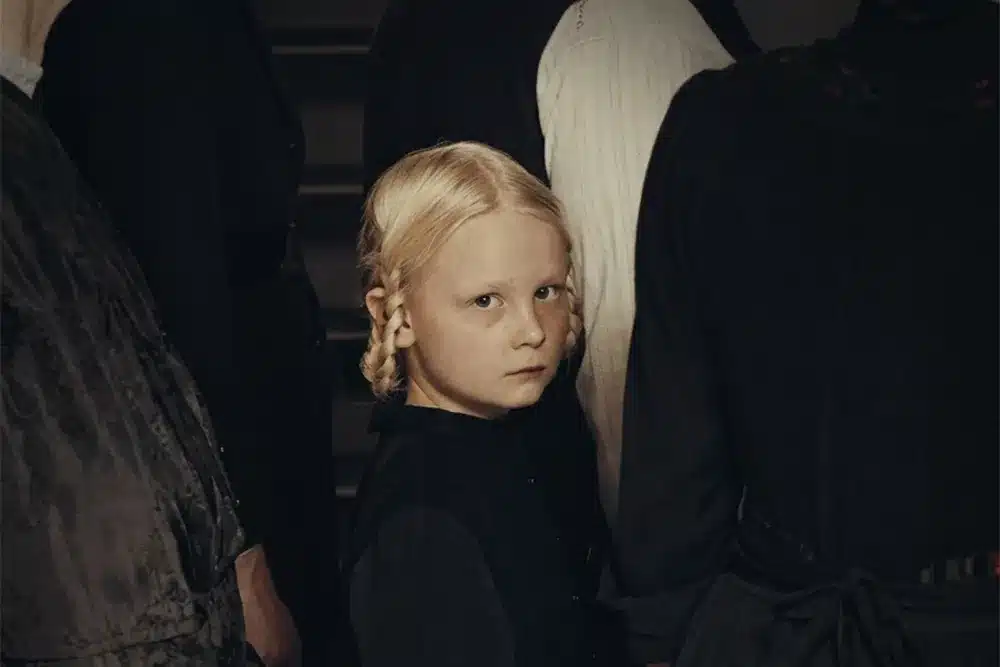
Sound of Falling is, in Schilinski’s words, a film about “the transgenerational trauma written into our bodies over time.” It follows four generations of women, although not chronologically, as they inhabit the same farmhouse in rural Germany. The film’s nonlinear arrangement cycles through scenes from four different time periods: the 1910s, 1940s, 1980s, and 2020s, each with its own main character. These characters are affected by the past, but often subtly and without having a memory of it. One of the ways the past works on them is through the movement of falling.
Indeed, the film is replete with falls: a boy is pushed off a tall ledge in a barn. Months later, his mother falls after suddenly losing function in her legs, and months after that, her mother simply “topples over” and dies. Several women commit suicide via a downward movement. Whether falling, drowning, tripping, or descending stairs, people in this film seem to be inevitably pulled toward the ground. The sun is not often seen, and when it is, it’s distant and obscured. Schilinski presents a world abandoned by God, where the people are left to suffer on the land without assistance from the heavens above. Sound of Falling asks us to think about how the past shows up in our lives, and it suggests the ground and the sky as fruitful points of departure for this inquiry.
The Mythological Fall
If we’re going to engage in a thorough exploration of the past, we might as well start as far back as possible. In most major creation myths, a supreme being first creates difference from oneness. Form necessitates separation; for anything to exist, it must be in a space where things are distinct from one another. In the Judeo-Christian tradition, within which the characters of Sound of Falling exist, this space is created through God’s separation of above from below.
Already, in the very first sentence of Genesis, God’s domain is above the Earth: “In the beginning God created the heavens and the earth. Now the earth was formless and empty, darkness was over the surface of the deep, and the Spirit of God was hovering over the waters” (NIV, Gen. 1.1). God then creates further distinctions between above and below on earth: the waters above are separated from the waters below, and thus the sky, sea, and land can take shape. Of course, in Biblical cosmology, the “above” is heaven, the divine realm where God resides and acts from, and the “below” is the physical realm where we live.
As we are well aware, life in the below is far from perfect. Physical suffering plagues the characters in Sound of Falling; amputations, physical defects, self-harm, abuse, and illness abound. Much of this suffering is deeply connected to the ground itself and is present even in the characters’ leisurely activities.
For fun, Angelika (Lena Urzendowsky), the teenage main character in the 1980s timeline, runs through the fields and counts how many wounds she accumulates on the bottom of her feet. Lia, Alma, and Gerti, three of the daughters in the 1910s timeline, play a lighthearted prank on their maid by nailing her shoes to the floor, causing her to fall on her face.
In the very beginning of Genesis, the ground was the stuff of life. God formed Adam with the clay of the ground, then brought it to life through his breath. For some time, spirit and matter existed in a harmonious union. Adam and Eve enjoyed an intimate relationship with God, and their bodies were free from pain and shame.
That is, until the Fall. After Eve ate the fruit, the ground assumed a different quality. God said to Adam:
Cursed is the ground because of you; through painful toil you will eat food from it all the days of your life. It will produce thorns and thistles for you, and you will eat the plants of the field. By the sweat of your brow you will eat your food
until you return to the ground, since from it you were taken; for dust you are and to dust you will return. (Gen. 3.17-19)
And to Eve he said:
I will make your pains in childbearing very severe; with painful labor you will give birth to children. Your desire will be for your husband, and he will rule over you. (Gen. 3.16)
The ground is now the stuff of death. With the Fall, the ground is reduced to the place one must suffer through before the physical body dies and dissolves. Then, and only then, one’s soul can reunite with God up above. The ground, and physical matter in general, is effectively inferior to the spirit and very distant from it. Humans are now subject to original sin, or what Simone Weil called “gravity”, a force that incessantly pulls the human ego to lower places (Weil 45). Gravity, of course, also pulls us towards the ground.
Here, God’s punishment condemns humanity to specific forms of suffering: uniquely female pain and submission, and an agricultural relationship with the ground marked by toil and misery. As women in farming families, Sound of Falling’s main characters endure both.
Angelika is a victim of ongoing sexual abuse at the hands of her uncle, Uwe (Konstantin Lindhorst). In one scene, she is working in the fields with her father, and her job is to flag any animals so that he does not run over them with the combine harvester. Angelika imagines seeing a dead fawn hidden in a deep patch in the field. As she approaches it, the noise of the combine slowly gives way to a quiet static sound. In this imaginary sequence, instead of signaling the fawn to her father, she lies down next to it and waits as the combine gets closer and closer to eviscerating the two bodies on the ground.
The Unconscious Will to Fall
The ground, because of its fertility, has long been aligned with the feminine in mythology and culture. The term “Mother Earth” comes from this association, which for many years emphasized the life-giving power of women and the land. However, when the farm plow was invented, the qualities of this association shifted. After the plow, women became culturally associated with the passive soil in which seeds are planted, and men with the active function of planting them. Men are now the active life-givers, and women the passive receptacles. This metaphor took root in almost all cultures that used the plow and still exists today in the language we use to talk about sex.
Similar associations are present in all sorts of traditions. In the Kabbalistic system, ten vessels, or sefirot, are arranged vertically to describe how God makes himself known to us. The topmost sefirot, Keter, is associated with God’s transcendent consciousness, which is beyond human understanding. The bottommost, Malkhut, is the immanent aspect of God, associated with the Jewish concept of Shekhinah, God’s feminine side that dwells within the physical world, exiled from the divine essence (Lancaster 78).
Keter, meaning crown, is often associated with the head and Malkhut with the womb, as it is a receptacle for the downwards flow of God’s light. Kabbalah is chiefly concerned with restoring unity between above and below, and prior to the 16th century, this was thought possible through practices that open one to receiving the divine flow from above (Rosenthal 223).

In Simone de Beauvoir’s analysis, the association of women with the earth is harmful in that it relegates them to the realm of social immanence. She defined immanence as pure material existence that changes involuntarily in response to biological cycles. Men, on the other hand, are free to exercise transcendence or consciously take creative action and pursue goals in a linear fashion. de Beauvoir described this in Ethics of Ambiguity as “the male principle of creative force, of light.” (qtd. in Strickling 39).
Lia (Greta Krämer) is the eldest daughter of the family in the 1910s timeline. Late into the film, we learn that Lia’s parents traded her to the neighboring farm to work as a maid as part of a deal after a bad crop season. It is made clear that farm maids are subject to sexual abuse, so much so that they are forcibly sterilized before beginning the job. They are made purely passive.
In a scene following the trade, Lia’s youngest sister Alma (Hanna Heckt) watches her ride atop a hay cart on this neighboring farm. Alma smiles and waves at her sister as a muffled static noise again supersedes the sound of the environment. Lia cannot return the gesture. Instead, she leans forward and falls off the moving cart, killing herself.
Not only is the ground the space of passive female suffering, but it is a receptacle that seems to hold the memory of those who have suffered on it. It is no coincidence that Angelika imagines a descent toward a dead body in the same fields where Lia fell to her death. The ground is where the passive, suffering body goes. The ground is also where the dead body goes.
Sound of Falling’s characters exist within a Christian tradition that believes the soul travels to other places after the death of the physical body. When Alma’s grandmother, Frieda (Liane Düsterhöft), dies, the funeral preparations include opening the window to “let the soul out.” The body, according to Genesis, then simply returns to dust and should be forgotten about. Right?
When asked if she is afraid of death, Frieda says, “I’m not afraid… But I’m not getting in a box, I tell you. Nobody knows if you notice anything they do to you.” In the screenplay, she says she’d rather be “laid to rest outside. On a mountain. Let the vultures eat me…at least you’re free in the open air, instead of six feet under.”
If one no longer resides in their body after death, why should it matter where one is buried? The lines from the screenplay refer to a Tibetan Buddhist funeral practice known as sky burial, in which a corpse is taken to the mountains to either decompose or be eaten by vultures. Inherent in this practice is the belief that the body is only an impermanent vessel, so the best use of it after death is to give it as a gift of compassion to the birds (Shank 10).
Clearly, this is not the case in the Christian tradition, at least for the family in the film. The maids go to great lengths to prepare Frieda’s body for burial, from putting stones on her eyes to ward off the evil eye to tying a ribbon around her jaw to prevent flies from entering.
Within Frieda’s anxiety is a sense that being buried underground would trap her within existence, while being higher in space would not. Specifically, she fears being trapped in a passive state of being where “they” can do things to her. This is not terribly surprising; after all, Hell, at least in Abrahamic religion, is the eternally painful torture chamber located below the surface of the Earth.
Frieda’s anxiety, though, is uniquely physical. For her, the continuation of her body underground means continued suffering, whereas a dissolution of her body into the sky would free her to move on to the next realm.
This fear is not limited to Frieda. In one scene, Alma and her siblings are inspecting their young brother’s corpse in the barn. One sister shouts, “The last one will be dragged into the realm of the dead!” which sends the children scrambling to race out into the open air.
Alma’s fear of “the realm of the dead” is sparked when she learns about her deceased sister, also named Alma, who looked exactly like her. Alma’s sisters joke that maybe she is not herself, but is inhabited by the soul of the dead Alma. The living Alma is left with the feeling that history can repeat itself within her body. It could be that, like her late sister, she will simply fall ill and not wake up one day, or it could be that another soul lives inside of her. Either way, Alma is afraid of the past’s presence.
In her book For the Time Being, Annie Dillard describes how the surface of the earth slowly rises, resulting in layers and layers of dead bodies directly beneath our feet. She writes, “The earth was plowing the men under, and the spade, and the plow. No one sees generations churn, or civilizations. The green fields grow up forgetting. Ours is a planet sown in beings” (203).
Sound of Falling’s modern-day timeline follows Christa (Luise Heyer) and her husband, Hesse, as they renovate the farmhouse where they live with their daughters, Lenka and Nelly. Christa is listed in the screenplay as Angelika’s daughter, although there is no indication of this in the film. Because of this, the renovations, and the fact that life appears less physically traumatic for this family, this timeline appears detached from the abject suffering in the other stories. The green fields have grown and their past forgotten, or so it seems.
One day, as Christa, Nelly, and Lenka walk home after swimming in the river near the farmhouse, Nelly imagines herself going back to the riverbank alone. The camera slowly descends towards the water as a muffled static grows louder. We then watch Nelly roll down the hill and drown in the river.
It is later revealed that, just after WWII, the 17-year-old Erika, who would be Nelly’s great-great aunt, drowned herself in this same river to avoid being raped by soldiers in East Germany. What is it that drove Nelly to imagine this suicidal descent towards the river? After all, she is only five years old and, to the viewer’s knowledge, has neither experience with physical trauma nor knowledge of her distant relative’s suicide.
For the characters in Sound of Falling, the dead are present, but not in the form of weightless spirits flying around. Instead, from right under the ground on which they work and live, the remnants of the dead physically affect them. The living often fall, or have visions of falling, in the same locations their deceased family members fell. The bodies of the dead seem to pull the living towards them; the living, usually unknowingly, reenact their dead ancestors’ physical movements.
Certainly, the characters’ memories are not stored in their conscious minds. Even when they are aware of what happened to their ancestors, they almost never speak about it to themselves or to each other. In depth psychology, and in the mythological systems it draws upon, underground or underwater spaces symbolize the unconscious, the psychic space of the hidden or repressed (Jung, CW9 35-42).
Carl Jung famously conceived of these depths as layered, containing not only repressed personal memories but also, farther down, the collective unconscious. This lower layer houses “the accumulated deposits from the lives of our ancestors,” which are shared with us through things like instincts and images (Jung, CW8 673). These deposits include both what is universal to all of humanity and what is specific to our unique familial histories (Jacobi 34).
The unconscious, in being hidden, is like a blind spot in our minds. It is the place Angelika refers to when, after an appointment with an optometrist, she demonstrates to her family how to find the blind spot in their vision. A blind spot is an area present in everyone’s eyes that has no light-sensitive cells, and, technically, we cannot see from those points. Nonetheless, because of the brain’s ability to fill in missing information, we sense what is there.
To fall towards the ground, then, is to fall towards the dark and hidden past. It is a passive movement, made not by choice but by the material conditions of the dead. It is immanent.
Women in the Wilderness
Sound of Falling represents the world as we live in it, where above and below, life and death, future and past are all irrevocably distinct from each other. We see ourselves in the middle of this vertical axis as members of the present. The past is below us in the form of dead bodies, and the future is somewhere above and beyond us. A valid question is: How can we ascend on this axis? How can we avoid death? Simone de Beauvoir asked: How can women transcend?
A better question might be: How can the axis be reimagined? After all, to varying degrees, we are all going to suffer. To non-varying degrees, we are all going to die.
The placard in the museum next to Murillo’s The Immaculate Conception references a passage from Saint John’s vision in the Book of Revelation: “a woman clothed with the sun, with the moon under her feet.” The rest of this passage, not included on the placard, says that the woman was pregnant with a male child, and once she gave birth, “her child was snatched up to God and to his throne. The woman fled into the wilderness to a place prepared for her by God” (Rev. 12.1-6).

In an essay about this passage in the context of Kristevan linguistics, feminist philosopher Andrea Nye explores a framework similar to de Beauvoir’s immanence/ transcendence duality. She discusses Kristeva’s metaphysics of the sun and the wilderness, in which the former is the realm of masculine logic, which uses language to climb the latter to clarity, and the latter is the feminine realm of direct bodily sensation. In Kristeva’s view, women feel the distance between these two places most strongly (673-674).
This is certainly true for the women in Sound of Falling. In a voiceover that plays directly after the fawn scene, Angelika describes how her body automatically adopts the speech patterns of those around her. Over shots of the sun blurred behind trees, we hear Angelika’s voice saying that her body cannot figure out how to speak like herself.
Kristeva and Nye both ask: Where can the woman in the wilderness go? What can she do? Looking only to the sun does nothing for her, as her experiences can’t be captured in the realm of the rational. Falling to the ground is an equally bad option, as it prevents her from being an autonomous subject. Despite some disagreements, Kristeva and Nye agree that there must be a way to close or eliminate the gap between above and below.
Jung, as we will see, had similar ideas. In The Red Book, Jung’s journey into his own unconscious took the form of a descent into underground caves to interact with the dead, who had questions for the living. This was one of many personal experiences that led him to suggest that the dead, rather than being omniscient, possess only the knowledge they had when they died. Thus, as he expands upon in Memories, Dreams, and Reflections, the dead look to the living to answer the questions they could not solve during their lifetimes (306-308).
Schilinski herself said that, in making the film, she was “struck by the idea that you can go through life as a proxy for previous generations who have had things happen to them that they…weren’t able to negotiate thoroughly themselves.”
For Jung, the dead can ask us questions because they reside within our psyches. The collective unconscious is essentially the realm of the dead. Jung scholar James Hillman, explaining the nature of this communication, said that “the dead are the daily encounter with everything that has been left out, buried, burned, drowned, forgotten on purpose. [They] continue to send wafts of little messages through all sorts of small intuitions… the little feelings in the stomach.”
These “small intuitions” are difficult to discern, given that the above/below, past/future distinction does not exist within the Jungian unconscious (Jung, Memories 319-320). Rather, the unconscious is the space of de Beauvoir’s immanence and Kristeva’s wilderness, where rationally ordered communication is of no use. Instead, as he emphasized throughout his work, Jung’s dead communicate via visions, intuitions, and even physical sensations, many of which involve primordial instincts and imagery from the deepest layer of the collective unconscious.
In Sound of Falling, characters across generations share certain physical instincts, such as saying the word “warm” when something touches their skin or practicing headstands (which are, interestingly, a literal reversal of the ground and the sky). In the Jungian context, these behaviors are inherited from the collective unconscious.
Similarly, Angelika and Nelly’s visions can be read as messages from Lia, Erika, and countless other victims of sexual abuse. In one scene, Nelly says she knows the taste of a doorknob even though she has never tasted one. The film is full of other, more subtle moments where characters seem to simply get a strange feeling about something but can’t put their finger on it.
Jung was interested in reincarnation and in the idea that once the dead reach a certain level of understanding, they will stop returning to the realm of the living (Jung, Memories 316-317). We don’t have to adopt a belief in reincarnation, though, to come to this conclusion. Alma’s fear, which is essentially that she is her sister reincarnated, is, in the Jungian view, simply a recognition that her life is, in some way, a continuation of those who came before. This is not too far-fetched. If we keep living as our ancestors did, especially without understanding why, they will keep reappearing in the form of our own behaviors and experiences. If we can live differently, the dead will be able to rest.
This is why, according to Jung, our spatiotemporal reality is so important. He writes that the dead can only learn by flowing “into a soul bound to a body” because, after all, “cognition… presupposes an opposition, a here and there, an above and below, a before and after” (Jung, Memories 308). Only the living can effect change, as space, time, language, and the five senses are necessary to come to any meaningful conclusions.
For Jung, it is imperative that we do so. He believed that if we dig deeply into the hidden past and bring that knowledge to our conscious lives, we will understand that our finite existences are connected to the infinite. With this level of understanding, the individual is taken out of a selfish, ego-driven state of being and instead exists in an “indissoluble community” with the world (Jacobi 119). If all of humanity operated from this space, perhaps we would inflict less suffering on each other.
Jung asks us to add a horizontal dimension to the axis. He wants us to bring the dead up to the horizon of the living. The dead are not obsolete and below us, but alive and present within ourselves and the people around us. This is a joining of spirit and matter, of above and below. It is an acknowledgment that our present material existence is animated by the spirit of the past.
In Jung’s own words:
The conscious mind…knows ‘spirit’ only as something to be found in the heights. ‘Spirit’ always seems to come from above, while from below comes everything that is sordid and worthless. For people who think in this way, spirit means highest freedom, a soaring over the depths, deliverance from the prison of the chthonic world, and hence a refuge for all those timorous souls who do not want to become anything different. But water is earthy and tangible, it is also the fluid of the instinct-driven body, blood and the flowing of blood, the odour of the beast, carnality heavy with passion (CW9 41).
What this suggests is a kind of immanent transcendence. In de Beauvoir’s sense of the words, we are brought to the possibility of moving towards something beyond ourselves by cycling back into the material past, of an upwards movement by way of the ground. Freedom, here, is not found in heading towards our personal futures, but in digging through the communal conditions that shaped our past.
The nonlinear sequencing of Sound of Falling is itself an act of this very kind. By interspersing the past and the present, the film makes the dead present now. It blurs the borders of time, making connections that could not be made from a linear perspective.
For example, at the beginning of the film, Alma’s mother bites the spot between her thumb and index finger. We then cut to a short clip of an eel biting a hand in that same spot, before returning to the 1910s All Souls’ Day preparations. Later, we see the entire scene from which the eel clip was taken: as Angelika’s mother, Irm, is cleaning up in her kitchen, she holds an eel up to her hand so that it will bite her. Because of the way Schilinski allowed time to jump earlier in the film, Alma’s mother is immediately present in this scene.
This type of arrangement encompasses the entire film and asks the viewer to constantly make connections among the characters. The viewer must invite the dead into each present moment.
These connections are usually suggested through sensation, rather than through language. In addition to those already mentioned, one of the more obvious examples is the use of motifs to connect the past and present through sound. The previously mentioned muffled sound recurs throughout all time periods, as do the images and sounds of a buzzing fly. Over time, the viewer realizes that these sensory details work to connect the experiences of different characters across time. The film operates in the language of the unconscious, or in other words, the language of the dead.
Sound of Falling is a response to Jung’s delegation of responsibility to the living. Every time we consider our ancestors as part of ourselves and our lives, we are moving a little closer to understanding and freeing them. They are relying on us. This brings to mind a quote by Rabbi Tarfon, which has since become a sort of Kabbalistic motto: “It is not your duty to finish the work, but neither are you at liberty to neglect it.”
Kabbalists often use this quote to refer to tikkun olam, or world repair. This work was popularized by Rabbi Isaac Luria, who revolutionized Kabbalah in the 16th century. He taught that creation resulted from the contraction of a divine light, thereby making space for darkness to exist. God sent vessels of light into this darkness, but they were unable to contain the light and shattered. Some of the broken shards became klippot, the basis for the material world where evil is able to exist, which fell downwards along with sparks of the divine light and became our physical world.
A similar process happened after the original sin, which shattered the light of the primordial man, Adam Kadmon. Soul-sparks then mingled with shards of materiality to form human beings. The result is a physical world where every thing and every person contains sparks of trapped divine light (Biale 322-325).
According to Lurianic Kabbalah, now the dominant strain of Kabbalah, our task is to find these trapped sparks and raise them back up to God, restoring the divine light to its original unity (Lancaster 99-100). God, who lacks a human consciousness and five senses, relies on us. We can do this work through contemplation and good deeds, or in other words, through turning towards the world and engaging deeply with the good.
Luria taught that some soul-sparks will continue to reincarnate on earth, either as individual human souls or, sometimes, as plants or stones, until this work is complete. In its goal of freeing trapped sparks and trapped souls, tikkun olam is cosmic, community, and individual soul repair (Rosenthal 226).
With Lurianic Kabbalah, the flow of divine light is reversed. The divine above becomes the passive receptacle. We, the physical bodies in the physical world, are the active agents in making life better. Yes, maybe God has withdrawn from the world, but we don’t have to wait until we get to the sky to interact with the spirit. The power to give life is placed back within the womb.
The path to transcendence is immanent. It already exists within what is trapped in the ground. We must turn not to the sky but towards the world, which is to turn towards the dead, which is to turn towards the spirit. Only then can we move upwards, only then can we free what is trapped. For Sound of Falling’s characters, Schilinski has done this very work.
In the film’s final scene, a strong wind blows through a hayfield. Farmworkers duck behind their haystacks. Alma, however, presses on, struggling through the force of the wind to walk across the field. She is going towards Lia, who stands at the edge of the field with her arms outstretched. Slowly, Lia begins lifting off the ground as Alma draws nearer. Soon, the two sisters are floating side by side in the air, their chests, holding their hearts, lifted towards the sky. In the final shot, we see only their feet, which finally hover far above the ground.
Works Cited
Biale, David. “Jewish mysticism in the sixteenth century.” An Introduction to the Medieval Mystics of Europe, edited by Paul E. Szarmach. State University of New York Press, 1984, pp. 313-329.
Dillard, Annie. For the Time Being. Vintage Books, 2000.
“Gilgul: The Concept of Reincarnation According to the Jewish Kabbalah.” Abrahamic Study Hall, 18 Aug. 2017.
Gray, Carmen, and Mascha Schilinski. “‘We Wanted to Give the Characters a Chance to Gaze Back’: Mascha Schilinski on Sound of Falling.” British Film Institute, 4 Mar. 2026.
Hillman, James. “James Hillman – The Red Book: Jung and the Profoundly Personal.” YouTube.
Jacobi, Jolan. The Psychology of Jung. Translated by K.W. Bash, 1st ed., Yale University Press, 1947.
Jung, C. G. Memories, Dreams, Reflections. Edited by Aniela Jaffé. Translated by Richard Winston and Clara Winston, Vintage Books, 1989.
Jung, C. G. The Collected Works of C. G. Jung Complete Digital Edition Vol. 8 Structure & Dynamics of the Psyche. Translated by Gerhard Adler and R. F. C. Hull, 2nd ed., Princeton University Press.
Jung, Carl. The Collected Works of C.G. Jung Complete Digital Edition Vol. 9 Part 1: Archetypes and the Collective Unconscious. Translated by Gerhard Adler and R.F.C Hull, 2nd ed., Princeton University Press.
Jung, Carl. The Red Book: A Reader’s Edition. Edited by Sonu Shamdasani, W.W. Norton, 2009.
Lancaster, Brian. The Essence of Kabbalah. Arcturus Publishing Limited, 2017.
McElvaine, Robert S. “The Ancient Metaphor That Created Modern Sexism.” The Washington Post, 17 Oct. 2018.
New International Version. Bible Gateway.
Nye, Andrea. “Woman Clothed with the Sun: Julia Kristeva and the Escape from/to Language.” Signs, vol. 12, no. 4, 1987, pp. 664–86. JSTOR.
Pirkei Atvot. Translated by Joshua Kulp, Sefaria.
Rosenthal, Gilbert S. “Tikkun ha‐Olam: The Metamorphosis of a Concept.” The Journal of Religion, vol. 85, no. 2, 2005, pp. 214–40. JSTOR.
Schilinski, Mascha, and Louise Peter. “Sound of Falling Screenplay.” Document Cloud, 2023.
“The Seven Emotional Sefirot.” Morashá, Aug. 2010.
Shank, Catherine H. “Sky Burials: Ecological Necessity or Religious Custom?” Relics, Remnants, and Religion: An Undergraduate Journal in Religious Studies, vol. 4, no. 1, May 2019. JSTOR.
Strickling, Bonnelle. “Simone de Beauvoir and the Value of Immanence.” Atlantis: Critical Studies in Gender, Culture & Social Justice, vol. 13, no. 2, 1988, pp. 36-43.
Weil, Simone. Gravity and Grace. Translated by Arthur Willis, University of Nebraska Press, 1997.