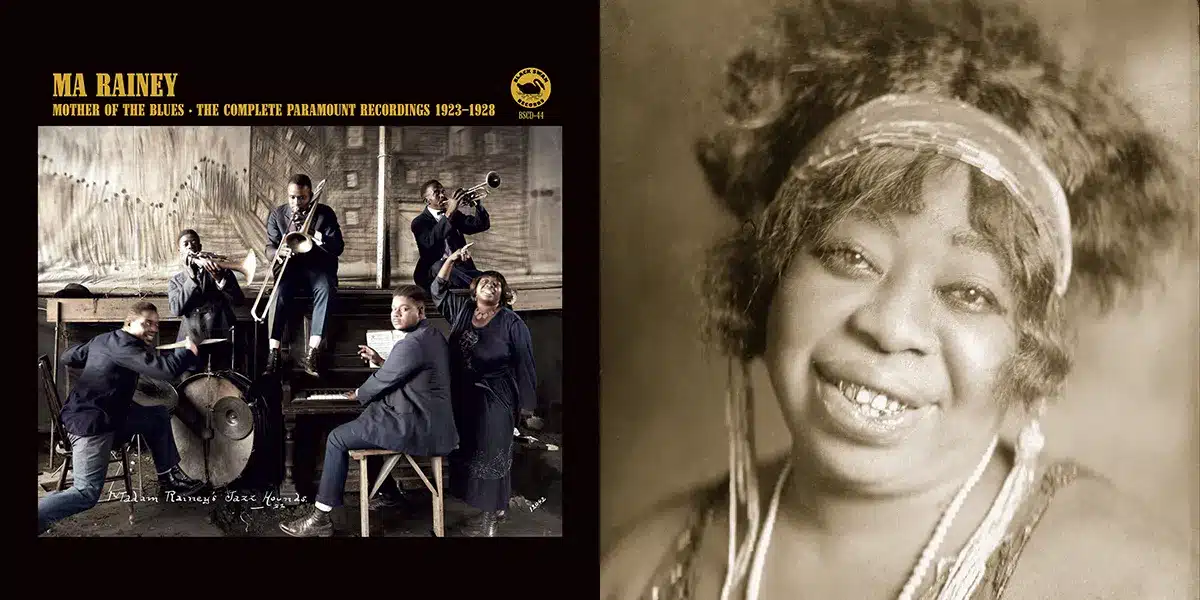
Gertrude “Ma” Rainey (1886-1939) somehow managed to be known during her lifetime as both “the Assassinator of the Blues” and “the Mother of the Blues”. Her greatness lies in that paradox. Raised in Columbus, Georgia, in vaudeville at the age of 14, Ma Rainey commanded the stage with a swagger, glamor, and at times menace that were matched by a mighty, emotionally devastating contralto voice. That she wrote her own songs and shows, managed her band and dance troupe, and was inimitably her own four feet seven inches, 300-pound, deep-dark-skinned, bisexual, freewheeling self only contributes to her myth and legacy.
In addition to shaping much of what we know today as the blues, it’s easy to trace a direct path from Rainey’s larger-than-life persona to the later worlds of rock ‘n’ roll and hip-hop. Long before Muddy Waters, Ma Rainey was singing, in “Slow Driving Moan” (1927), “I’m a common old rollin’ stone, just got the blues for home sweet home.” Like Louis Armstrong, with whom she recorded a landmark session during the young trumpeter’s short stint with Fletcher Henderson’s band in 1924, Rainey stands tall at the foundation of modern American popular music.
The blues find joy in suffering, exuberance in violence, consolation in betrayal, and resilience in a life lived on the edge. One generation removed from slavery, Ma Rainey could sing of being “a slave to the blues” in full awareness of the metaphor’s aptness, referring both to the blues that find her “dreamin’ ’bout that man of mine” and the blues that reflected her life under Jim Crow. “If I could break these chains and let my worried heart go free,” she broods, “But it’s too late now, the blues have made a slave of me.”
Both an injustice and a bond she is unable to break, the song ostensibly ends in defeat. “I’m a good-hearted woman, jus’ that I’m slaved to the blues.” But before that concession, as in the space of every two-and-a-half to three-minute song she recorded, Rainey owns it all, her voice soaring even over musical fills by the likes of a 21-year-old Coleman Hawkins’s bass saxophone. As long as the song lasts, she fulfills the otherwise thwarted dream of “Damper Down Blues”: “If I had wings, I’d fly all over this town.”
Slow 12-bar blues sold well in the mid-1920s, and a good percentage of Rainey’s recordings follow the standard template of two repeated verses with a one-line response or chorus. Some, like “Those All Night Blues”, disguise their structure with varied lyrics in the first two lines. Others, like “Jelly Bean Blues”, begin as a 12-bar blues before diverging into other forms. Many of the most memorable tunes, like “Jealous-Hearted Blues”, “See See Rider Blues”, “Ya De Da”, or “Black Eye Blues”, blend the blues with choruses and sometimes verses from Tin Pan Alley’s pop composers. As with all great popular music, the art comes from variation within tight formal constraints and innovative vocal and instrumental phrasing.
It is characteristic of pop personae to challenge the separation of life from performance, if not fully to collapse one into the other. Traces of Rainey’s elaborate stage shows persist on the recordings, in skits that introduce or conclude a number of the tracks, in sounds effects from kazoo, saw, and regular band instruments, and in lyrical references to presumed stage antics, as when the singer introduces the song made famous by August Wilson’s 1984 drama with a strip tease, “Now, you’ve heard the rest. Ah, boys, I’m gonna show you the best. Ma Rainey’s gonna show you her black bottom!”
The “black bottom” was a 1920s dance craze. It conjured a Southern “bottom,” infertile land to which white landowners pushed Black communities, like the one referenced in “Louisiana Hoo Doo Blues.” It was where the blues would invariably take you or find you, as in “Down in the Basement” (“Oh, this is a low down days, boys, take me to the basement!”). It pointed, indubitably, to the singer’s own capacious backside, the blues’ double entendre embedded in every one of those examples.
Ma Rainey’s performance could be aggressively cutting, whether figuratively (“You low down alligator, just watch me sooner later / Gonna catch you with your britches down,” in “Black Eye Blues”) or literally (“I got rough and killed three women, before the police got the news / ‘Cause mama’s on the warpath with those rough and tumblin’ blues,” in “Rough and Tumble Blues”). It could be self-lacerating in the extreme (“Man I love broke my heart, an’ I’m ’bout to pass away,” in “Ma Rainey’s Mystery Record”; “Every night for five years, I’ve got a beatin’ from my man / People say I’m crazy, I’ll explain and you’ll understand,” in “Sweet Rough Man”). Even when the words speak only despair, the singer and her band take us somewhere else, whether it’s “that island where the women never hear bad news” (“Explaining the Blues”) or the Cannonball locomotive rolling between New Orleans and Chicago that she’s going to escape on after she kills her man (“See See Rider”).
Ma Rainey sang in the voices of an alcoholic (“Dead Drunk Blues”), an abused sex worker (“Hustlin’ Blues”), and a murderer (“Cell Bound Blues”, “See See Rider Blues”, “Rough and Tumble Blues”, “Broken Hearted Blues”, “Tough Luck Blues”). However, no evidence suggests she acted out any of these roles. On the other hand, that she indulged regularly in younger men and was regularly unlucky in love was as well-documented on her tours as in her lyrics.
There’s less documentation of her fondness for women, leaving no way of knowing whether she sang “Went out last night with a crowd of my friends / They mus’ been women, ’cause I don’t like no men” from experience. She sings it with conviction regardless. That the world of the blues was fluid and open in ways that much of mainstream society was not is equally evident from Rainey’s original composition “Sissy Blues”, where her man, who “says sissies got good jelly roll”, runs off with “a sissy, his name is Miss Kate”.
Always in control as a performer, Ma Rainey could play the victim as easily as the assassin, often in the same song. Or she could slyly flip the roles, as in the 1924 New York sessions with Armstrong that produced both the sublime “See See Rider Blues”, credited to her erstwhile pianist Lovie Austin, and Rainey’s own composition, “Jelly Bean Blues”. In the former, abandoned by an “easy rider,” or faithless freeloader, she vows to buy a pistol, kill her lover, and catch the next train north.
In the latter, she starts what sounds like a lovelorn blues (“My daddy left me this morning / That’s why I moan and cry”), before she recalls her baby’s parting words: “He said, ‘See, see rider, today I’m going away / And I won’t be back until you change your ways.” When Rainey sings it, she slips into the cadence of the song she’s quoting, the banjo plucking the familiar melody. She both rejects the label of “easy rider” and embraces the masculine power it typically implied.
A third track from the same session takes Rainey’s self-referentiality even further. In “Countin’ the Blues”, the singer fights off her nighttime blues by “counting”, or listing every song in her repertoire, playing them to herself one after another in her head. “Lord, I’m going to sleep now, just now got bad news,” she concludes, “To try to dream away my troubles, countin’ these blues.” From the music-hall to the juke joint to a pallet on the floor, there’s nothing like the blues for, as the Scripture-derived saying goes, “making a way out of no way.”
Despite 40 years of public performance, Rainey’s recording career was limited to 92 titles during six years from 1923-1928. Those songs, along with some alternate takes (a few presented for the first time), make up the five-disc set, Mother of the Blues: The Complete Paramount Recordings. This is by no means the first collection of Rainey’s music; what distinguishes it from its predecessors is a state-of-the-art digital transfer and restoration of the low-quality, often poorly recorded originals. Having first encountered Ma Rainey on a buzzy old Sony cassette ripped from a public library LP, hearing these recordings in something like a pristine state was a revelation.
Even someone familiar to Rainey from streaming sites or older CDs will have their ears opened by the newly accessible detail, range, and sheer force of many of these tracks. An evident labor of love by Black Swan Records, the George H. Buck Jazz Foundation, audio engineer Doug Benson, and project coordinators Lars Edegran and David Stocker, the box set includes a 100-page booklet full of photos, sheet music, testimonials, a full biography, recording notes, lyric transcriptions, and a full discography. Mother of the Blues is a treasure trove that fully lives up to both of Ma Rainey’s famous sobriquets.