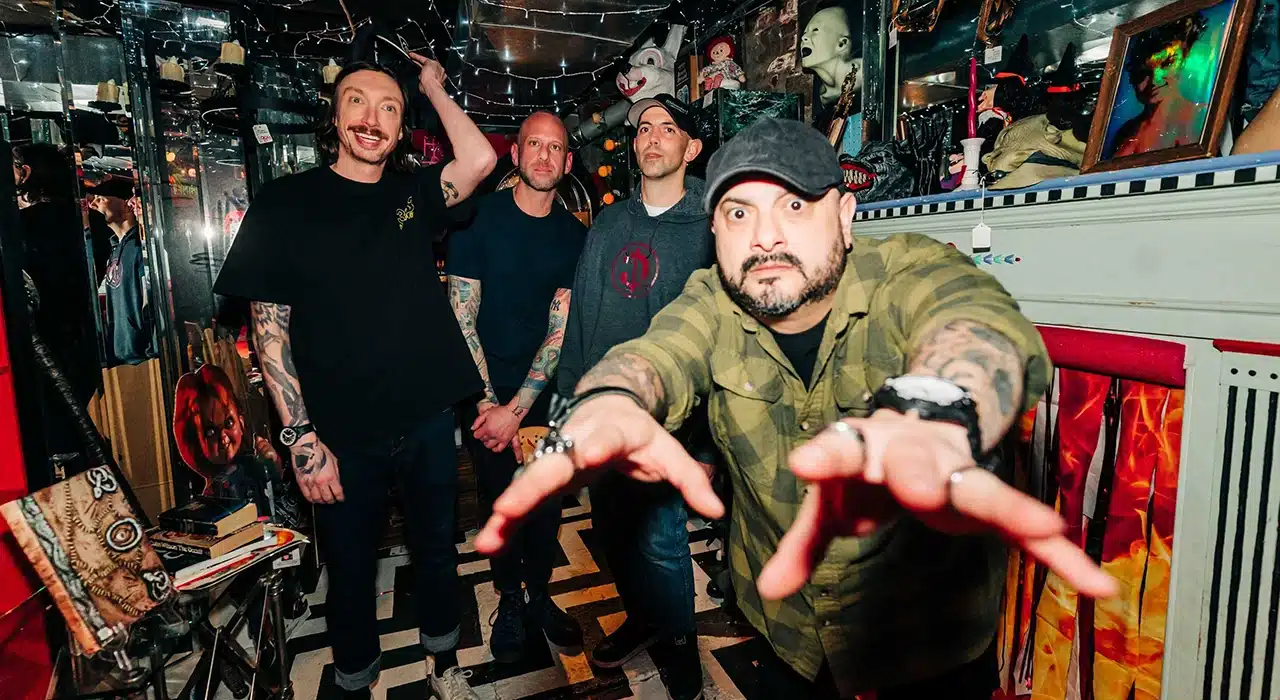
The alternative rock band ME., short for “Mark” (O’Connell) and “Eddie” (Reyes), was never supposed to exist. That’s partly because it was formed by two previous members of the Amityville group Taking Back Sunday, and partly because interpersonal tensions locked these members in a state of no contact for nearly a decade.
Plenty remained unknown between Mark O’Connell, ME., and Taking Back Sunday‘s (former) drummer and guitarist, Eddie Reyes, when their manager sat them down for their first real conversation in years. What followed was a gradual, if difficult, easing of misunderstandings and a discussion that was shaped into song. From this reunion came ten gritty, rough-hewn rock instrumentals that spoke volumes but still needed a vocalist to fill in the emotional sketches.
In stepped an unexpected frontman for an already unexpected new band: Chicago-based musician Mike Jansen. His lyrics serendipitously captured many feelings O’Connell and Reyes knew intimately. Together with Jansen, as well as O’Connell’s longtime friend Neal Amiruddin on bass, Reyes and O’Connell birthed a new beginning in ME.’s spirited debut, All Good Things (2026).
I sat down with Mike Jansen and Mark O’Connell over Zoom to plumb the depths of this newborn band’s soul and see how the bitter experiences of adulthood can blossom into surprising transformation. Both are seated before me in a garage: O’Connell in a deep red polo and Jansen zipped up in an aubergine hard-shell jacket.
“There is so much that Eddie and I had to go through throughout this entire process to keep things going,” shares O’Connell, who speaks with the kind of candor and conviction that feels palpable and immediate—much like ME.‘s intensely forthright new record. “To be honest, there were times when neither of us knew if we were going to be able to see things through. Thank God we were, because the outcome is All Good Things, and we couldn’t be more proud.”
The group have every right to be proud. Although the details of O’Connell and Reyes’s troubled history together remain largely private, one can easily grasp its emotional toll through the prism of All Good Things. Honesty erupts across the record in bright, sharp, heated bursts. It’s a tinderbox catching flame, an effusion of hot gases once trapped under pressure finally breaching containment. Guitars form walls of thunderclouds out of which Mike Jansen’s vocals surge and snap like chain lightning.
The sound recalls the best of 1990s and early 2000s punk rock, paired with confessional lyrics like “I’m not gonna change for you / I can’t even change for me” (“Bloodsport”) and “Why can’t I see the colors of a rainbow anymore?” (“Sun Poison”). If O’Connell and Reyes’s often throbbing instrumentals are the rupture, Jansen’s words provide the reason; these men have a lot on their minds.
“When you’re healing a relationship with someone—when it’s important enough to you—you have to handle it as delicately as needed. You have to go through certain things and open yourself up,” says O’Connell, speaking to his relationship with Eddie Reyes. “You have to realize that maybe things weren’t what you thought they were, so you have to be able to say ‘I’m sorry.’
“That was how Eddie and I were able to heal. We never did anything to each other that was bad enough for us not to be able to at least try to reconcile. Also, we’re both sober. If we weren’t, there’s just no way things would have gone beyond that first trip where we had to try to write some music together. No way. I would say that’s the main thing, us being sober, off alcohol.”

“Bloodsport” is among the tracks on All Good Things that throws relational chafing into sharp relief. The title captures the battleground that life can be, especially between people who are enormously at odds. “With our hearts on the floor, this is a bloodsport,” sings Mike Jansen, adding that “You’ve got a passion, and it’s gone too far.” Perhaps the passion is a vice, or a character flaw that’s weaponized against others for the sake of control or image maintenance. Whatever it is, it’s beating everyone within an inch of their lives.
Amazingly, Jansen didn’t walk into ME. knowing about the conflicts that had separated O’Connell and Reyes for years. “When I saw that Mark and Eddie were working on this project, and the instrumentals came out, it was like a breath of fresh air for me to write over a different palette of expression from what I was familiar with. I grew up listening to Taking Back Sunday, and I knew the sound that the guys were working with. That’s what grabbed my attention in the first place. I tried to attack it from an angle that was not doing vocally what they had already done.”
Jansen elaborates, “That sound was great, but I’m also one person. I found a lot of inspiration from a lot of ’90s things that I was already kind of dialing in on my own. I thought, ‘You know, this vibe can go really well with what [Reyes and O’Connell] are doing.’ They connected really quickly to it because it didn’t feel forced. It didn’t feel like I was trying to imitate something else. I wanted to make sure that what I brought sounded honest, and I mean, it is.”
I asked Jansen what it was like entering Reyes and O’Connell’s world from outside their history. “Coming into the situation… it was a learning experience for all of us,” Jansen shares. “They were going through it. Figuring out if it was going to work again. At the time, there wasn’t going to be a singer, so I was just kind of there. I wasn’t in the band when I showed up. I wasn’t in the band a week later, either. I was just there still, working on the songs, like, ‘What’s happening?’
“I was freshly married, and I’d been used to writing songs alone for a long time. I’d been in bands, but I’d also been writing creatively at home in my workspace. But we all wanted to be here to write this album. We’re glad we did it; we’re excited about what’s going on, and once we had the album, a weight came off our shoulders. Then we started thinking, ‘What’s the next thing we have to do? How do we drive forward?’ It’s not something you think about—starting again from the beginning at 40 years old.”
All Good Things certainly strikes the feeling of starting anew by addressing what has already passed as well as what’s to come. It’s like a long-awaited clearing of the air, when a storm goes from a held breath to a tumultuous dance of wind, rain, and electricity. “What’re you gonna do when the heart stops holding you back?” asks Jansen in “Grown Man”. Here, the emotional deluge isn’t anger but hope. “Everything’s better with you in my life / This just started / I’m not slowing down.” Now, we don’t just have permission to speak truth to people who wronged us, but also to be uncynical with people who move the deeper parts of our hearts.
“Big Smiles”, the de facto ballad on All Good Things, is a powerful example of this. The gentle, open-hearted piece marks a welcome shift toward softness that listeners can rest inside for a little while before re-entering the record’s harder observations. It’s also a refreshing glimpse into a different kind of maturity ME. embodies on their debut: the willingness to look forward to something again, and to be tender, even at the risk of opening yourself to suffering.
“I think that when you’re younger, and you love hard,” says Jansen, “and you get hurt, it scares you out of doing that again. If you really want to keep loving as hard as you have, you have to be aware of how hard it could hurt. That’s a lot of what the discussions are in the songs when it comes to love. That fear and anxiety is kind of what I like to write through.”
This conception of love goes beyond romance. At its core, All Good Things doesn’t only question life, self, or the people and circumstances that make existence difficult. It’s also a call to love and forgive audaciously—including creative partners. This is the belief that inadvertently brought ME. together in the first place, and it’s the belief that continues echoing through the music.
As for cynicism? Mark O’Connell has thoughts. “Run away from that bullshit.” As for lessons learned from forming ME.? “Do the hard thing,” he says emphatically. “Every time, if it’s right. If the intent is positive and good, do the hard thing. It’s worth it.”