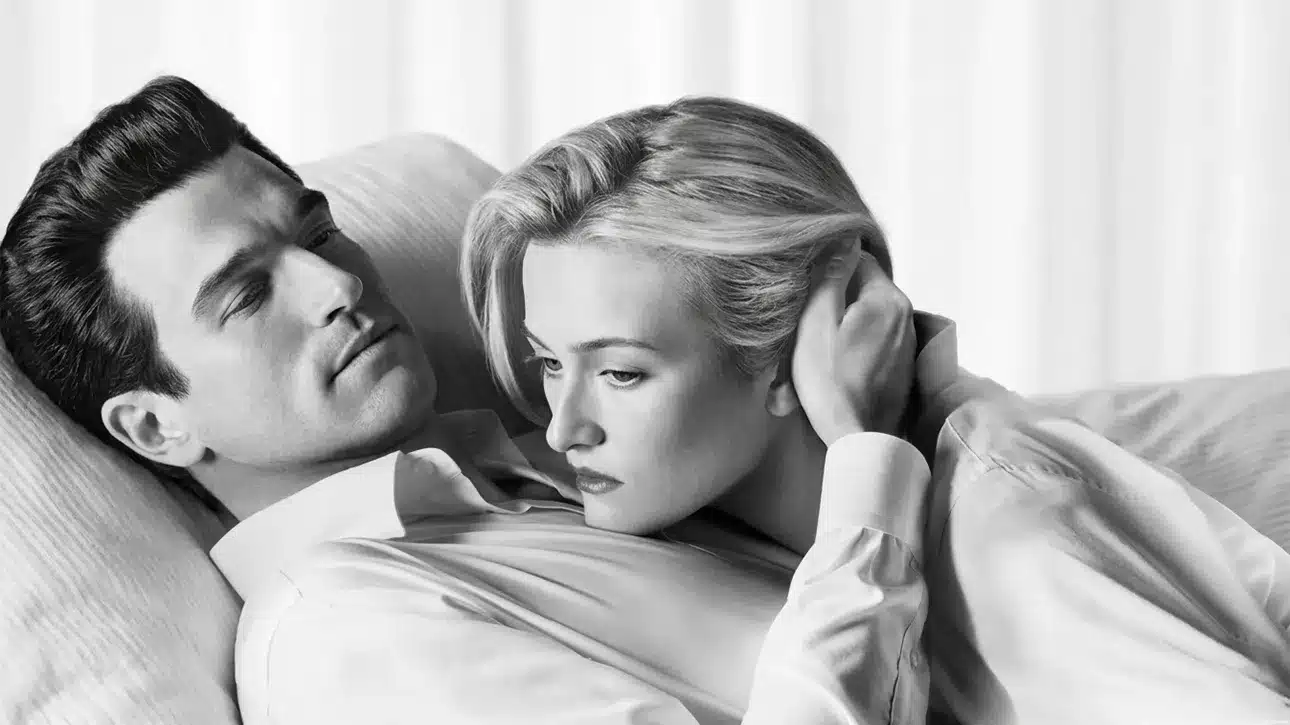
Love Story: John F. Kennedy Jr. and Carolyn Bessette is the television series that, in nine episodes, dramatizes the story of this couple’s heady courtship and fraught marriage. For a while in early 2026, it seemed that almost every entertainment-focused publication had a review or a media item of the FX-Hulu series. Based on the 2024 biography of Carolyn Bessette by Elizabeth Beller (Once Upon a Time: The Captivating Life of Carolyn Bessette Kennedy), not only was the quasi-biopic one of the most-watched limited television series ever (with over 65 million hours streamed worldwide according to Variety), but apparently, viewership increased by over 90 percent from the first episode to the penultimate one.
Indeed, Love Story is a massive success for its creator, Connor Hines, and producers Ryan Murphy, Nina Jacobson, and Brad Simpson. While the glamour and tragedy of the real-life story make these characters easy fodder for a cinematic rendering of their lives, I hadn’t expected to find the story so affecting. Despite being a hypercritical television viewer, by the final episode, as the Henry Scott Holland sermon “Death Is Nothing at All” was solemnly read by Bessette’s TV mother (Constance Zimmer), I was sobbing.
Like so many Gen X’ers, I have a nostalgia for the mid-1990s. I was in college when George magazine first launched. I remember the photographs of JFK Jr. and Carolyn Bessette while they were dating. They married the year I graduated. My friends and I discussed whether she was beautiful, how sophisticated her minimalist fashion choices were, how unlikely it was that he would have chosen an unknown like her, and that slinky yet unforgettable wedding dress.
Then, of course, there were all the trashy celebrity rags that circulated gossip about her being a reckless cokehead who was dragging down the gorgeous prince of America’s greatest political dynasty. We believed all the rumors—the ones about him and his playboy lifestyle and the ones about her—mostly because it was fun to demonize a rail-thin blonde who seemed to have it all (we were under 5’3″ and mostly self-defined minorities from working-class backgrounds).
I didn’t give much thought to their relationship or how the glare of the media might have affected it. I assumed they were in love, caught up in each other, and, rich as they were, trying to figure out what to do with their money as they merged their full-of-promise lives. When they died in a small plane crash over the Atlantic, it seemed unreal in the same way that it seemed unreal when River Phoenix died of an overdose, the fall of my sophomore year in 1993. America’s beautiful pantheon of minor gods suddenly forced us to see our mortality in theirs.
Reading the reviews, op-eds, and guest essays (and there were many), I was prepared to watch what I thought would be a story that flipped the script. Love Story, however, is not merely a Cinderella tale of JFK Jr. making a princess out of a chambermaid; rather, in this story, Bessette’s inner life and ambitions are centered. This would be an entertaining, highly aestheticized neo-feminist take on a woman’s rise and fall at the hands of a risk-taking man. It would be eye candy with some real-life referents and a fast-moving script.
The New York Times film critic Wesley Morris provocatively titles his podcast review “Love Story is Actually a Horror Story”. He describes the series as moving from a Sex in the City arc—Bessette as a “Carrie” figure living her best life in New York City—to swiftly becoming something akin to Roman Polanski’s Rosemary’s Baby (1968), the story of a woman “choosing to marry into a kind of darkness.” Morris poses the question the series asks this way:
“Do I remain this free independent spirit having the time of my life in New York or do I give all that up to marry a man who, he may not want to change my life, but the world he comes from and all of the things that are attached to it—in this case meaning the tabloids and the paparazzi—is that going to be worth the sacrifice of all my carefree single girlness? [… ] And she chooses yes, and she marries this man… It takes a minute to show you how this feels for her, what this is like watching her descend from this happy-go-lucky person—who has some emotional complexity too—but essentially into this flavorless, stuck, trapped, caged, creature.”
For all the verve in Morris’s categorization of the series, his description of Bessette, wealthy and beautiful as she was, struck a nerve. So many of us know what it feels like to be a “flavorless, stuck, trapped, caged creature,” particularly after years in a relationship. It happens in many marriages and long-term, monogamous partnerships when you start to wonder how two people who once loved each other so deeply could be reduced to such flawed versions of themselves, emptied of all the interesting parts.
That All-Consuming Love
On the face of it, I like Morris’s framing and his comparison to Rosemary’s Baby. Indeed, the slick television series takes a dark turn once Bessette marries, forcing us to wrestle with how she may have been suffering or how unfulfilled she was in her relationship. The parallels to Princess Diana’s story and untimely death are unmistakable. Yet, what Morris and other reviewers don’t mention, and what keeps me thinking about the episodes days after the final credits rolled, is the way in which Love Story works to explore in some surprisingly raw scenes the experience of intimacy and marriage.
Love Story is not only about the penetrating way that fame and celebrity change the course of Carolyn Bessette’s life. At its core, Love Story is more analogous to Ingmar Bergman’s Scenes from a Marriage from 1973, or the more recent 2021 miniseries directed by Hagai Levi starring Jessica Chastain and Oscar Isaac. Noah Baumbach’s difficult-to-watch Marriage Story (2019) also comes to mind.
The question Hines’ narrative alludes to is: what does marriage (or monogamous coupledom)—with all its messy, destructive, transcendent parts—really look and feel like? What does it mean to join your life to that of another? Can a woman (or any two people) become deeply intimate and love one another without losing themselves and their sense of who they want to be? Fundamentally, is the breaking down of the self—the destruction of our sense of individuality and ambition—part of what marriage means for many of us? Must the individual’s will always be at odds with what is best for the couple? How much should a person be expected to compromise?
What Love Story‘s nine episodes do, in a classic marriage-story sort of way that I had not expected, is portray how a woman with plenty of moxy, emotional armor, and ambivalence toward men gradually lets a man in and then finds herself wondering who she is and what she gave up. At first, there is a kind of halo around her and young John (Paul Anthony Kelly)—the early episodes depict what new love looks and feels like.
We see him surprise her by calling on Carolyn (Sarah Pidgeon) at her place of work at the Calvin Klein office (to the shock of her co-workers), then watch their all-too-human first date at the Panna II Garden Indian restaurant when he emotionally opens up, and she admits she’s guarded. We see how socially adept she is, bantering with his bro-type friends, and how the two of them retreat in gorgeous water scenes, sharing moments of quiet off the coast of the Kennedy compound at Martha’s Vineyard.
However, soon after she agrees to get married and as we watch the paparazzi hound both of them, Carolyn Bessette becomes reduced to a shell of her former self, chain-smoking in their Tribeca loft with a kind of depressed aimlessness, waiting for her new husband to come home and deliver her from her isolation. Gone is the bold, ambitious fashion icon on the make. Now she appears merely as a desiring thing, lost in the swirl of Kennedy celebrity and unable to protect the raw intimacy the couple once shared in the early days of their relationship.
Midway through the series, at Bessette’s rock bottom, I’m of the work of Laura Kipnis, an academic at Northwestern who writes on media and sexual politics. In her lively and insightful work Against Love: A Polemic (2003), she sums up the extent to which modern love is a form of entrapment, as desire has been yoked to marriage (or long-term monogamy). The “emotional bargains,” “trade-offs”, and “work” required to maintain a long-term relationship are, in her reading, a form of domestication, rendering individuals docile and obedient. Love—the heady, intoxicating sort—can only ever be fleeting.
For women in particular, who have been told by their mothers, professors, and feminist friends (and maybe even their therapists) never to become emotionally or financially dependent on a man (lest we replay the mistakes of a demographic of women in the 1950s in America), this irrational merging of selves kind of love is especially dangerous. On Freud and desire, Kipnis writes,
“Of course according to Freud… desire is regressive, and antisocial, and there’s no cure, which is what makes it the wild card in our little human drama. (And also so much fun). It screws up all well-ordered plans and lives, and to be alive is to be fundamentally split, fundamentally ambivalent, and unreconciled to the trade-offs of what Freud called, just a bit mockingly “civilized sexualized morality.”
While Kipnis’ main concern is how we got to this point in American society where we seem to be so prudish that we celebrate desire only when it is tied to “civilized sexualized morality”, the crux of her argument lies with why we seem so reluctant to see the problems of modern coupledom. She offers,
“Clearly the couple form as currently practiced is an ambivalent one—indeed, a form in decline say those consensus takers—and is there any great mystery why? On the one hand, the yearning for intimacy, on the other, the desire for autonomy; on the one hand, the comfort and security of routine, on the other, its soul-deadening predictability; on the one side, the pleasure of being deeply known (and deeply knowing another person), on the other, the strait jacketed roles that such familiarity predicates…”
While qualifying how problematic it is to draw on Freud’s century-old ideas to understand contemporary matters of the heart, romantic love for Kipnis is still one of America’s greatest mythologies. Love is dangerous to society unless it leads to marriage; if it does not, it usually has a fairly short shelf life. Marriage, she reminds us, serves the State, though in our modern formulation by tying it to desire, we tend not to see its shackles for what they are—keeping us anesthetized as compliant subjects with the promise of lifelong partnerships organized around the notion of ongoing work, maybe having children, and granting us the possibility of a lifetime of unending opportunities to consume.
Ann Messina Freeman, Bessette’s mother (played by Constance Zimmer), views “John-John” as one of F. Scott Fitzgerald’s “careless rich”, someone who is incapable of valuing her daughter or recognizing her ambitions, and most likely will trample on her sensitive heart. She admonishes Carolyn for trusting him and his family, then watches helplessly as Carolyn careens headlong into a passionate relationship (episode four). Speaking at their wedding, she warns John that he must acknowledge her daughter as a gift and not take advantage of her, nor let her be exploited by the media circus that follows him and the Kennedy family. Kennedy, in a moment that reads as sincere, promises Freeman on the eve of their wedding that he will love and prioritize Carolyn.
We learn in these scenes that Carolyn, despite her self-consciousness about her educational pedigree or knowledge of geopolitics at the Kennedy dinners, was raised by a smart, socially astute mother. Her mother warns her. Her mother tells her she should know better than to give up everything for this man. Then, instead of abiding by her mother’s advice, she does what her heart tells her, quits her job at Calvin Klein, and marries the dashing Kennedy.
This is not the tale of Lady Diana Spencer obeying her family and reluctantly marrying Prince Charles because that is what she must do. Love Story depicts Carolyn and John as star-crossed lovers, so madly in love that they would relinquish the worlds from which they both had come for the chance to remain together.
Yet, almost as if on script, over the next few episodes, we see their life of newly married domesticity turn into a prison for Carolyn Bessette as she hides from the glare of the cameras and self-isolates. While the series implicitly blames the media for her decision to retreat, the tenor of the couple’s arguments at home suggests otherwise. Carolyn is clearly unhappy.
At one point in episode eight, “Exit Strategy”, during one of their spats, she admits that part of why she had never fully “let him in” is because she knew she would regret becoming vulnerable, reduced to a defenseless, wanting type. The state of co-dependent blissful intimacy in the early days of their relationship turns her into a needy creature who seems to have no one else to confide in except her sister or John, who, most of the time, is off promoting George or socializing in circles that don’t interest her.
As expected, the two of them bicker; they enter therapy to “work” on their relationship, and John temporarily moves out to give Carolyn space. Their relationship suffers from the same ambivalence that Kipnis describes afflicting so many modern relationships: Carolyn yearns for intimacy, wanting John to see her and to “make space for her” while also desiring a kind of autonomy that she lost along the way. They still love each other, but they can’t seem to find a way through. Then, in the midst of all this marital ambivalence, their plane goes down in the night over the Atlantic en route to a Kennedy wedding at Hyannis Port, presumably due to John’s inexperience as a pilot.
Anti-Love
Love Story, for all its couture fashion and bio-pic fluff, is radical in how it echoes Kipnis’ polemic. To some extent, it follows the “anti-love” script she cites as fundamentally exploring what turns out to be “misrecognition”—what you thought was true love is actually something else entirely; when “love”, as she puts it, “is both intoxicating and delusional but in the end, toxic: an extended exercise in self-deception”.
Even while we may know that romantic love is a myth that cannot last and that may even destroy us in some manner, women like Bessette—women who seemingly have it all (brains, beauty, career)—still cannot help themselves and willingly subordinate their autonomy for that “regressive” impulse to love and to be cared for. It is a difficult contradiction to square (why would anyone give so much away?), and yet the series forces us to sit with that truth. Carolyn Bessette chose this—this form of binding. We know what we might have wanted for our cinematic heroine, but Carolyn chose this mad love anyway. Perhaps it’s a story of domestic horror, after all.
Yet the overwhelming feeling at the end of the series is not one of horror but of grief. It is not just the spectacle of young lives cut short, but the idea that maybe what they had together—that gorgeous intimacy they shared in those early, tenderly crafted scenes off the coast of Martha’s Vineyard—could not survive the challenges of routine coupledom. Not just the dueling career ambitions, family tensions, contrasting social worlds, a lack of time, but also, in their case, the relentless demands of the paparazzi.
In one of the final scenes at the funeral, Ann Marie Freeman reads excerpts from Henry Scott Holland’s poetic sermon “Death is Nothing at All” (1909). The lines are spoken in the deceased’s voice. Death experienced as absence is not quite real in the text. There is a kind of magical thinking that is willed of the living, as if the departed were merely in the “next room” and “everything remains exactly as it was.” The quality of listening to Bessette’s mother read this poem, however, is wrenching.
We feel poignantly what she has lost, the unfathomable reality of having two daughters taken from her. As she reads Holland’s poem, we can only imagine both her grief, her rage, and her screaming into the abyss, “How could I have ever trusted this man? You have taken everything from me.” As viewers of this biography, we feel the loss tied to the arc of the love story itself, having watched John and Carolyn’s relationship deepen, then steadily disintegrate.
By the time of their deaths, John and Carolyn were living apart, but trying to mend things before they set off for Hyannis Port. He had summoned her back to Panna II Garden for their anniversary by inviting her to “[m]eet me back at the beginning.” The trip to Hyannis Port is a gesture toward some aspirational togetherness. In the final moments before the plane goes down, Carolyn steps into the cockpit to join John as he navigates through the dark, turbulent skies. As he begins to lose control of the plane, he tells her to return and sit with her sister, Lauren. She puts her hand on his and responds, “I want to stay with you.” In our television fantasy of their last moments, they go down together, bodies touching.
For the audience, the voice that speaks from the dead in Holland’s haunting sermon at the funeral doubles as both Carolyn’s and John’s. At first, we are grieving as a mother does, imagining the life her daughters might have had, and what Carolyn might have said had she wanted to soothe her mother’s aching heart. Unquestionably, we also hear the voice of a wife who seems to be calling to her husband.