
Sound of Falling
Mascha Schilinski
MUBI
15 February 2026 | Sofia Film Festival
Mascha Schilinski’s psychological drama Sound of Falling (2025) moves back and forth across time, always returning to the same farm and house, as if the place itself were carrying something its inhabitants cannot fully absorb. The film follows four generations of German girls who grow up there.
By the time it reached the Sofia International Film Festival in 2026, Sound of Falling had already arrived with the aura of a major festival film. It premiered in competition at Cannes in 2025, where it won the Jury Prize, and already screened in Toronto, London, and Rotterdam before beginning its run in American theaters in 2026. Its acclaim came early, before most audiences had much chance to see what the film actually does.
At times, Sound of Falling comes close to horror. Schilinski is especially good at how long she holds an image, letting the camera lean in and wait. Nothing supernatural has to appear. It is enough that ordinary things begin to feel wrong once death has passed through the space. Even the hush between adults takes on a shape.
A girl moves down the dark hallway of the house on crutches, unsteady, one leg tightly bound at the thigh, driven by the strange fascination of discovering what it might feel like to have only one leg. The handheld camera follows her in a long, unbroken take.
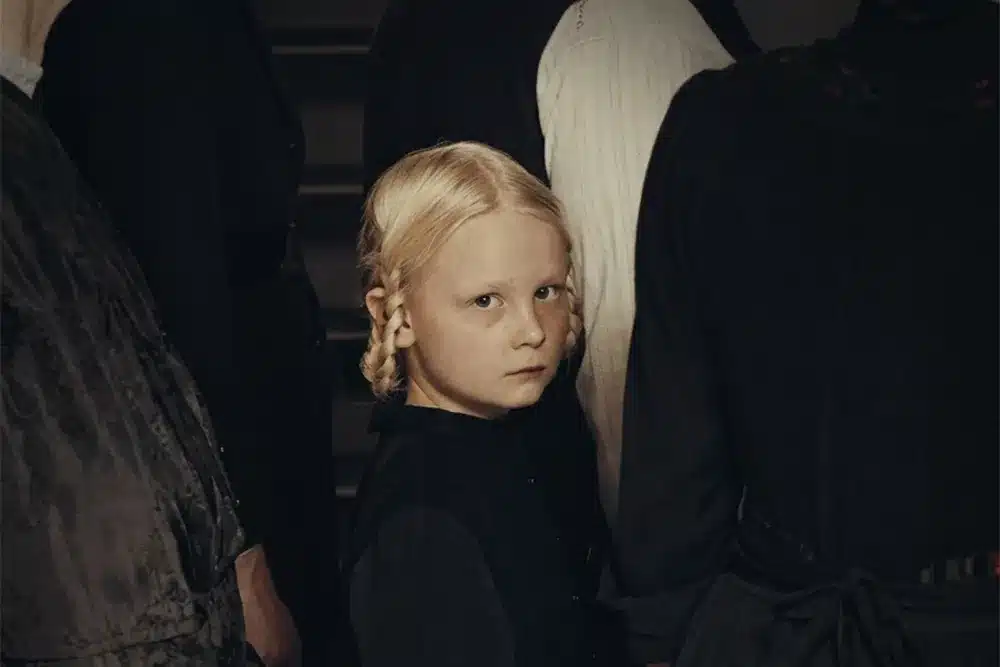
Elsewhere, a child comes up against her first clear signs of death while witnessing something like a wake, the camera held at eye level, dialogue stripped away, the strangeness intensified by the sheer absence of speech. The effect is simple and unsettling: we are left in the same position as the child, forced to register death before anyone explains it.
For a while, Sound of Falling seems ready to build itself out of that first encounter with death, out of half-heard speech, rituals only partly understood, and the feeling that a place can turn strange before you understand why. Then the story widens. It moves across generations of women tied to the same land, and the tension begins to thin out.
Germany’s history hangs over the film. So does the sense that a place can outlast the lives shaped inside it. What happened there does not disappear. Once that broader design comes into view, the film changes very little.
The later sections keep returning to the same heavy mood. Pain and shame are already there, and Sound of Falling keeps circling lives that seem burdened from the start. It rarely finds a fresh way to make any of this felt. The uncertainty that gives the opening its force slowly hardens into something fixed. From there on, the story starts going back over ground it has already covered.
That is when it begins to drag. It is not the slowness that wears you down so much as the repetition. The visual control remains, but it no longer opens the material up. One scene follows another with the same insistence, and after a while, that insistence stops adding anything.
By the end, the story’s world has become boring. Sound of Falling keeps returning to the same feeling after that feeling has already landed. Watching the film becomes less a matter of staying with something difficult than of waiting for something to shift that never really does.
What stings is how alive its beginning is. The Alma scenes are attentive to the way a child reads adult behavior without being able to decode it. Here, death first appears as distance: voices lowered just enough to exclude her, glances aimed somewhere she cannot follow, a room whose meaning has changed before she has words for the change. Those scenes carry darkness, but they also carry curiosity.
The later passages keep the darkness and lose the curiosity. There is a better film in those early scenes, one that would stay with partial understanding and let the house keep its secrets. That imagined version of this story remembers how strange death feels before it hardens into meaning, before it is folded into history.
Sound of Falling begins with a child sensing that death has changed the air around her. Nothing after that feels as close to experience as that first discovery.