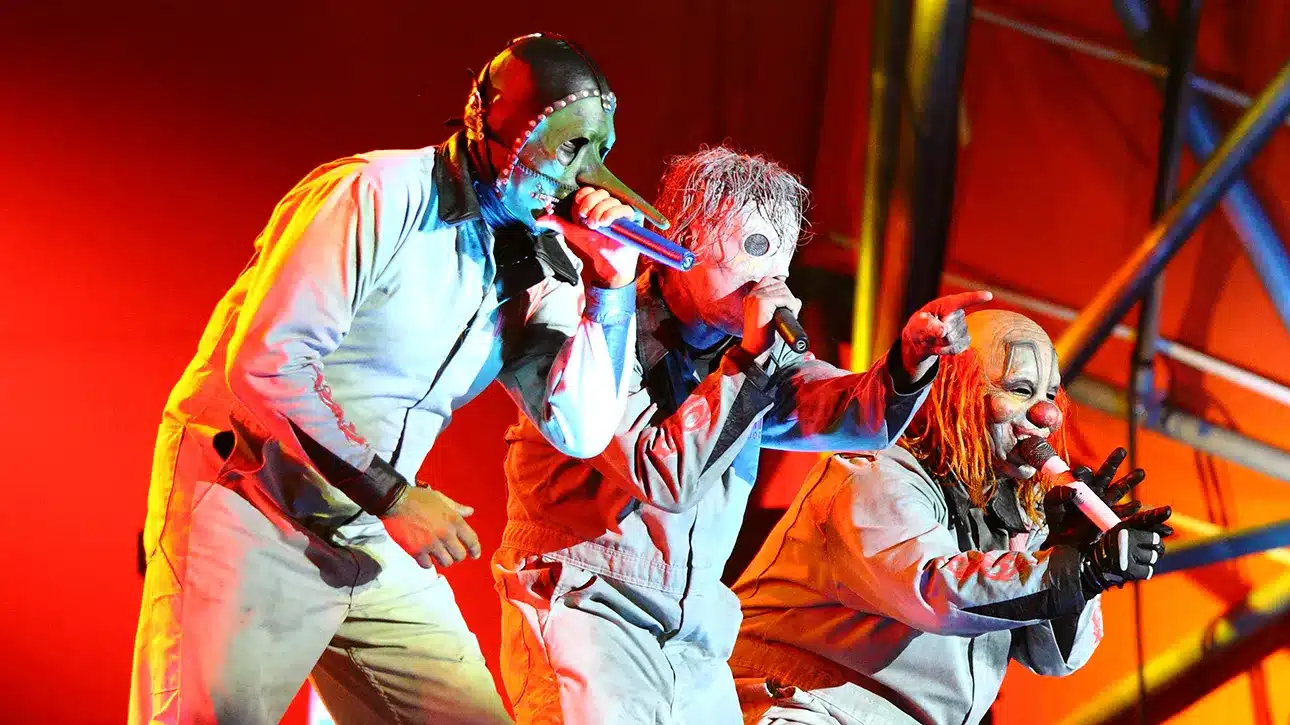
Nu Metal Anomaly 1: Slipknot
Slipknot’s rise wasn’t supposed to make sense, but it was undeniable. I’d seen them open for Coal Chamber on the Livin’ La Vida Loco tour, where they made quite an impression on my 13-year-old impressionable mind. Their feral energy was contagious, and they were contaminating Ozzfest-minded fans by the minute.
On MuchMusic, Slipknot was described at the time as a new movement in metal, and it couldn’t have been better put. The thing was, they were abrasive. Ugly, even in appearance, with weird, frightening, and even perverted masks, and in sound. Still, they quickly appeared on the front covers of Circus, Kerrang!, and Hit Parader.
Their trajectory unfolded fast. After the release of their self-titled album in 1999, Slipknot moved from opening slots and festival exposure—Ozzfest among them—into larger touring cycles, including their own package tours. By 2000, they were no longer treated as a supporting curiosity but as a headlining draw. By 2001, the release of Iowa arrived with a fully formed audience already in place, the result of two years of relentless touring, media visibility, and word-of-mouth momentum.
Slipknot’s success wasn’t a sudden spike so much as a compressed buildup, an accumulation that reached a tipping point almost all at once. Their emergence from Iowa also added to the sense that they were operating outside the usual geographic centers of music trends, reinforcing how unexpected their rise felt in the broader industry landscape.
Another factor in their positioning was the team they aligned with early on. Slipknot chose to work with Ross Robinson as producer, a figure already associated with Korn, Limp Bizkit, Sepultura, and Soulfly at the time. They also signed to Roadrunner Records, a label that had built a roster of credible heavy acts across multiple subgenres.
Working with Robinson and joining Roadrunner placed Slipknot within an established network of nu metal and heavy music credibility, giving their sound and image a framework that could be taken seriously by different audiences. That association shaped how they were received—not just as a novelty but as part of a larger, recognizable movement with proven industry backing.
By the time Iowa came out, Slipknot’s popularity had gone from surprising to downright bizarre. It reminded me of the moment Pantera’s 1994 album, Far Beyond Driven, hit number one: the kind of thing you assume is a statistical error until you see the news twice. At my school, every third kid had a hoodie that said “If you’re 555, then I’m 666,” usually worn by the same types who looked like the singer from Adema—spiky hair, lip rings, oversized pants.
It wasn’t the “metal kids” wearing Slipknot merch. It was the nu metal crowd, the mall-scene crowd, kids who’d never voluntarily listen to Morbid Angel but suddenly loved blast beats because Corey Taylor screamed over them. Slipknot had somehow become a gateway drug to extremity, but without the respect of the actual extreme-metal purists. They were the acceptable face of ugly music—ugliness made catchy.
A shift in perception followed their rise. As Slipknot became more visible and commercially successful, their position in subcultural hierarchies changed. Within more underground metal circles, credibility was often tied to distance from mainstream attention.
Once a band crossed into heavy media rotation and arena-level recognition, some listeners began to reclassify them as mainstream rather than underground. That reclassification had social consequences. A Slipknot shirt that once aligned with a heavier, more niche identity could be read differently once the band became widely recognizable.
This is where the “poser” label entered the conversation. It wasn’t directed at the band itself so much as at the people wearing the merch. In a subculture that values exclusivity and perceived authenticity, widespread popularity can alter what a band represents. A group that once signaled alignment with extreme music could, in the eyes of some, become a marker of general trend-following. Slipknot’s rapid rise to visibility turned them into a reference point that crossed audience boundaries, and that crossing blurred distinctions certain listeners used to define themselves.
Nu Metal Anomaly 2: System of a Down
System of a Down felt like the other anomaly: the band nobody predicted would reach the same heights. I loved their 1998 debut, but I was convinced that songs like “Sugar” were too weird, too twitchy, too Armenian-folk-meets-hardcore to ever break through in a mainstream way. It felt like outsider art wearing nu-metal clothes.
Visually, System of a Down didn’t present a clean or immediately familiar image that fit neatly into late-1990s rock expectations. Serj Tankian’s large afro, Daron Malakian’s makeup and stylized eye looks, Shavo Odadjian’s bald head paired with a braided beard, and John Dolmayan’s occasional use of a gas mask in early visuals all contributed to a band identity that felt deliberately unconventional. Rather than aligning with a single recognizable aesthetic, their appearance suggested a mix of individuality and theatricality, reinforcing the sense that the band existed slightly outside the typical visual language of the era’s mainstream rock.
I remember listening to their self-titled album in my friend’s basement, well before Toxicity (2001) was released. Lines like “When your stars are baked and your rivers fly, do you ever believe you were stuck in the sky?” felt completely unmoored from anything I’d heard on mainstream rock radio. We would play it alongside bands like Mindless Self Indulgence, groups that felt quirky, confrontational, and too niche to ever be enjoyed by normies let alone played in stadiums.
From that vantage point, both bands seemed like outsiders operating well beyond the boundaries of what could realistically become commercially viable. In that context, mainstream success felt almost like something that belonged to an entirely different category of music.
Who would have thought a band writing in that kind of imagery—shifting between surrealism, political undertones, and abrupt emotional turns—would end up with a number one album in 2001? “Chop Suey!”—originally titled “Suicide”—became Toxicity‘s entry point, the song that translated their strangeness into something that could reach a mass audience without fully simplifying it.
That track talked to people in a direct emotional register, even if the details remained abstract or opaque. It had the same “Freak on a Leash” effect—that same sense of watching the underground become an overground avalanche. Suddenly, every teenager was screaming, “I don’t think you trust… in… my… self-righteous suicide!” without understanding a single nuance of what Serj Tankian was aiming for.
Part of what made System of a Down’s breakthrough feel even more improbable was the backing they received from Rick Rubin. His belief in the band carried weight in a way that’s hard to overstate. Rubin had a history of bridging underground and mainstream audiences, and his involvement signaled that this wasn’t just another experimental act that would remain on the margins.
With his guidance, their sound was preserved rather than diluted, which may have been crucial in maintaining the very qualities that made them stand out in the first place. In other words, the production didn’t domesticate them; it framed them in a way that could be received without neutralizing their identity.
System of a Down’s sound invited comparisons outside the nu metal frame, closer in spirit to acts like Mr. Bungle and Faith No More than to the groove-oriented approach of bands like Korn. Their abrupt transitions, shifts in tempo, and willingness to move between contrasting styles within a single song placed them in a lineage of experimental rock and metal that prioritized composition over repetition.
This perspective helps explain why their music felt unconventional within the nu metal category while remaining accessible to a broad audience. That duality also contributed to their reception among established metal musicians. Anthrax’s Scott Ian, for example, described Toxicity as a “thrash album” due to the emphasis on guitar work and riff structure. That kind of recognition reinforced the idea that, beneath their eclectic surface, System of a Down contained elements that aligned with more traditional metal sensibilities, even as their overall identity resisted simple classification.
Their live trajectory reinforced credibility. Opening for Slayer during their debut album cycle placed them in front of audiences far removed from the mall-scene nu metal crowd, and they held their own in that environment. There was a toughness to their presentation that matched the intensity of the music. Even with Daron Malakian’s makeup and glitter, there was nothing fragile or performative in the sense of being detached from the aggression of the performance. They took to those stages with a kind of defiance that made the contrast between appearance and sound feel intentional rather than contradictory.
Touring with Slayer carried a specific kind of weight in metal culture. Slayer, also associated with Rick Rubin through production and label connections, functioned as a benchmark of legitimacy, and sharing stages with them placed a band within a lineage that audiences associated with intensity and credibility. Slipknot and System of a Down both operated in that space at different points, and that overlap made their pairing on larger tours feel aligned in both cultural and business terms.
The Nu Metal Anomalies Align
Seen together, Slipknot and System of a Down occupied different ends of the same shift. Slipknot represented instrumental density, and visual identity pushed to an extreme. System of a Down represented irregularity, cultural specificity, and compositional unpredictability pushed just as far. Yet both were absorbed by the same audience ecosystem that nu metal had helped create, a landscape where listeners were increasingly open to intensity, whatever form it took.
Both bands had already crossed paths before either reached their peak visibility. Their shared appearance at Ozzfest ’99 placed them on the same broader stage, even if at different positions in the lineup, embedding them early in the same circuit of exposure that connected emerging acts with large, genre-curious audiences. In retrospect, Ozzfest functions as an early convergence point, an environment where both bands were already being introduced to overlapping listener bases, setting the stage for the later moment when their parallel rises would become visible and, eventually, aligned.
In 2001, Slipknot and System of a Down shared the same stage as co-headliners on the Pledge of Allegiance Tour, a major arena run that placed both bands at the center of the nu metal moment at its peak. The tour was scheduled before the infamous events of September 11, postponed briefly afterward, and resumed later that month.
The Tour’s timing coincided with a period when attention, identity, and cultural tone were in flux, and that environment amplified already-rising acts’ visibility. Albums, touring cycles, media exposure, and audience growth had already built momentum for both bands, and the arena circuit consolidated that momentum into mass reach.
Slipknot and System of a Down occupied different forms of extremity in the 1990s; one rooted in theatrical presentation and instrumental density, the other in cultural specificity and structural unpredictability, yet both reached the same level of mainstream penetration. Their success marked a point at which the boundaries of nu metal expanded to include acts that had previously remained outside commercial consideration, before the scene began to fragment and diverge in separate directions.
Both bands were proof of something almost contradictory: that, in addition to catchy, melodic acts, nu metal’s boom created space for the extremely weird and the extremely heavy. Slipknot shouldn’t have succeeded. System of a Down shouldn’t have succeeded. Their popularity didn’t follow the old rules of mainstream rock or metal. It followed the Follow the Leader logic (Korn’s 1998 album): once the floodgates opened, anything that felt extreme, emotional, theatrical, or just plain bizarre could suddenly go platinum.