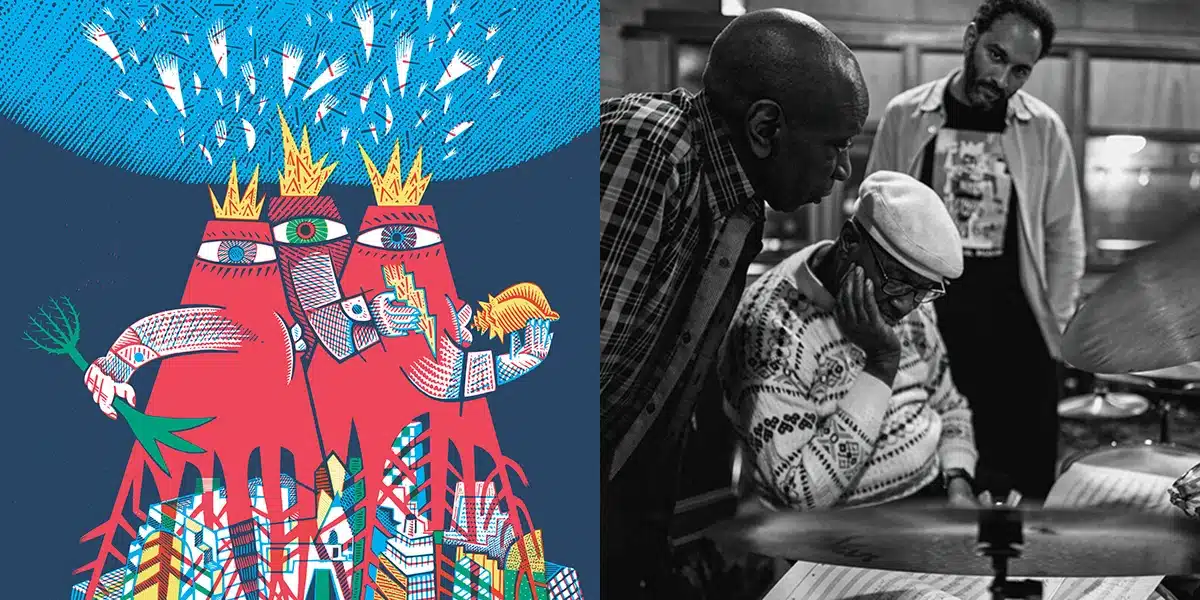
Trio Imagination are a newly minted band that adds Cuban-born pianist David Virelles to the rhythm section for Trio 3: alto saxophonist Oliver Lake (now retired), bassist Reggie Workman, and drummer Andrew Cyrille. Virelles was one of several pianists who had collaborated with that group, and the new ensemble’s debut, Creative Inspirations, is a fine outing that elevates everyone’s game.
This encounter ought to work well. Workman and Cyrille are jazz royalty, and David Virelles is one of the most interesting pianists on the scene, conjuring music that integrates his heritage into the inquiring contemporary jazz. The result is an album that is consistently engaging, subtly spirited, and also contains a few question marks.
Workman (89) and Cyrille (86) have jaw-dropping jazz pedigrees. The bassist shared the bandstand with John Coltrane, Art Blakey, Freddie Hubbard, Thelonious Monk, and Oliver Lake. Cyrille (86) skews a bit more avant-garde, forever connected to Cecil Taylor, but has made creative music of every kind across dozens of sessions as a leader and hundreds of sideman appearances, spanning collaborators from David Murray to Dave Douglas to Bill Frisell. As a rhythm section, they are connected at the gut.
David Virelles joins this energy unafraid and central to the new group’s approach to harmony and texture. Half of the tracks here are spontaneous compositions (or, if you prefer, free improvisations invented on the spot) that develop themes out of thin air. The other half seem nearly as free, as their composed elements typically grow out of searching introductions. As a result, this program lives in a creative sweet spot between the jazz tradition and more adventurous explorations.
This fits the history of Workman and Cyrille and the natural vocabulary of Virelles, whose jazz education came through modern masters like Henry Threadgill and Steve Coleman. No one in Trio Imagination has any patience for a wall between jazz traditions.
“Pétalo”, composed by Virelles for this session, starts with an Afro-Cuban groove with the piano’s left hand rumbling the bass line as Workman improvises. The simple chordal theme rises in Virelles’s right hand—the kind of short melody that reminds me of Mongo Santamaria’s “Afro Blue”. Virelles gives the song a gentler B section, with impressionistic chords floating over Cyrille’s gentle continuation of the clave groove. The drummer channels the influence of Elvin Jones here (the drummer who played “Afro Blue” with John Coltrane’s classic quartet) and also has the cirrus-cloud subtlety of Paul Motian in mind. What a groove, then, for both Virelles and Workman to improvise over.
A similar groove-based track is the brief “Neves”, which sounds like it was plucked from a longer jam—a dance of drums and piano interlocking like the gears in a wind-up toy. It is wonderful, but it makes you wish the album spent more time in this kind of musical conversation.
When there is no composed section, the trio still find opportunities to engage your ear. “Space Dance” begins with a piano statement built on wide intervals—no ballad, but also not a slew of atonality. Could it have been composed? Because David Virelles has such a fine musical ear, he never lets go of this initial idea, repeating it (as you would a composed melody) and transforming it in waves: the sound of that first theme, periodically relieved by calming harmonies that descend in simple steps.
The rhythm section delivers the “space” promised in the title: sounds that seem to come from far away, comets streaking or a wash of galactic haze, with Workman using his bow to create cries in both upper and lower registers. The performance settles into a haunting ballad tone, with minimal piano and plucked bass guiding the listener further out to beauty.
The decision to cover Andrew Hill’s “Refuge” makes so much sense. This tune appeared on Hill’s classic Blue Note album Point of Departure, where it was a zippy opening track: a contrapuntal theme over a fast 6/8 tempo, with Kenny Dorham, Eric Dolphy, and Joe Henderson weaving a nervous conversation on top of Tony Williams’ agitated cymbals. Trio Imagination slows it down to a loping waltz, recognizable but with a different tone altogether: relaxed and worn in like a favorite sneaker.
Perhaps the most intriguing music on Creative Inspirations are the two versions of David Virelles’ song “Unseen Mother”, which also appeared as a short ballad theme on the pianist’s Continuum (2013). Each version is about six minutes long, presenting atmospheric suites that build suspense through slow crescendos. They begin in similarly spare ways, with chiming bells and muffled toms, after which they diverge dramatically. The performance that opens the album dives low into the piano’s register and discovers the written theme in the center of the keyboard, with rich harmonies that frame both the melody and an improvised counterpoint from Workman’s bass.
The second exploration of “Unseen Mother” bides its time, patiently exploring an open atmosphere in which Virelles’s piano seems nearly like a strummed guitar. Is that the theme early on in the upper register? No, but there it is four minutes in, where it belongs at last.
If Creative Inspirations seems like it is the pianist’s album at times, it is also true that Workman takes center stage for “Universal Sketches”. The bassist plays arco for the first half, then invites in Cyrille and eventually Virelles, with an atmospheric ending that includes vocalizations and cymbal creaks. It’s the most “out” track here, but also the most cinematic.
“Sometimes I Wonder” is a solo for Cyrille’s drum set, but as subtle as a drum solo can be. Most of the track is a controlled essay on what a pair of brushes can create against a snare drum and a tom or two. Cyrille is aware of the delicious resonance his drums create as he lets them ring after “chhh-chhh” hits against the heads, fading.
That solo feeds the listener into the album’s closing track, David Virelles’s “Para Ti”, another too-brief delight that dances and sways and then, literally, fades away. Here, again, it seems as though the session might have held some deeper or more powerful delights after the fade. Why couldn’t we find out?
Why be so picky with a trio that gives so much, with such intelligence and sensitivity? Trio Imagination is a worthy demonstration of the strength of communication between the elders who bashed down the false barrier between jazz traditionalism and stylistic freedom and younger players who inherited that freedom.