
Nearly 40 years ago, World Famous Pets bandmates Edie Brickell and Matt Chamberlain found themselves at the center of their alternative rock jam band, Edie Brickell and the New Bohemians, meteoric ascent following the success of their debut album: 1988’s Shooting Rubberbands at the Stars. Still in their early 20s and suddenly catapulted into a maelstrom of record-label politics, newfound fame, and a demanding touring schedule, the group disbanded just over a year later, after releasing their sophomore LP Ghost of a Dog.
Brickell came to New Bohemians almost by happenstance, joining them one night on stage in 1985 and improvising alongside them, a practice that would come to define the group’s performance ethos hereafter. Still just a teenage undergraduate student at Southern Methodist University, Edie Brickell and New Bohemians would spend the next year writing and playing together throughout the Dallas area, growing their local following and eventually self-releasing their cassette album It’s Like This, drawing the attention of some suits at Geffen Records, the behemoth record label founded by ghoulish billionaire David Geffen.
Despite the professional promise a major-label release offered, production on the group’s debut Shooting Rubberbands at the Stars pitted the band’s hallmark unrestrained style against the confines of a more commercial form of production. Eventually, tensions between the group’s drummer, Brandon Aly, and Geffen Records producer Pat Moran reached a breaking point, leading Moran to oust Aly from the group before the band’s major-label debut.
In spite of the album’s contentious production process, Shooting Rubberbands at the Stars was a massive commercial hit, going on to achieve double platinum certification and spawning the group’s most widely known single “What I Am”, a quixotic sort of Gen X anthem (though millennials and zoomers might better recognize it as one of the tracks Marnie Michaels earnestly, if misguidedly, covers in HBO’s Girls).
By the time New Bohemians were gearing up for production on Ghost of a Dog, Geffen Records had replaced Aly with drummer Matt Chamberlain, a friend of the group’s. Despite the group’s shared affinity for Chamberlain, the band had lost a certain balance with Aly, which partly contributed to its decision to take an indefinite hiatus in the early 1990s.
After New Bohemians split, Brickell took some time away from the music industry to start a family with her husband, singer Paul Simon, before returning in 1994 with her solo debut album Picture Perfect Morning. Chamberlain, meanwhile, spent much of the 1990s solidifying his position as one of the most in-demand session musicians in the industry, later recording with everyone from legends like David Bowie and Elton John to more contemporary artists like Lorde and Frank Ocean.
“Well, I think it’s a whole lot more fun,” Edie Brickell told PopMatters of how playing with Chamberlain has changed over the years. “It’s very, very easy. In this life, in this band [World Famous Pets], Matt put this band together. He’s the creator of the band and the band name, and he just made it all happen. He’s flexible, he’s free, and it’s just in the spirit of making fun music, getting together and having a good time, not like what it felt like when we were kids, which probably should have been more fun but somehow it just wasn’t.”
“I think because there’s that great mystery of am I going to be okay? Is this a job? Will it work out? Will my dreams come true?” Brickell told us of that uncertain time in her and Chamberlain’s early careers. “After having all of that evolve to a place of, ‘Yes, your dreams came true. Yes, you get to keep doing it,’ and now let’s do it for all the fun that’s in our hearts and all the feelings that we’ve collected by being alive for a few decades and the easy friendship that always exists with a personality like Matt. So to be able to do that again is a twice-in-a-lifetime joy.”
“I feel like the way we work together is pretty much the same as it was back then. We would just get together and play, but the intention behind it is so much different than when you’re like 21 years old. Because everything is life or death, you know, when you’re 21,” Chamberlain agreed. “We have a lot more perspective in our lives, playing music for as long as we have, and we can just enjoy it. There’s still some work to be done within it, but it’s more joyful.”
Although it’d been decades since Matt Chamberlain and Edie Brickell had worked together in an official capacity, they’d remained within each other’s orbits, recently reuniting on Paul Simon’s A Quiet Celebration Tour where the germ of the idea for World Famous Pets was born. After Chamberlain got bassist Kaveh Rasetgar (known for his work with artists like John Legend and Sia) and guitarist Mason Stoops (credited as a guitarist and producer on tracks from artists like sombr and Role Model), World Famous Pets met for a whirlwind recording session of less than a week.
Like New Bohemians, World Famous Pets places a premium on improvisation, integrating that same spirit of spontaneity into their debut album’s recording. “The minute the band started to play, I knew I wanted to be in this band,” Brickell tells us. “Matt, he did it as an experiment. He said, ‘We’ll put these guys together, and we’ll see what happens.’ I was a little nervous going in because I didn’t know Kaveh and I didn’t know Mason, but the minute everybody started playing, it felt like home.”
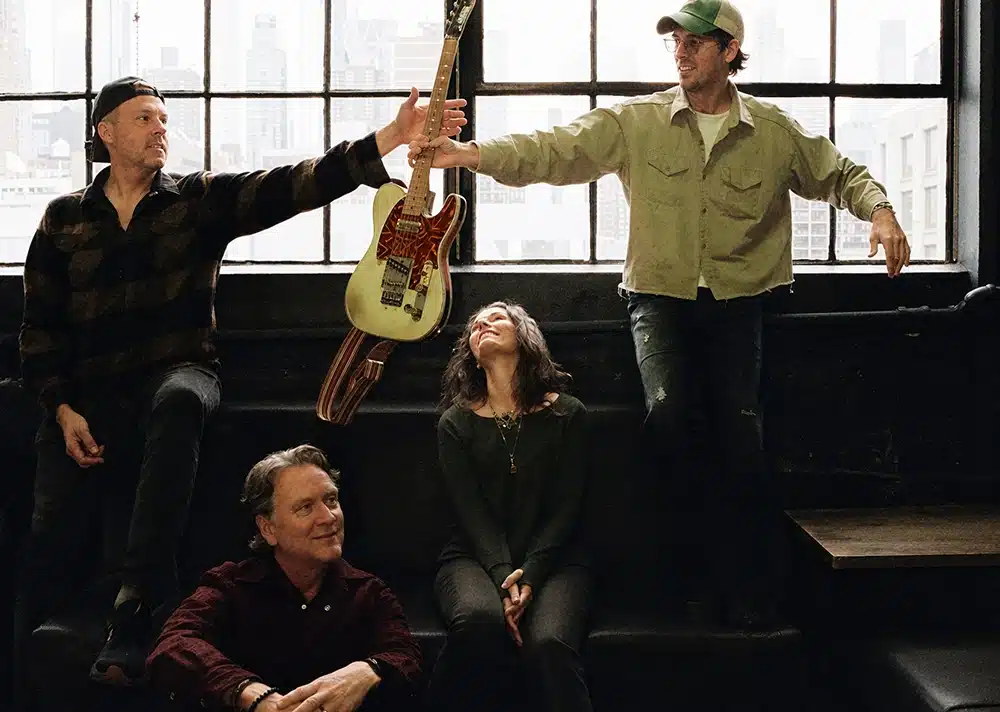
Edie Brickell reflected that throughout production, group members took the tracks home, fiddling and fine-tuning them to get the sound just right. “A lot of the songs, they rolled out,” she explains. “You got a verse, and you got a chorus, and then I took the tracks home, and I would keep singing to them until I got a complete song and I’d send it back to them.”
“Everything they added to it just blew my mind,” Brickell notes of Chamberlain, Stoops, and Rastegar’s additions to the tracks. “Even though the initial recording was five days, everybody put these beautiful touches on it to make it the album that you hear now,” Chamberlain elaborated, emphasizing the collaborative ease with which the group was able to construct their debut.
Matt Chamberlain also promised the group would be taking that same improvisational spirit to their upcoming live shows, telling us, “We’re pretty wide open right now, so it [our performance] hasn’t been defined other than our recording. Once we start playing, it’s probably going to go to a whole other place, which is awesome. I’m looking forward to it.”
“There’s something always growing, and I can’t wait to see the bloom,” Brickell added of the group’s approach to improvisation. “I’m so drawn to the mystery, and that’s, again, what I love about this band and preparing shows for improv. The only way to prepare for improv is to believe there’s always something in the air. I do know that this band is going to bring it, and all I have to do is listen, pay attention, and allow.”
Edie Brickell has always described her approach to songwriting as one of intuition and spontaneity, at least in part stemming from her own mother’s proclivity for crafting her own impromptu tunes throughout Brickell’s childhood. During production on her and actor Steve Martin’s Grammy Award-winning bluegrass album Love Has Come For You, Brickell and Martin worked together bi-coastally. Martin would record the song’s instrumentals in California before sending them to Edie in Connecticut, where she’d ornament them with lyrics and lines.
When asked if she’d pull the lyrics from a cache of images, lines, or inspirations she’d been working from, Brickell joked, “No, I don’t have a thought in my head, and I like that. If I can get to this blank state and just observe the world and take it all in, especially the sounds of insects and frogs and nature, then I’m in a good spot.
“In terms of songwriting, any time I’ve tried to craft something, I’ll listen to it later and think, ‘That’s so square. That’s so boring. I don’t like it.’ With Steve Martin, he’d send me these gorgeous banjo tracks. So I would get my phone, and I would hit voice-note before I ever heard it, and then we’d have it on record, and I would play his track, and I would sing the first thing that came.”
Edie Brickell explained that while working on the album, she and Martin were inspired by the folk story of the Iron Mountain Baby, an infant found in early 20th-century Missouri after being stuffed into a suitcase, tossed from a train, and somehow surviving.
“I just saw this story of this girl who has this affair with this guy who works at a small-town bank, and he’s got this powder blue suit on, and it’s just awful. She had a child with that man from the bank, and you just knew what kind of guy he was and what he was up to. It was just, ‘Ah!’ and it was right there, and so you take that line, and you just say, ‘You know, what’s next?’ and then there’s always something next.”
Eventually, Edie Brickell and Martin would do precisely that, following that thread until their Broadway musical Bright Star, based on the album, took shape.
Alongside their shared New Bohemians connection, Brickell and Chamberlain both shared a longstanding personal and creative relationship with the late Brad Houser, a founding member of New Bohemians and Critters Buggin, the eclectic, Seattle-based group Houser helped found alongside Chamberlain and saxophonist Sherik.
“We were in so many bands together. He was such a natural musician. He was so intuitive and could really play. He was just a fan of music, you know, and was always wanting to play and was generally open-minded,” Chamberlain shared. “He could be a bit of a grouch sometimes, but you know, so could I.”
“I really miss Brad a lot. He could be so authentic and kind of coarse, and it would always make me laugh,” Edie Brickell agreed. “Then when he played, there was a warmth and a gentle aspect to it that expressed a heart that was underneath all that. And it made me love him even more. So, I catch myself thinking about him a lot. I had a dream about him, too, and he just said, ‘You wouldn’t believe where I am.’ He was so happy, and that made me happy. When I’m writing, sometimes I’ll think about Brad, and I’ll think, ‘Just be better. Do this in a better way.’”