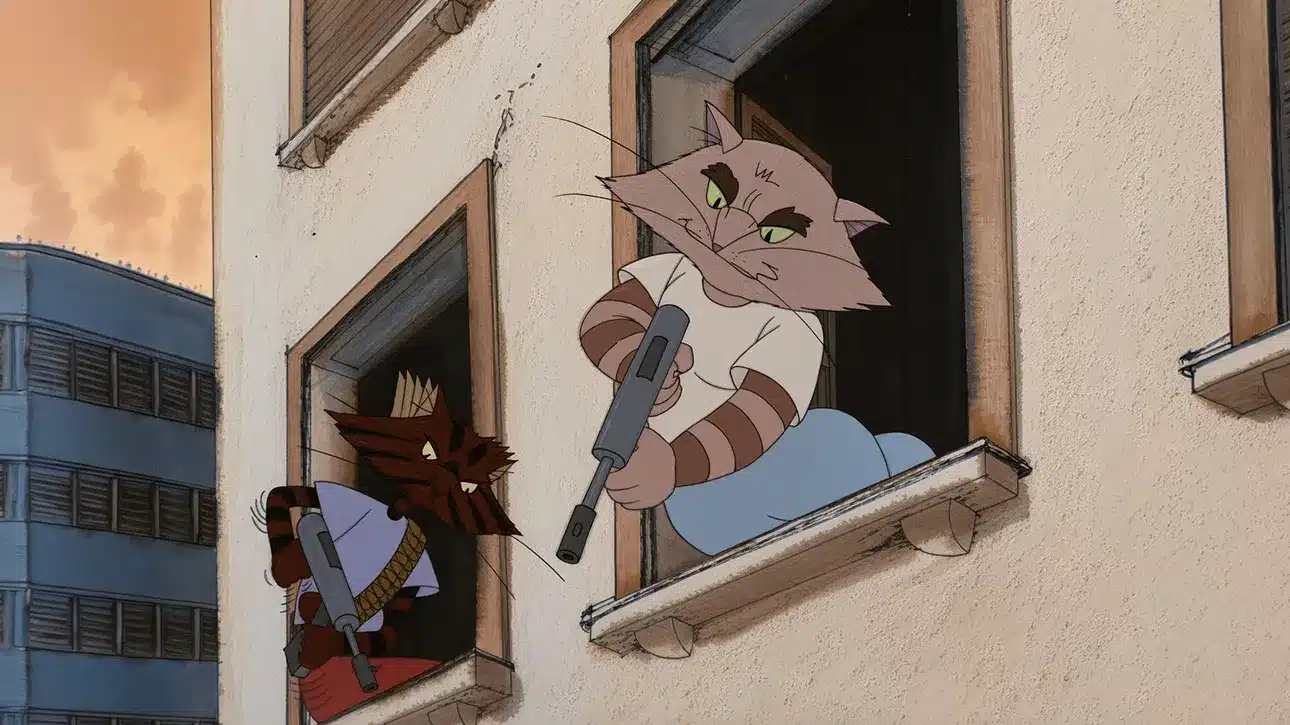
One handy way to parody and expose the human world is to imagine a world where everyone is an animal. By what’s surely no coincidence, these two Blu-rays from Deaf Crocodile turn their attention to social and political parodies from the rich world of non-American animation, specifically Hungary and the Philippines. One looks aft the eternal battle of cats and mice, while the other literalizes Bill Murray’s warning in Ivan Reitman’s social prophecy of 1984, Ghostbusters: “Cats and dogs living together, mass hysteria!”
First, a little background. Animated animal movies are a sprawling worldwide phenomenon and always have been, even if American products from Walt Disney, Pixar, DreamWorks, and other companies tend to dominate the market. These companies specialize in supposedly wholesome films for the whole family, although edgier, ruder, satirical animation aimed at adults may be found on television.
It’s wise to remember that the classic Hollywood studio cartoons of Disney, Warner Brothers, Max Fleischer, MGM and others were aimed at general adult audiences, who saw them as part of a regular evening’s film program. Postwar television programmers seem to have decided to package those older cartoons for kids, which gradually led to censorship and outcry over them.
One prominent target was the bone-crunching sound effects and violence in the adventures of Tom & Jerry, which embodied the eternal cat-and-mouse archetype with its attendant cruelties, defenses, and revenges. For that matter, even the black-and-white adventures of Mickey Mouse indulged in moments of violence and cruelty, if you take the images seriously.
Another problematic element in old cartoons was racial and ethnic stereotypes. Tom and Jerry were sometimes chased by an apparently African-American maid voiced by Lillian Randolph, until her voice was redubbed. Eventually all the older adventures got replaced by kinder, gentler, duller newbies. As for the frank sexual tease of the garter-belted Betty Boop, get outa here.
While American theatrical animation eventually became dominated by family fare, the rest of the world’s animation-producing countries continued their own brazen thing. The most obvious examples are Japanese anime and the celebrated animated cinema of Eastern Europe’s various studios. Sadly, most examples of the latter have been hard to find in recent decades.
All of that brings us to Deaf Crocodile, a Los Angeles-based Blu-ray label that concentrates on a few specialized areas. One of its missions is to explore and restore the byways of world animation, often presenting titles on home video for the first time. These two examples are violent spy spoofs from Hungary and a romantic parody from the Philippines.
“Cat City” and the Eternal War of Cat and Mouse
The 1986 feature Cat City (Macskafogó, literally “cat catcher”) opens with a spoof of company logos. A huge round cat head might be a nod to MGM’s lion, except that instead of roaring or meowing, he’s gonged by a mouse’s mallet in parody of J. Arthur Rank’s logo (the Gongman), so we get two mockeries in one. Then the story begins with an explanatory crawl spoofing George Lucas’ Star Wars (1977), as it was known then and still is to some of us now. We’re told the war of cats upon mice, in disregard of all treaties, is happening in this year of 80 A.M.M. (After Mickey Mouse), but there’s “a new hope”.
That’s only the start of japery in what’s basically a send-up of James Bond. The ultimate mastermind, Mr. Gatto, looks exactly like supervillain Blofeld’s white Angora and is first seen only from behind, like his former stroker. His executive minion, the tall and skinny Mr. Teufel (“devil”), has seen a fight or three. He sports an eyepatch, a shredded ear, and a nasty mechanical hand.
As a sign of villainy, that hand recalls the demented Rotwang (Rudolf Klein-Rogge) in Fritz Lang’s Metropolis (1927), while Teufel (first name Fritz, wink wink) resembles the crime lord in Lang’s Dr. Mabuse the Gambler (Dr. Mabuse der Spieler, 1922). His iron-handed progeny include the title characters in Stanley Kubrick’s Dr. Strangelove (1964) and the first Bond film, Terence Young’s Dr. No (1962). As several critics note, it’s odd for Hungary to spoof the Bond movies so extensively, since the adventures of that decadent capitalist Cold Warrior weren’t legally distributed behind the Iron Curtain, but perhaps they got themselves seen by hook or crook, despite any iron hands.
As a cat-and-mouse story, the catalog of parodies includes not only Mickey Mouse but also Tom and Jerry, Mighty Mouse, Danger Mouse, Western characters, and more. With additional parodies of gangsters and war films, Cat City features levels of violence that even surpass Tom & Jerry, and only some of the cartoon violence is survived.
The carnage begins in the opening scene of a giant cat-driven tank demolishing a mouse bank. Now, tanks rolling in the city streets were a living memory for Hungarians of the Soviet invasion of 1956, so this vision of “little people” (mice) dominated by violent, indeed genocidal felines can’t help inviting a political reading. As is often the case with Iron Curtain films, nominal nods toward anti-Nazi struggles in WWII (as Teufel seems to symbolize) do double duty as cover for more contemporary oppressions. As a further alibi, they’re dressed like corporate gangsters.
That sounds like heavy lifting for a frenetic cat-and-mousy cartoon, but Cat City was a big hit in Hungary and even got chosen as the country’s submission to the Academy Awards’ Foreign Film category. Clearly, it spoke to them. It would have been what they had instead of Art Spiegelman’s more sober Maus comics, which he began serializing in 1980 as a family history of the Holocaust.
The supposed hero of Cat City, Intermouse agent Nick Grabowski (voiced by László Sinkó), believes himself the 13th reincarnation of Mickey Mouse. Amid the many burlesque characters, including a pop quartet of incompetent assassin-rats and a “lazy” mouse who survives a plane crash in the jungle, we get Los Vampiros, a musical group of vampire bats in an Aztec pyramid. Yes, they speak with Mexican accents.
While saving the day, the leader yells “Saludos Amigos!” which animation fans will recall as a Walt Disney title from 1943. So many Yankee nods. Is all this mere parody, or does it count as an act of cultural defiance against Soviet hegemony? It’s an open question.
The guiding hands, mechanical or otherwise, behind Cat City are Hungary’s longtime animation team of director Béla Ternovszky and writer József Nepp of Pannónia Films, a premier animation studio whose dazzling career ran from 1951 to 2015. Deaf Crocodile has released a few of the studio’s other films, and some Yanks may recall William Feigenbaum’s psychedelic American co-production Hugo the Hippo (1972), on DVD from Warner Archive.
Ternovszky and Nepp’s collaborations have a morbid sense of humor, as seen in earlier shorts included on the disc. Modern Training Methods (Modern edzésmódszerek, 1970) posits that athletes can achieve their best under threat of death, such as swimming from sharks or playing tennis with grenades; the satire on Olympic training is impossible to miss. Let Us Keep a Dog (Tartsunk kutyát!, 1974) has gentler humor, though one faithful animal lies on his master’s grave to dig up a bone. One of its canines clearly spoofs Scooby-Doo.
Where Is the Limit? (Mindennek van határa, 1975) shows the difference between surviving animated death traps and failing to survive the real world. Another short from Nepp, glimpsed partially in a making-of, consists of characters killing each other for our fun. It’s all a dry run for those wicked cats.
All this is Disc One material, including interviews and a commentary by critic Samm Deighan, who tells us the film is littered with untranslatable Hungarian puns. Deaf Crocodile issued that Blu-ray in 2023 as the first US release of Cat City, now out of print.
As a new release, The Cat City Collection adds a second disc with the US premiere of the belated 2007 sequel, Catcher: Cat City 2 (Macskafogó 2 – A sátán macskája). Set 20 years later, the sequel is another Hungarian blockbuster that brings back all the characters and introduces computer animation into the hand-drawn mix. As before, it’s a blizzard of pop-culture nods, including Tarzan, Dumbo, Godzilla, Rambo, Japanese anime, and, of all things, Riverdance.
The sequel opens in Africa, or rather “Pafrica”, with an explorer mouse named Henry Morton Stanley searching for Dr. Livingston and getting caught up in blithe parodies of racist native and cannibal tropes of a type unseen in US animation for decades. Fortunately, this segment ends early as the plot shifts to the conjuration of the demon Moloch (another Metropolis nod), who resembles the black-silhouetted devil in Walt Disney’s Fantasia (1941). He orchestrates a feline-rodent “armageddon and apocalypse combined” that requires more footage of wars and tanks. Again, we get bonus commentary and interviews that largely focus on the animation.
Hayop Ka! and the Romantic Mystique of Cats and Dogs
Those who can’t get enough feline comedy-melodrama are advised to explore the computer-animated antics of Avid Leongoren’s Filipino production Hayop Ka! (2020), an anthropomorphic parody of romantic telenovelas and escapist romance in general. Set in a world where cats and dogs not only have sex but offspring, the story wears its absurdity on its Day-Glo cut-out sleeves.
The opening shot of Manila in Hayop Ka! (an expression that means “you animal”) immediately has an anime quality, and it also resembles the city-scape openings of the Cat City duo. This vision of Manila is lovely yet anti-glamorous, a jumble of buildings littered with posters and 1984-ish admonitions to work hard and buy consumer goods.
Our kind-of-heroine is Nimfa (Angelica Panganiban), a cat who works the perfume counter at a department store with her bunny best friend. They have bawdy conversations about their sex lives and Nimfa’s hulking but underachieving janitor boyfriend, the dog Roger (Robin Padilla). Nimfa yearns for a rich boyfriend to rescue her like in the chick flicks she loves, including a parody of Wayne Wang’s Maid in Manhattan (2002) with Jennifer Lopez. Movies and narratives like this feed escapist fantasies while deluding their fans, or so the subtext argues.
Nothing in Hayop Ka! ever comes out and lectures anyone about the unhealthy nature of the narratives being spoofed. It’s something we grasp from details around the edges, like the fact that the instant rich boyfriend, Iñigo Villanueva (Sam Milby), is a smooth, womanizing property developer who inherited all from daddy, who prefers to speak English over Tagalog, who’s pulling political strings with bribery, and whose plans are being picketed by protesters who get arrested by police.
Nimfa never notices these realities because she’s so caught up in his wealthy dazzle, her paperback-cover sexual montage, her unfaithfulness to the simple-minded Roger, and jealous, literal catfights. The fights channel anime and TV series like The Powerpuff Girls with their vibrant flashing lines amid highly colored poses. (Speaking of which, Leongoren points out that the Philippines has a busy history in animation, primarily in contract jobs for Japanese and US projects.) The fights not only channel telenovelas but go all the way back to class-ridden soap fantasies of the 1980s like Dallas and Dynasty, power fantasies of elevated outsiders who marry themselves inside.
Nimfa, with her delusions and irrational bursts of violence, isn’t exactly a heroine to root for but more a parody heroine. Unlike the Cinderellas she wants to emulate, her surprising, impulsive, whimsical non-resolution to her problems involves renewed family relations and different plans for her future, as quickly conveyed in the closing credits. There’s a serious undercurrent in how Hayop Ka! deconstructs its genre’s conventions under campy excess and bright design, and those messages are implied in how the film affectionately treats its minor working-class animals.
Hayop Ka! is the first fully animated adult feature for Leongoren and his Rocketsheep Studios (logo: a rocket tied to a sheep), but his six short bonus films already showed his tendency to puncture conventional dreams and happy endings in favor of disappointment, sometimes even cruelty. Perhaps the most sobering is Jepoy (2018), in which a bullied boy sees an opportunity in the 2011 Fukushima nuclear accident to become a superhero by exposing himself to radiation. Already, Leongoren is suggesting that escapist fantasies aren’t good for you.
Leongoren and co-writer Manny Angeles provide commentary. Other bonus material includes interviews and a visual essay by Celeste de la Cabra that unpacks the realistic social and political messages beneath the unreal narrative and fizzy visuals of Hayop Ka!
These examples are a glimpse of the company’s busy restoration work. Coming up is Héctor López Carmona’s Roy del Espacio (1983), a film so obscure that almost nobody in Mexico saw it at the time or has heard of it since. From Taiwan, Chris Huang’s English-titled Demigod: The Legend Begins (2022) is a martial arts fantasy enacted with puppets, so we may call it animation-adjacent. In short, viewers ready for a non-American, non-Disney-fied world of entertainment that uses visual creations instead of human actors have more options these days, and they don’t necessarily have to rely on CGI and spandex.