Setting aside the challenges surrounding a worldwide pandemic, The New Abnormal (2020) was released at a critical time for the Strokes. It was nearly two decades following their groundbreaking debut and seven years removed from another middling effort. Any misstep would have signaled the beginning of the end. Instead, the record was a mid-career resurgence lauded by critics and fans alike and even earned them a Grammy Award for Best Rock Album.
The Strokes had finally gained some distance from their role in the rock and roll resurgence, yet they still faced considerable pressure to deliver on their next effort. The new record was pushed back a month to better align digital and vinyl release dates, according to Albert Hammond Jr. However, that explanation only feels like part of the story, especially considering the mixed reception surrounding early singles “Going Shopping” and “Falling Out of Love”. In the end, the delay has done little to help make a big splash. Reality Awaits contains moments of brilliance that ultimately get overshadowed by artistic choices that feel impersonal if not arbitrary.
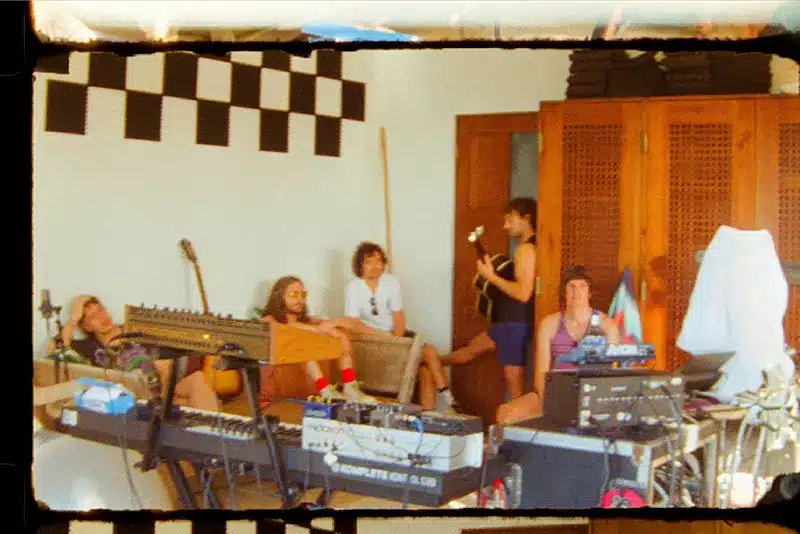
Reality Awaits was once again produced by Rick Rubin and recorded at his studio in Costa Rica. In Transit: Part II, a short film by Johann Rashid, captures footage from the six-week recording process (when they’re not tossing a football around the infinity pool). Those clips spliced together suggest just how exploratory those sessions were. Most notably, the sun sets after a particularly productive day with Rubin saying, “something’s there” and “good vibes”.
The band’s immoderation no longer stems from hard partying or frivolous behavior but the freedom to completely lose oneself in an idyllic place. One can argue that the Strokes have earned the right to immerse themselves in the recording process and see what transpires. Surely, it doesn’t take a music guru to tell a band of that caliber that they made some magic in the studio. The main issue is whether or not it connects.
Much has been made of Julian Casablancas’ Auto-Tune vocals, which surface throughout the album. Upon repeated listens, one can understand how each intonation was meticulously selected for maximum impact. The style works to perfection on “Tyrants of the Mellow Moon” but less so on “Falling out of Love”. When the melody seeps into hyperreality, we can only surmise that this was precisely the point, not that it makes the song any more enjoyable.
Underneath all the layers, Reality Awaits features a handful of songs that feel like signature hits. “Dine N’Dash” recalls a more youthful band that can still build around a catchy guitar line and light cymbal work. It hearkens back to a simpler time when they didn’t have enough cash for a meal, way back before the doom and gloom. The lyrics become progressively darker, until Casablancas asks, “How can I reconcile this beast?” Is it all too obvious that they may want to double down on what made them so charming in the first place?
The upbeat “Going to Babble On”, embellished with a new wave guitar solo, brings their signature sound to the fore. Conversely, “The Fruits of Conquest” reminds us just how inventive the band has always been. The song leads with bongo drums and a clean guitar riff before meandering into darker territory, downshifting into Casablancas repeating “I’m a leech, I’m a leech” with glimmering guitar effects. Everything bogs down before getting resurrected by the groove. It’s not exactly post-punk, and it’s not sexy in a traditional sense, but the song contains a certain allure that’s unmistakable.
More than ever, the Strokes appear far too aware of how they might be perceived. In “Lonely in the Future”, amidst some truly random references, Casablancas disses music critic Anthony Fatano—a move that will only help to raise his profile—by saying, “Stick to the technical ’cause that’s great / But you would not recognize art in any age.” As much as the music is forward-thinking, the singer cannot help but focus on the past. Toward the end of the song, he reflects, “And in a hundred thousand days from now, I’ll say / ‘I did that yesterday when I was a kid.’”
For the 40-somethings who experienced adulthood alongside the band, such a nostalgic sentiment feels on point. However, pining for one’s youth gets lost alongside a whole litany of observations, leaving the impression that this all amounts to one brilliant mess. Reality Awaits ends up being too cerebral to the point of obfuscation. However, there’s a reasonable chance it sits alongside their best work and will be better understood in a future age. In either case, the album fails to hit with the same immediacy we’ve come to expect from one of the most beloved indie bands of all time.