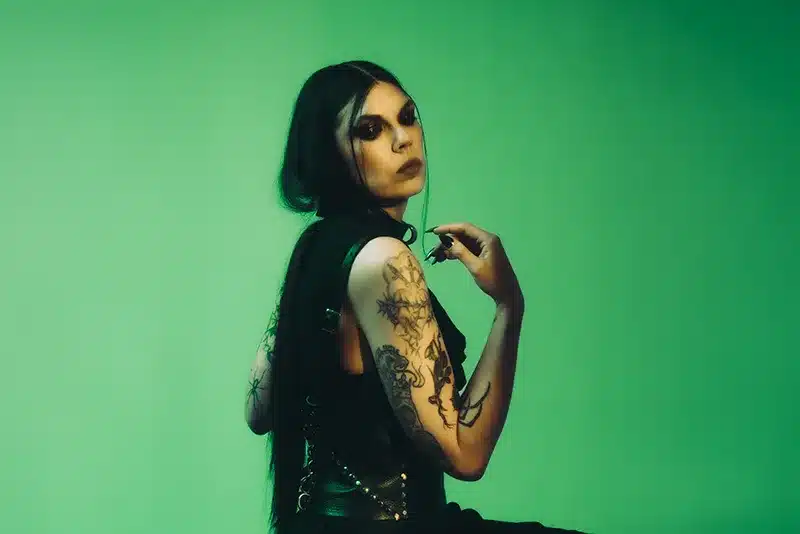
With her full-length debut, 2020’s Forever Blue, and 2022’s elegant follow-up, As the Moon Rests, A.A. Williams explored the intersection of doom rock and dream pop, integrating exquisite dread and compelling fragility. With her covers album, Songs From Isolation, released in 2021 during the COVID era, she paid tribute to a variety of songs—from the Deftones‘ “Be Quiet and Drive” to Gordon Lightfoot’s “If You Could Read My Mind”—tipping her hat to the originals while asserting her own signature takes.
Williams’ new album, Solstice, doesn’t necessarily offer any major surprises. That said, her go-to templates land as perennially relevant (and still frequently spellbinding). The notable shift is that throughout the set, Williams’ voice is less bathed in reverb, chorus, and echo—in production terms, more in line with her string-heavy, drier EP, 2021’s arco. Solstice’s instrumentation, meanwhile, oscillates, as expected, between melancholic space-sprawls and unsettling grunge-escapes. The result is a tweaked sense of contrast: the instrumentation is panoramic, sublime, while Williams’ voice is grounded in the micro, landing as hyper-present and exemplarily confessional.
A.A. Williams remains the wounded angel singing in the forsaken pit, the mythic heroine offering her pleas to an impenetrable universe, though this time around, one has the sense that she’s a bit wiser, perhaps even equanimous, albeit with a depressive tilt. Opener “Poison” is at once a desperate love song (“Be my savior from myself”) and a grim acknowledgment that romance, at least this brand of it, is somehow tantamount to death (“The savage haze that fills my lungs / The unseen whisper”). Williams’ voice, undergirded by burnished keyboards and raspy chords, is strikingly clear, celestial, effortlessly projected.
“Wolves” segues from trippy arpeggios to serrated pseudo-riffs. Williams’ voice, again, is riveting. Largely stripped of effects, it conveys vulnerability, strength, doubt, and desire with immediacy. While comparisons to Chelsea Wolfe are apt, Williams’ voice is more nuanced and classically trained. Also, while Wolfe leans toward occult references and mythical/biblical/Jungian rearrangements, Williams traffics in transparent self-doubt, her lyrical style primarily diaristic.
“Overwhelmed and unprepared in the stillness I have become,” Williams sings on “Hold It Together”, exemplifying, perhaps improving on, her familiar Plathian slant. Her voice exudes pained credibility, à la Elaine Aron’s The Highly Sensitive Person, as she adds, “Don’t you know this isn’t easy, feeling everything so deeply?” It’s disturbing when she then concludes, “I can’t do it forever, my love.” Is she referring to a breakup or a suicidal impulse? The colossal and contagious gloom of Kristina Esfandiari circa Miserable’s Uncontrollable and the King Woman debut, Created in the Image of Suffering, comes to mind, anguish so palpable that it’s difficult to take in. That said, Esfandiari’s version of pain is infused with rage while Williams’ is founded in trauma, disembodiment, and uber-vulnerability.
“I crave your kiss / Both sweet and bitter the taste / … And I am powerless to leave,” Williams laments on “Just a Shadow”. As she launches into her sultry chorus, the instrumentation gets dirtied up; the guitars grow sinister. Both she and Lingua Ignota petition the cosmos or the outside world, yet in their own ways: Williams from a post-romantic, existential viewpoint; Ignota from a gnostic-Christian or mystical poise. That is, Williams seeks solace from the Lover in the flesh while Ignota seeks union, in classical fashion, with the Lover in the universe (God). For both, however, the Lover is essentially unavailable and/or unreliable.
“It Won’t Rain Forever” moves between keyboard verses and guitar-heavy choruses, occasionally evoking Madeline Johnston (Midwife). Johnston’s vocals, however, are customarily interred in the soundscape, the mix-down illustrating how societal systems and deep conditioning oppress or erase the individual’s identity. Williams’ voice, meanwhile, and particularly throughout Solstice, hovers above the mix, clearly discernible. While Johnston’s struggle for selfhood is sonically illustrated, Williams’ struggle is overtly defined, lyrically and vocally.
With Solstice, Williams claims her status as one of her generation’s transcendent singers and further develops her persona as the tragic shero. Surrounded by gossamer and doom-heavy sounds, she navigates confusion, the barbs of romance, and the knowledge that nothing can ultimately save or distract us from who we are. Illusions are shattered. Once untethered, we collapse into nihilism or embrace auto-absolution. A.A. Williams captures that limbo between the two, teetering on the line between self-destruction and self-actualisation.